

The Shopify token leaderboard changed its message
Your engineers are using AI, and someone asks whether the biggest spenders deserve recognition. The Shopify token leaderboard offers a useful warning: in The Pragmatic Engineer’s April 23, 2026 report, engineering leader Farhan Thawar said Shopify renamed it a usage dashboard to discourage competition for the top position.
A leaderboard makes first place look desirable. We think making experimentation visible is worthwhile, but celebrating consumption gives the wrong instruction: recognize what people learn and deliver, not how much they spend.
Treat the Shopify AI usage dashboard as a reported change in framing. The executive account doesn’t establish that the rename improved adoption, reduced spending or produced better work, and April 23, 2026 is the report date, not a documented rename date.
Sources: The Pulse: ‘Tokenmaxxing’ as a weird new trend - The Pragmatic Engineer
Make spending alerts start a conversation

For Shopify AI spending alerts, distinguish an alert from the response it permits. In The Pragmatic Engineer’s April 23, 2026 report, Thawar described the ability to cut access immediately when an individual’s daily spending spikes. That supports an intervention capability, not a claim that runaway agents are automatically detected and stopped.
If you’re copying this approach, decide what happens after an alert before deploying it. Our practical choice would be to investigate with the employee before judging the expense; an interruption should trigger a workflow review rather than become a performance verdict.
Use this suggested response sequence to make that review concrete. It’s editorial guidance, not a documented Shopify procedure.
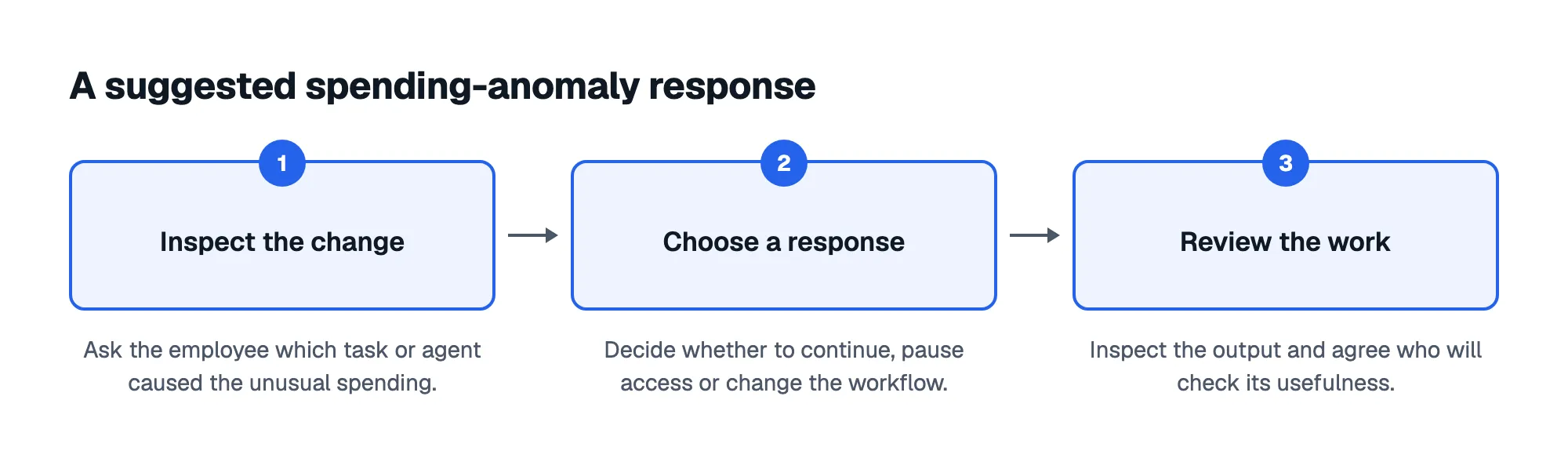
Sources: The Pulse: ‘Tokenmaxxing’ as a weird new trend - The Pragmatic Engineer
Inspect solutions and retained learning

What should a Shopify token leaderboard discussion lead you to inspect? In the vendor-published Bessemer Venture Partners interview, Shopify VP and Head of Engineering Farhan Thawar addressed what he wants from engineering work.
“But I don't want code, I want solutions.”
— Farhan Thawar, VP & Head of Engineering, Shopify · Source: Inside Shopify’s AI-first engineering playbook | Bessemer Venture Partners
Shopify’s October 28, 2025 account describes Daniel Beauchamp’s approach to tightly scoped prototypes intended to teach something, with learnings shared afterward. That gives experimentation a purpose without requiring every prototype to become a shipped feature.
We’d review lasting work and retained learning together: a discarded prototype can still leave a useful lesson. The following review prompts are our suggestions, not Shopify’s documented scorecard or performance-review policy.
| Review focus | Suggested question | Evidence to inspect |
|---|---|---|
| Completed work | What problem does this solve? | A demo against the intended task |
| Reusable workflow | Who can use this again? | Instructions and a responsible owner |
| Retained learning | What should the next attempt change? | A documented lesson or decision |
| Continued usefulness | Is this still worth maintaining? | Follow-up evidence from its owner |
Sources: Serious results, unserious methods: Shopify’s AI playground
Ask what keeps employees from progressing
A Shopify AI usage discussion can prompt a different question inside your organization: “Does this team need skills support, better access or clearer working conditions?” Use employee responses to choose what to investigate alongside the work review.
AI Adoption Score’s AI Skills Distribution maps employees’ self-reported capabilities and willingness to help colleagues. These responses, including any perceived impact you collect, don’t establish causal productivity improvements.
AI Adoption Barriers identifies obstacles and who can remove them. Use that distinction to choose between skills support and changes to tools, rules, time or managerial support.
Give the next experiment an owner
Before your next experiment, record its task, intended benefit, expected output, responsible owner and review date. At that review, ask: “What remains useful, and what did we learn?”
Keep the Shopify token leaderboard lesson focused: spending should prompt investigation; recognition should follow useful work and learning. Start with one experiment.
Frequently asked questions
Who should own the spending review?
Assign one operational owner and involve the employee whose workflow triggered the review. As editorial guidance, your engineering or AI program lead can coordinate the discussion, with finance helping interpret the expense. Keep the decision close to someone who understands both the task and the tooling.
How often should we revisit an experiment?
Tie the timing to when there will be work to inspect. As editorial guidance, use an expected demo, a reusable workflow or a documented lesson as the review trigger rather than a universal calendar interval. Bring the review forward if spending changes unexpectedly or the task changes.
Should we introduce a public spending ranking?
Start with a private operational view as an editorial recommendation. Before publishing individual rankings, decide what behavior you intend to encourage and how employees could misread the display. Give managers enough context to investigate unusual activity without making visibility itself an invitation to compete for the largest bill.