
You have an hour and three numbers
Imagine your CEO asks for an AI adoption strategy for business by the end of the day. You have a usage rate, a top reported barrier and a biggest skill gap. No consultant, no budget line, no time for a diagnostic.
Is that enough? For a first draft, yes. A Head of AI can write a credible one-page strategy in under an hour if the page is treated as a hypothesis, with owners, a review date and a list of unknowns. It's not a final plan.
This is an editorial exercise. Nobody has run or validated it, and no evidence shows that a one-hour draft beats consultant-led work. In our view, waiting for a complete diagnostic before writing anything gets the order wrong: a dated hypothesis you can test beats a perfect plan that arrives after the decision.
Label how each input was measured

Prerequisite: the three inputs, plus a note on how each was produced. Use the table below as a prompt. The questions are our suggestions, not a validated instrument.
| Input | Record this | Question to ask |
|---|---|---|
| Usage rate | Definition, population, date | "Active in what period, and who counts?" |
| Top barrier | Self-reported or observed, and who answered | "Who named it, and how many were asked?" |
| Biggest skill gap | Self-rated or tested, and which roles | "Which roles, and how was skill judged?" |
A usage rate means little until you define it. Microsoft's documentation for Copilot in Microsoft 365, last updated in August 2026, defines its adoption score as the average of licensed users' active days in the prior 28 days, scaled so 12 days scores 100. That applies to Copilot only, but it shows why your definition belongs on the page.
Deloitte's 2026 State of AI in the Enterprise report surveyed 3,235 senior leaders in 24 countries in August and September 2025. Leaders named insufficient worker skills as the biggest barrier to integrating AI into workflows. That's a leader-reported view, not a causal test, and the sample is organizations at the leading edge, so your workforce may differ.
In the same Deloitte survey, 53% of leaders reported educating the broader workforce to raise AI fluency, the most common talent adjustment. Far fewer reported re-architecting roles and workflows.
We'd drop any input you can't define or date. An undefined number is the first thing a skeptical CFO will challenge.
Sources: The State of AI in the Enterprise - 2026 AI report | Deloitte US, AI Adoption Category in Adoption Score - Microsoft 365 admin | Microsoft Learn
Write the AI adoption strategy for business in 50 minutes

Time-box the work. As a suggestion, spend 10 minutes stating the inputs, 25 drafting and 15 stress-testing.
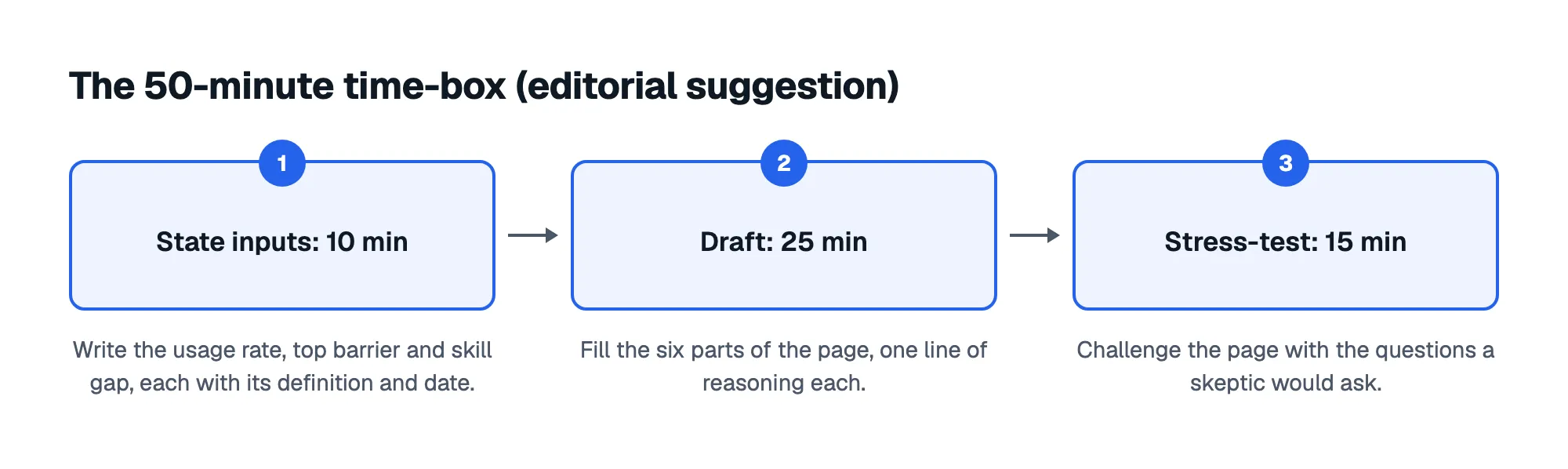
Draft the page in the order below, then save it as a one-page AI adoption strategy PDF so it can circulate with its review date attached.
- Situation: the three data points and how each was measured
- One priority barrier
- One skills intervention
- One measure of success
- An owner
- A review date
For the stress test, ask: "Would this change if usage were half or double?" "Does the top barrier point to a skill, governance or workflow fix?" "What would a skeptical CFO challenge first?"
We'd pick one barrier and one intervention, even though a broader plan looks more thorough. A page that tries to fix everything gives no owner anything to be held to.
Here's a filled-in AI adoption strategy for business, as a hypothetical example. Imagine a 300-person sales organization where usage is defined as weekly active use, the top barrier is unclear use cases and the biggest skill gap is judging AI output. It's an illustration, not data or a real result.
| Part | Example line |
|---|---|
| Situation | Usage means weekly active use; top barrier is unclear use cases; biggest gap is judging AI output; all self-reported in one survey. |
| Priority barrier | Staff don't know which tasks suit AI. |
| Skills intervention | Short role-based sessions on two common sales tasks. |
| Measure of success | Weekly active use under the stated definition, plus perceived usefulness labeled as perceived. |
| Owner | Head of AI, with the sales enablement lead. |
| Review date | Next survey round, about one quarter out. |
Check the page against four completion criteria
The exercise is complete when you can tick every line below. Anything unticked goes back into the draft.
Labeling matters most for impact claims. Microsoft's documentation suggests four agree/disagree statements on quality, mental effort, speed and productivity, and these measure user perception. If your page cites a similar result, call it perceived, not measured.
Sources: AI Adoption Category in Adoption Score - Microsoft 365 admin | Microsoft Learn
Call in outside help only when inputs fail

Reflection, and our suggested answer: you don't need a consultant to draft an AI adoption strategy for business.
AAPOR's 2016 survey-quality guidance says to judge a survey by its fitness for use. Some decisions need precise estimates, while others need only directional information combined with other data. It also flags coverage, sampling and nonresponse as sources of bias. A one-page draft is directional; a large budget commitment may not be.
| Situation | Move |
|---|---|
| An input is missing | Collect it before drafting |
| Inputs conflict | Check definitions and populations first |
| Decision is high-stakes | Get more precise data or outside review |
| Inputs are clear and consistent | Draft, then re-survey to see if they changed |
Sources: https://aapor.org/wp-content/uploads/2022/11/AAPOR_Reassessing_Survey_Methods_Report_Final.pdf
Run the hour, then measure again
If you don't have the three inputs, a predefined employee survey can produce them. AI Adoption Score uses predefined surveys, with guidance on which one to start with.
If you survey, AAPOR notes that a full email directory of all employees can serve as a nearly complete sample frame, which minimizes coverage bias when you draw from the whole population.
Write the page this week, name what you don't know, and set the date to measure again. The first draft only needs to be testable.
Sources: https://aapor.org/wp-content/uploads/2022/11/AAPOR_Reassessing_Survey_Methods_Report_Final.pdf
Frequently asked questions
Who should stress-test the draft?
Ask someone who didn't write it and who owns a cost or risk, such as a finance partner or a team lead from the affected function. They'll press on definitions and impact claims faster than a fellow AI specialist. Give them ten minutes and record what they raise.
What if two surveys give conflicting numbers?
Don't average them. Compare who was asked, when, and how each question was worded, then put the input you trust more on the page and list the other as an unknown. If the gap stays unexplained and the decision is large, treat that as your cue to collect cleaner data.
How should I present the draft to a CFO?
Present it as a dated hypothesis, not a forecast. Lead with the one barrier and one intervention you chose, say what would change your mind, and name the cheapest check. Avoid promising financial returns, since the page rests on perceptions and a single snapshot.