
The short version
Each person rates how independently they can do a set of AI-assisted capabilities, and how deeply they work with a set of AI tools and models, on five levels from No experience to Advanced. Then they say which of those colleagues may ask them about. About six minutes, with the default questions.
The report is a practical skills directory: who is Independent or Advanced at what, which capabilities nobody covers or only one person does, which tools people really use, and how all of it moves from one run to the next. It is a self-reported map, not a test, a score or a ranking.
A directory, not a test
The survey answers four questions: what AI skills does each person report today, who is skilled in what, what is the company's average for each skill, and how does that change over time. It doesn't test knowledge, certify expertise, rank people or treat one vendor's tool as a required skill. A person's level for an item is exactly their own rating; nothing is inferred, and no composite score is built per person.
It separates two things on purpose: capabilities, the durable, platform-independent things people do with AI, and technologies, the tools and models that change every quarter.
Sixty-four capabilities
Ten capabilities are for everyone, from giving AI clear instructions to measuring whether AI improved the work. The rest belong to a path: 19 technical ones, and 35 across four kinds of non-technical work. Each is one card with the capability, a line on what it means, and the five levels.
Five levels
Every capability and technology card uses the same five levels. People see the labels; the report reads them with these meanings:
Level 1 is an absence of practical experience, not automatically a gap. Level 5 remains a self-assessment, not a certification.
125 tools and models
Technology cards ask for hands-on experience: "Rate your direct, hands-on experience with this technology." For a model: "Rate deliberate selection or direct hands-on use of this model. A model chosen invisibly by another product does not count." The catalogue is checked against the vendors' own announcements, and each model release is its own entry, so old entries keep their history while new ones are added. The ones asked by default are named below; the rest can be switched on per run.
Who can help
A high rating never volunteers anyone. After the cards, one question asks: "Would you be available to help colleagues?" with the items the person rated Independent or Advanced, and three answers: Not now, All eligible items, Choose specific items. "Choose specific items" opens a list of those items only. The survey won't accept an item the person didn't rate 4 or 5, and lowering a rating removes it from the list.
Paths and questions
The first question picks a path: "Which path best describes your work?", Technical or Non-technical. Non-technical people then pick a work focus: "What is your main work focus?". Each path gets its own capabilities and technologies, so a marketer never rates a coding agent.
What the report shows
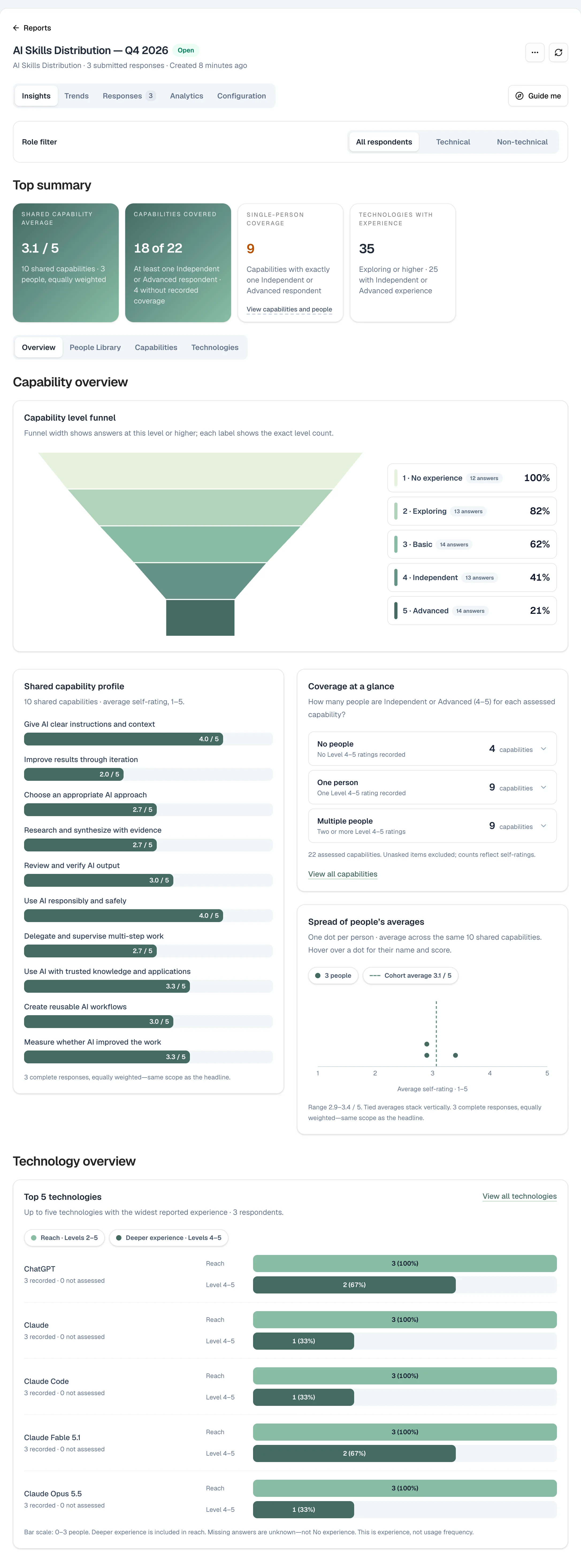
- Top summary: the shared capability average (each person's mean over the capabilities everyone was asked, then people averaged equally), capabilities covered (at least one Independent or Advanced person), single-person coverage (exactly one), and technologies with experience.
- Overview: a funnel of all capability answers by level, the shared capability profile, coverage at a glance (no people, one person, multiple people), the spread of people's averages, and the top 5 technologies by reach.
- People Library: each person's capabilities and technologies, as cards or a matrix, with search and filters such as "Independent or above in…". Sorted by name by default.
- Capabilities and Technologies: every item with its level distribution, how many people rated it, the company average and the count at Level 4–5.
- Trends: matched by person and capability across compatible runs: moved up, unchanged, moved down; the shared average, single-person coverage and technologies with experience per period; and a level-to-level movement matrix. New catalogue items stay out of comparisons.
Below 5 complete responses the report shows a small-sample warning rather than hiding numbers.
Where the model comes from
The capability model follows SFIA's AI skills framework, which recommends enduring, platform-independent capabilities because AI products change quickly; UK workforce AI-skills guidance, which groups capability into technical, non-technical and responsible domains; the UK foundation-skills benchmark; and the European Commission's AI literacy guidance, which says to consider experience, training, context and risk rather than assume one universal level. The technology list is an inventory, checked against first-party sources, not an endorsement or a market ranking.
Who sees what
- Answers are identified. People sign in with Google, through an allowed email domain or an invitation; the survey says so on its first screen. Names and ratings are visible to the report's viewers, in the People Library and in Responses.
- Sharing is the owner's choice. A public link shows the report with people's names, as the team sees it. Earlier runs feed Trends as aggregates only; their names are never loaded.
- No ranking. A downward change is reported descriptively, never as failure, and the survey isn't for performance decisions.
Limits
- Self-reported. Using a tool is a useful directory fact, not evidence of expertise, and the levels aren't validated proficiency.
- Low coverage is descriptive. A capability nobody covers isn't automatically a gap; it depends on whether the work needs it.
- Six minutes is an estimate. The time is the app's figure for the default questions; a path with everything switched on asks a lot more cards.
- No benchmark. Averages are your organization's; there is no external comparison.