
What Is Change Management Consulting for an AI Rollout?
What is change management consulting? In practice, it is an outside engagement that helps an organization move people through a planned change — communication, sponsorship, training and reinforcement — instead of leaving adoption to chance. For an AI rollout, the real question for a digital transformation leader usually isn't whether change management matters. It's whether to pay for outside help now, and what to measure before deciding.
The most useful sequence is to baseline your own organization first, then scope any consulting engagement around what that baseline actually shows. Change management consulting works best aimed at a specific, diagnosed gap rather than applied as a general-purpose fix from day one.
What Change Management Frameworks Like ADKAR Actually Deliver
Many consultants apply ADKAR, a model built around five individual-level milestones — awareness, desire, knowledge, ability and reinforcement — to track how a person moves through change. Prosci, the framework's own creator, describes ADKAR as a model for individual change, not a complete change management methodology on its own.
A full Prosci-style engagement typically starts earlier than training: developing a customized, scaled change strategy and lining up sponsorship before tools or workshops appear. That framing is a useful check: a change management consultant is primarily selling a structured way to diagnose and sequence the human side of a rollout, not just workshops.
Sources: The Prosci ADKAR® Model | Prosci, Prosci Methodology Overview
Why AI Rollouts Strain Traditional Change Management
Gallup argues that adopting AI well requires a culture shift across the whole organization, and that traditional change management approaches built to minimize disruption aren't equipped for that scale of shift.
A resource-allocation framework often cited by change consultants, attributed to BCG and MIT Sloan research, holds that most of the effort in an enterprise AI transformation should go to business process change and change management — people, culture, incentives and workflows — rather than the technology itself. This figure is reported secondhand by a vendor blog rather than confirmed against the original study.
Sources: A People-First Approach to AI Adoption - Gallup, Why AI adoption is a change management challenge
What to Measure Yourself First
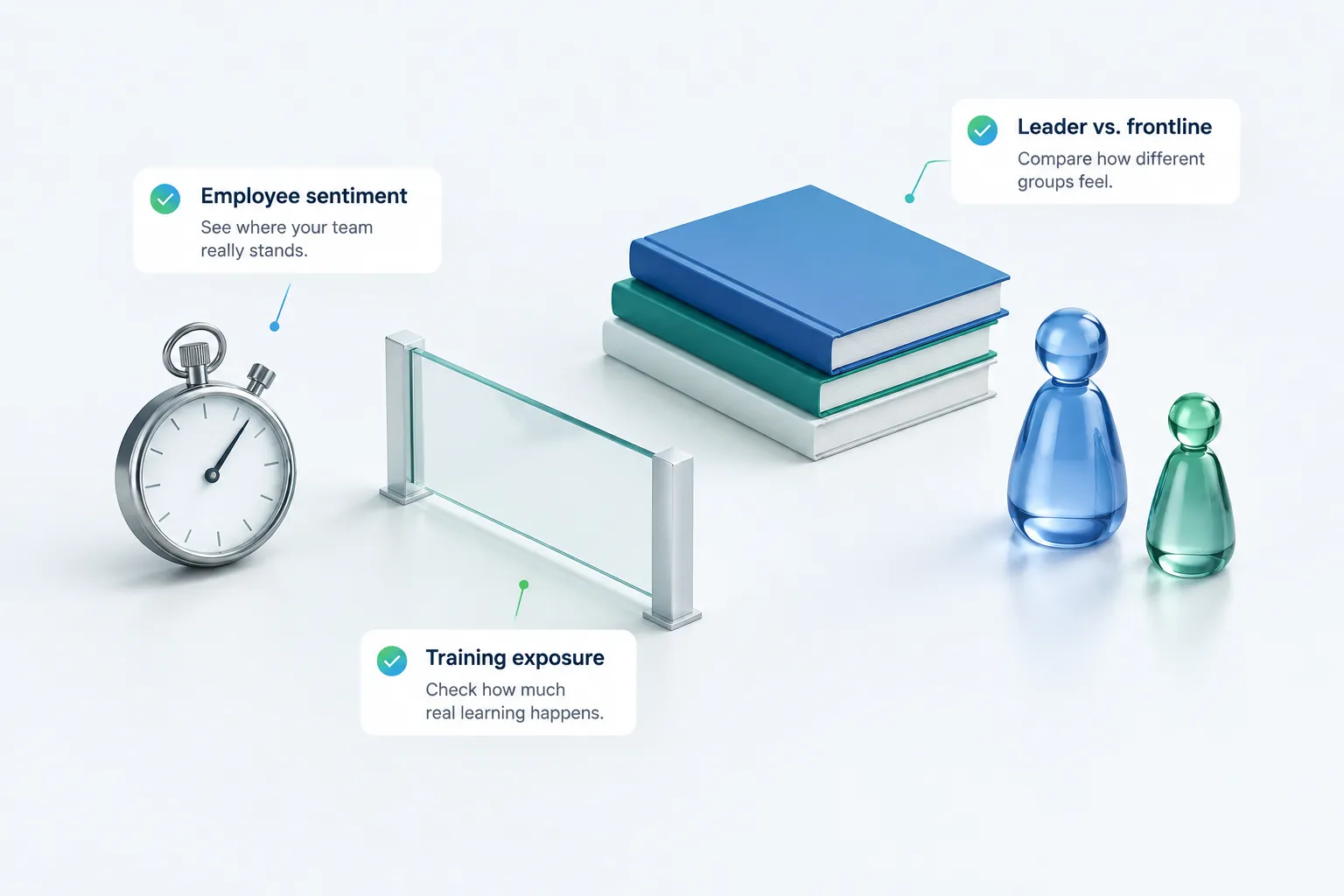
This is where what is change management consulting earns its cost — after you already know where the gaps are, not before. Dan Cumberland, founder of an AI implementation consultancy, argues on his own firm's blog that measuring employee sentiment ahead of deployment gives leaders an unfiltered view of where their team actually stands.
“Before rolling out any AI tool, run a sentiment baseline. Get a direct read on where your team stands”
— Dan Cumberland, Founder of Dan Cumberland Labs; helps engineering and construction firms assess where they stand with AI and decide what to build first · Source: AI for Change Management in Professional Services Firms | Dan Cumberland Labs
Training exposure is one gap worth checking directly. A vendor blog citing Harvard Business Review reports that a large share of office workers spent under five hours learning about AI, and nearly a third received no formal training at all.
Leader-versus-frontline sentiment is another gap worth checking: a vendor blog reports Prosci research showing executives rate AI sentiment far more positively than frontline employees, though the original study's methodology isn't stated in that source.
Sources: AI for Change Management in Professional Services Firms | Dan Cumberland Labs, AI Change Management: 8 Differences from Traditional | Dan Cumberland Labs
Reading Self-Reported Adoption Data Before You Decide
These are employee reports, not independent measurements. Survey answers on usage, sentiment and perceived impact describe how people experience an AI rollout, not proof that AI caused a change in output; treat gaps and low scores as things worth investigating, not as settled causal findings.
With that in mind, Gallup's own data is telling: even in AI-adopting organizations, only about one in ten employees strongly agree that AI has transformed how work actually gets done at the organizational level, separate from any individual task-level gains they report.
Once you have baseline numbers, the pattern in the results — not the numbers alone — points toward hiring outside expertise or handling the gap internally.
| Pattern in your baseline | Likely underlying gap | Suggested next step |
|---|---|---|
| Large leader-vs-frontline sentiment gap | Trust or sponsorship gap | Outside facilitation and sponsorship design often helps |
| Low usage, strong training completion | Motivation or trust, not skills | Consider outside change expertise |
| Low usage and low training exposure | Skills or knowledge gap | An internal L&D plan may be enough |
| Leadership aligned, training gap only | Ability gap | Build an internal training and communication plan first |
| Consistently low sentiment across all levels | Deeper cultural or strategic gap | Consulting is more likely to add value |
Sources: Rising AI Adoption Spurs Workforce Changes, AI for Change Management in Professional Services Firms | Dan Cumberland Labs
A Practical Sequence for Scoping the Engagement
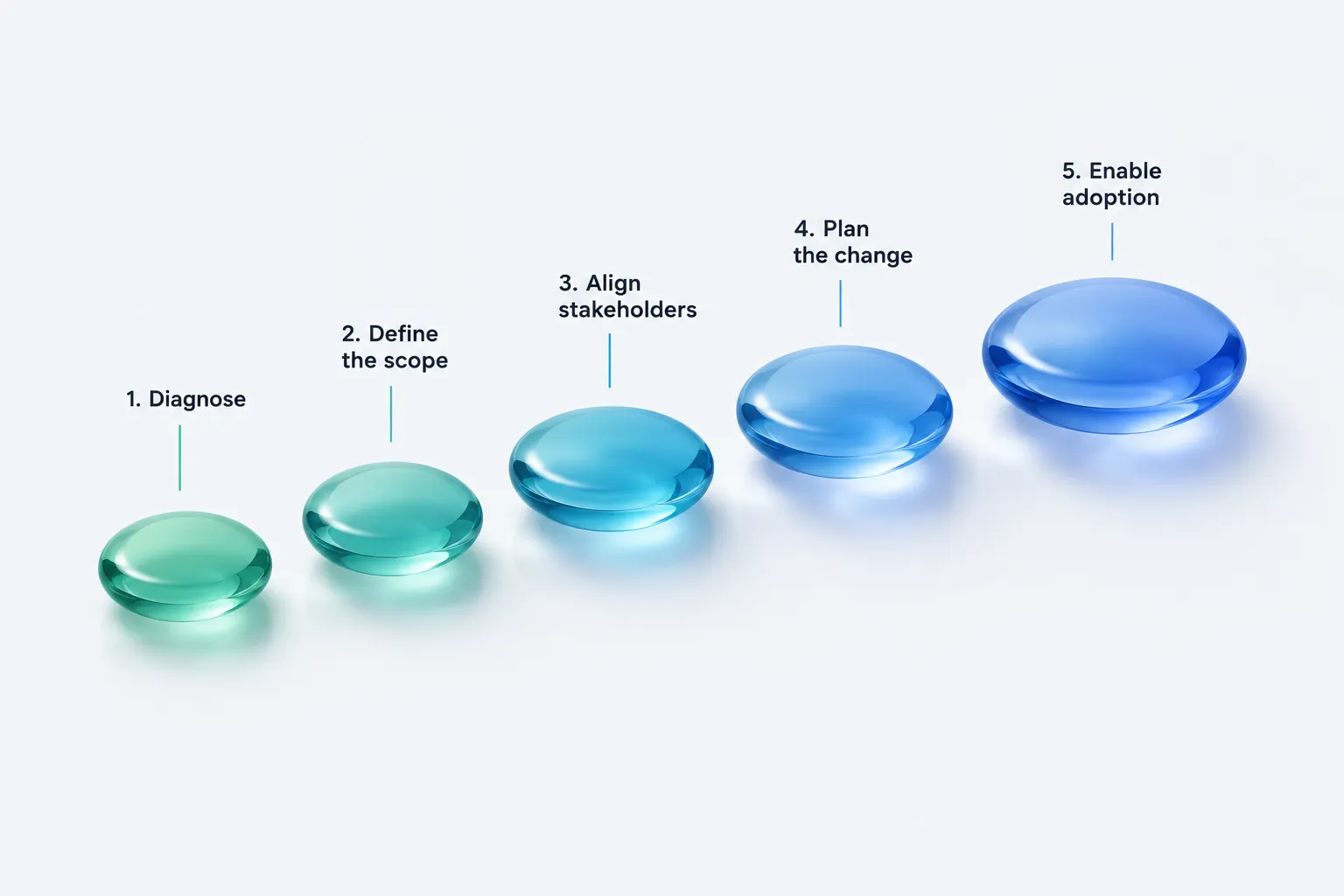
Once the baseline is in hand, treat scoping as a short, structured decision rather than an open-ended search for a vendor.
Baseline-to-decision sequence
- Baseline: Run an anonymous employee survey covering usage, barriers, training and sentiment.
- Diagnose: Identify which ADKAR-style stage or barrier the data actually points to.
- Decide: Match the pattern in results to hiring outside help or handling it internally.
- Scope: If hiring, write the brief around the specific diagnosed gap, not a general program.
- Re-measure: Repeat the survey periodically, since needs keep shifting after initial deployment.
That's the practical answer to what is change management consulting worth, for an AI rollout: real value when it's scoped to a diagnosed gap, not applied broadly from day one.
Sources: The Prosci ADKAR® Model | Prosci
Frequently asked questions
How long should an internal AI baseline survey take before talking to consultants?
There's no fixed rule, but running the survey, reviewing results with stakeholders and mapping gaps to a hire-or-handle decision typically fits within a few weeks, well before a formal request for proposal, so it doesn't meaningfully delay a rollout timeline.
Who inside the company should own the baseline survey?
Ownership usually sits with whoever leads the AI rollout — often a digital transformation leader, CIO or Head of L&D — working with People or HR teams to keep responses anonymous and to compare leadership and frontline results fairly.
Should we re-run the baseline after hiring a consultant?
Yes. Re-surveying periodically, rather than treating the rollout as a one-time project, helps confirm whether an engagement addressed the diagnosed gap and whether new barriers or training needs have emerged as AI capabilities and employee needs keep shifting.
Can a consultant help design the baseline survey itself?
Possibly, but it isn't necessary: predefined survey tools can capture usage, barriers, training effectiveness and sentiment without outside design help, keeping the diagnostic phase independent of the vendor you might later hire and scope work with.