
A survey answers a narrower question than adoption
Your CIO wants proof the AI rollout is working. Your last employee survey came back with forty open comments, three percentages that don't quite agree, and no clear next move. That's the gap between running a survey and surfacing the AI adoption challenges you can actually act on.
The common practice is to run one broad survey and expect it to settle the AI adoption challenges in one pass, covering who's using AI, why some people aren't, and whether the rollout is paying off. That gets part right: a well-built survey surfaces real barriers employees face. Proving payoff is a separate question, one the sections below treat differently from barrier data.
Treat a survey as a map of what's getting in people's way, not a verdict on return. That distinction decides what you ask, what you believe when the numbers come back, and what you do with the answers next.
What AI adoption challenges actually show up in answers

When Gallup asked U.S. employed adults in a 2025 panel survey what the single biggest barrier to AI adoption was, the top answer wasn't a missing tool or a blocked license. It was not knowing a clear use case or value, named by 16%, just ahead of legal and privacy worries and a lack of training.
Among employees who don't use AI at all, Gallup's same panel found the dominant reason isn't lack of access. It's a belief that AI simply can't help with their specific job, a belief that no amount of training alone will change.
We're skeptical that an answer like "I need more training" always means training is the fix. Often it's a stand-in for not yet seeing a use case worth trying.
Professional-services employees report a different kind of block. Thomson Reuters Institute's survey of more than 1,500 legal, tax, accounting and compliance professionals across 26 countries found many receive conflicting directives about AI use from leadership and clients, and close to 80% cite worry about inaccurate AI responses as a reason adoption stays shallow.
| Signal | What it reveals | Reported by |
|---|---|---|
| Unclear use case | Employees don't see a job-specific reason to try AI | Gallup panel, U.S. employed adults, 2025 |
| Trust in output | Employees doubt AI accuracy enough to avoid relying on it | Thomson Reuters Institute, professional-services survey |
| Policy gaps | Conflicting or missing guidance from leadership and clients | Thomson Reuters Institute, professional-services survey |
| Non-user belief | Belief that AI can't help their specific role | Gallup panel, U.S. employed adults, 2025 |
A question like "What is blocking you from adopting AI in your role?", the kind SurveyMonkey's survey template suggests, works as a starting prompt, not a validated diagnostic. Treat any single survey question as a prompt worth investigating further, not a scored instrument on its own.
AI Adoption Score's AI Adoption Barriers Survey is built around the same idea: ask about the specific reasons a team isn't using AI more effectively, rather than collecting general sentiment about the technology.
Sources: Manager Support Drives Employee AI Adoption, AI use and employee experience: New research reveals guidance gap in professional services | Thomson Reuters Institute, AI Readiness Assessment Template | SurveyMonkey
Self-reported productivity gains don't settle the ROI question

Gallup's February 2026 survey of U.S. employed adults, with 23,717 respondents, found 65% say AI has improved their own productivity and efficiency. Gallup itself flags the catch: firm-level research covering the same period shows only a minimal measured productivity effect.
We think treating that 65% figure as proof of ROI is the single most common mistake when teams report on AI adoption challenges. A survey measures how people feel about their work, not what changed in the business's numbers.
Perceptyx's 2026 analysis of its own Workforce Panel data found a similar gap one level down: people report trying generative AI occasionally far more often than they say their team has adopted it as standard practice, with only 20% saying their team has adopted it to a large extent.
That gap between individual trial and team-level habit is itself useful information. It tells you adoption hasn't become routine yet, even where people say they like the tool.
Sources: Rising AI Adoption Spurs Workforce Changes, What Does It Take to Move Employees From AI Access to AI Adoption?
Worry and readiness split by role and tenure

Pew Research Center's February 2025 report on U.S. workers, run on its American Trends Panel, found about half, 52%, say they feel worried about how AI may be used in their workplace in the future. That figure describes a general attitude, not a reaction to any one employer's rollout.
Perceptyx's 2026 framework description recommends separating fast-moving sentiment, confidence, trust, willingness to experiment, from slower group and organizational indicators. Segment both layers by role, tenure and manager before you decide what to fix, since a skeptical team lead reads very differently from a skeptical new hire.
Sources: What Does It Take to Move Employees From AI Access to AI Adoption?, Workers’ views of AI use in the workplace | Pew Research Center
Write questions you can actually act on

Perceptyx's 2024 guidance, dated before this year but still a reasonable rule of thumb, suggests asking only what the organization is willing and able to act on, with the behavior described observable rather than vague. Consider testing each candidate question against a short set of prompts before you ship it, offered here as a starting point rather than a validated checklist.
Perceptyx's own 2026 commentary makes a sharper point: writing an action plan after a survey is not the same as changing behavior. The real test is whether leaders and employees did anything differently afterward. Our view: skip the polished action-plan deck. Name one behavior to change, one owner, and a date to re-survey, and skip the slide nobody revisits.
Sources: Everything You Need to Know About Effective Employee Surveys, Why Don't Employee Survey Action Plans Drive Business Outcomes?
Re-survey to test the change, not to repeat the question
The U.S. Office of Personnel Management's guidance for federal employee surveys, dated 2014 and not specific to AI, still describes the right shape for follow-through: treat action planning as an ongoing change-management activity, not a one-time deliverable attached to a single report.
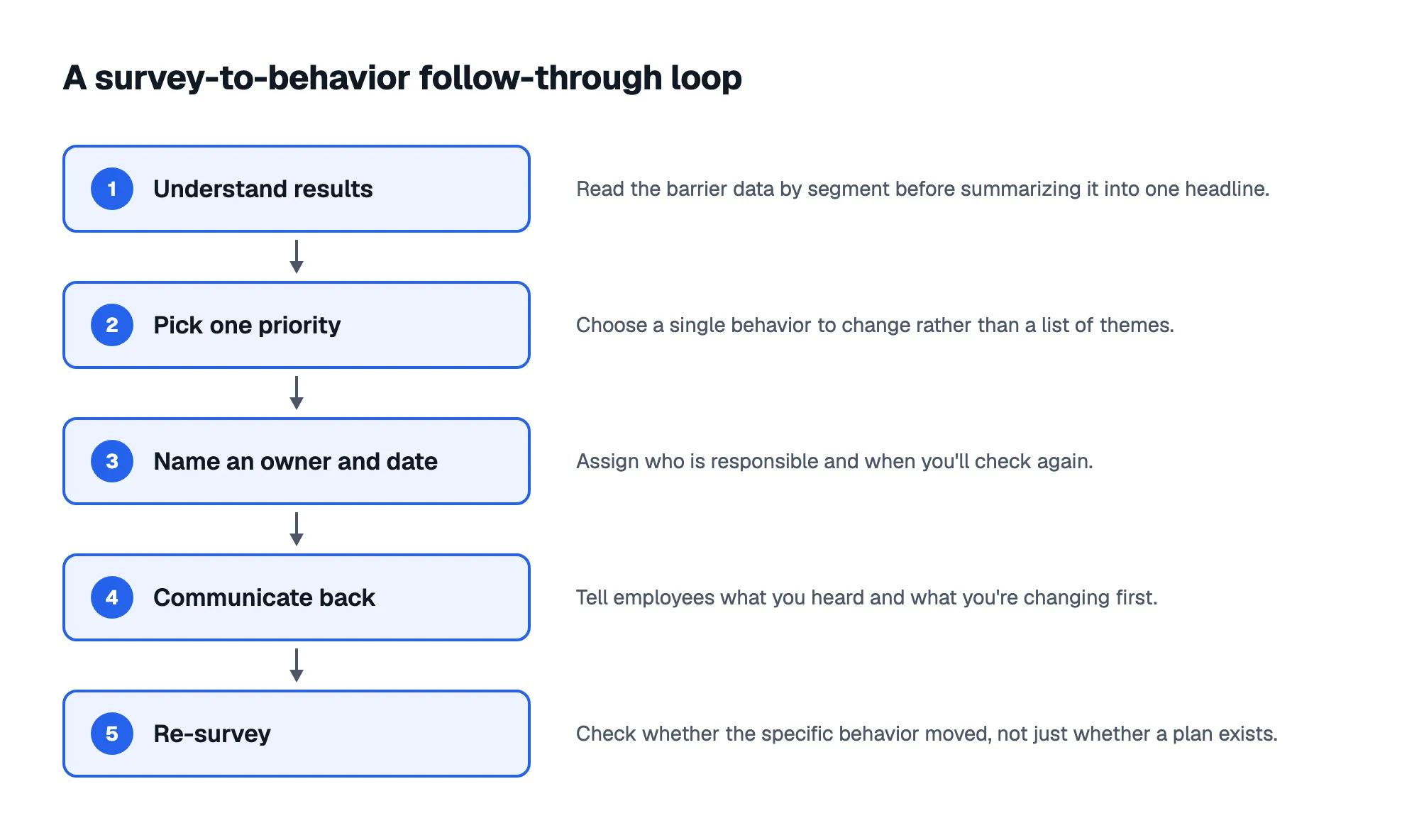
Our bet is against the annual all-hands AI survey. A short, repeated pulse on one or two barriers tells you more about whether anything moved than a once-a-year census ever will.
Pair that cadence with a baseline reading of usage, skills and barriers across roles, so the first re-survey has something concrete to compare against. That baseline, not the first set of answers, is what turns a survey into a measurement you can report back on with confidence.
Sources: Why Don't Employee Survey Action Plans Drive Business Outcomes?, Getting the Most out of Your Federal Employee Viewpoint Survey Results
Frequently asked questions
How long should an AI adoption barrier survey be?
Editorial advice, not a tested standard: keep it short enough that people finish it in one sitting, usually under fifteen minutes, with a handful of behaviorally specific questions rather than a long opinion sweep. Longer surveys tend to collect vaguer answers, not better ones.
Who should see the raw survey comments before action planning?
At minimum, the sponsoring leader and the manager of each team the results cover, before anything gets summarized into a deck. Letting the summary happen first tends to flatten the specific, job-level detail that makes a barrier answer actionable.
How often should we re-run an AI adoption survey?
Tie it to the action taken, not the calendar. The leader who owns the priority you acted on should schedule a short pulse, limited to the one or two questions tied to that specific change, a few weeks after it took effect, rather than waiting for the next full cycle.
Can a survey tell us whether AI is actually saving time?
Not directly: a survey captures whether employees believe AI saved them time, a useful early signal but not a measurement of hours recovered. To get closer to a real answer, compare the self-reported figure against task-level data you already track, such as cycle time or ticket volume, rather than reporting the survey number as a result on its own.
Should non-users and active users get the same survey?
No, ask them different questions. Non-users need a question about why they haven't started, since reasons like 'it won't help my role' call for a different fix than a lack of access would, while active users need questions about trust, frequency and manager support instead.
Sources: Why Don't Employee Survey Action Plans Drive Business Outcomes?, Getting the Most out of Your Federal Employee Viewpoint Survey Results, Rising AI Adoption Spurs Workforce Changes, Manager Support Drives Employee AI Adoption