
How AI Adoption Score works
People answer short surveys about how they use AI. The report fills in with every answer: a level for every person, team and the organization, what holds people back, and what to do next. There's nothing to install or connect.
- 7surveys, each for a different question, with two more on the way
- 5–20 minper person, for most surveys
- L1–L5a level for every person, team and the whole organization
- 0integrations, agents or admin access
From first survey to a rising trend
Your first run sets the baseline. Every run after it shows what your changes actually moved.
Pick a survey and invite your people by email or link — no integrations needed
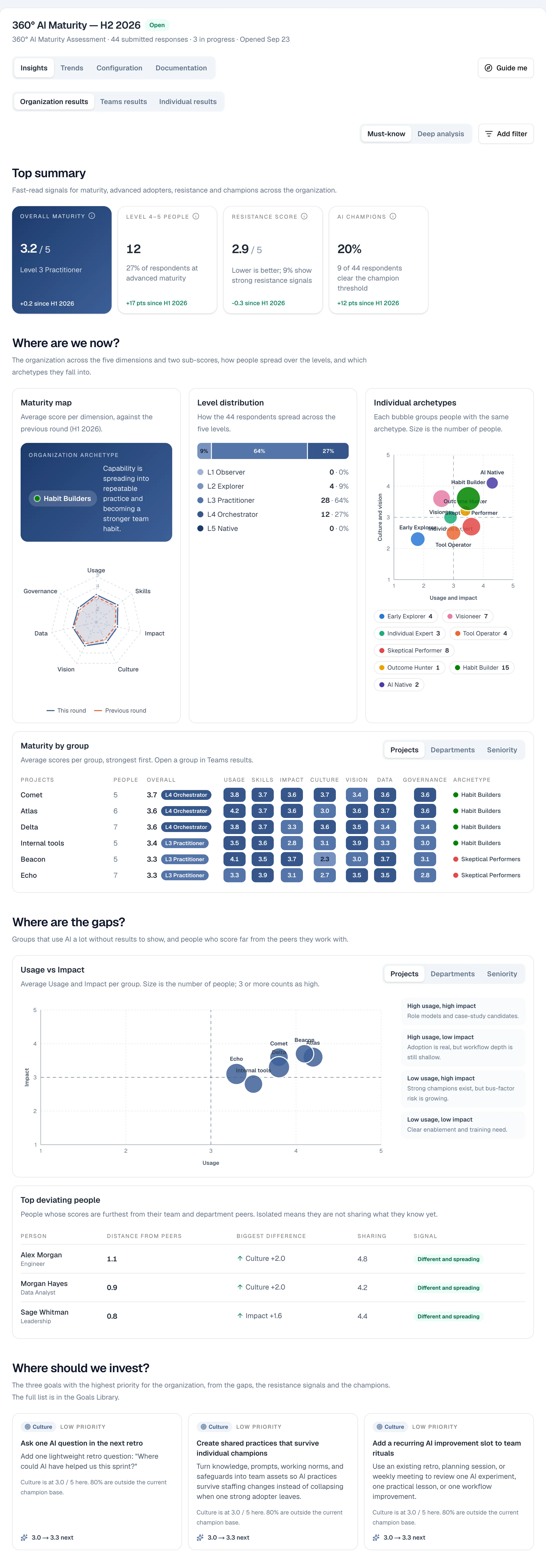
Results update with every answer: overall level, five dimensions, every team
Fix the weakest spot, run the survey again, and see the trend move
Repeat every quarter
What do you want to know?
Each survey answers a different question about AI adoption. Pick yours to see the survey behind it and what its report shows.
360° AI Maturity Assessment
- Everyone
- About 15 minutes
- Named by default, or anonymous
- A level from L1 Observer to L5 Native for every person, team and the organization, across five dimensions.
- Eight archetypes, the AI champions and a resistance score.
- Three goals for each person, team and the organization, each with a near target.
Surveys
 360° AI Maturity AssessmentHow the flagship survey scores every person, team and the organization: five dimensions, five levels, eight archetypes and the goals that follow.
 AI Market PulseHow the quarterly pulse works: this quarter's AI developments, six stages from Not aware to Regular use, each one's position against the market, and the absorption funnel.
 AI Anxiety Scale (AIAS)The validated 21-statement Artificial Intelligence Anxiety Scale: its four areas, the 1–7 scale, the AI Concern Index, and how to read results without over-reading them.
 AI Skills DistributionA self-reported map of who can do what with AI: 64 capabilities, 125 tools and models, five levels, who volunteers to help, and the directory the report builds.
 AI Adoption BarriersWhat stops people from using AI more: 18 barriers in six areas, each with who can fix it, eight beliefs, and a verdict on whether it's skills, conditions or motivation.
 Software Quality Management (SQM)How a project's quality practices are reviewed: 248 yes/no questions in 14 areas, routed by role, weighted by importance into a score out of 10, with findings most important first.
 n8n Skills AssessmentA self-rating and a quiz in ten skill areas of n8n, a level from Beginner to Expert set by the quiz, and where confidence and results differ.
 Claude Skills AssessmentThe same quiz format for everyone who uses Claude at work, with extra questions for people who use Claude Code or build with the API. The survey itself is coming soon.
 Quick AI Self-EvaluationComing soon
Who it's for
- CEOs and leadership teamsWhether AI is changing how your company works: a level for the organization and every team, what holds people back, and whether people keep up with each quarter's AI developments.
- Chief AI OfficersA baseline for your AI program and proof that it's moving: who gets results from AI, who your champions are, what stops the rest and who can fix it.
- HR and L&D leadersWhich AI skills people have and who can teach them, what people worry about, and where training should start, before you spend the budget.
- Engineering leadersWhat telemetry can't show: skills checked by a quiz, the practices behind delivery, and whether engineers get results from AI or just use it. No integrations.
Built for honest answers
A survey is only as good as its answers. These defaults keep them honest.

Nothing to install
No integrations, agents or admin access. People answer questions; nothing reads their tools, files or messages.

Anonymous where it matters
The AI Anxiety Scale is anonymous by default, and so is the one-click launch of AI Adoption Barriers. The 360° names people so its person and team views work, and can run anonymously instead.

For development, not ranking
No survey ranks people. Ratings collected for decisions about people come out more lenient, so the results are for development, not performance reviews.
How we get honest answers
Know where your team stands
before you invest more.
One week. A clear picture of your organization's
AI performance — and exactly what to do next.