
Count coverage before assigning helpers
Your rollout sponsor asks, "Who else can do this if Priya's away?" A skills matrix example should help you answer that question without turning your highest-rated employee into everyone's default trainer.
AI Adoption Score's AI Skills Distribution documentation, retrieved on 18 October 2026, defines coverage among surveyed employees as at least one person reporting Independent or Advanced proficiency, and single-person coverage as exactly one. Its ratings are self-reported, not validated proficiency; changes in ratings don't establish causal training effects or productivity gains.
We think a list of your strongest AI users is a useful starting point, but an incomplete staffing plan. Count reported coverage, not assumed availability.
Sources: AI Skills Distribution: how it works · AI Adoption Score
Set up the editorial exercise
This editorial exercise asks you to identify needed AI capabilities with exactly one reported practitioner, then propose peer support or cross-training. The fictional inputs and suggested solution below haven't been executed or validated.
Imagine a sales operations team using Microsoft Copilot for recurring work. Before using this skills matrix example, gather the following prerequisites and inputs; these are suggested exercise requirements.
Separate skill matrix coverage from willingness

Use this skills matrix example with invented inputs dated 18 October 2026. Developing means proficiency below Independent; Yes means willing to help with that specific capability; Unknown means willingness wasn't recorded.
| Person or total | Draft proposals | Check AI claims | Summarize calls | Analyze spreadsheets |
|---|---|---|---|---|
| Priya | Advanced; Yes | Independent; No | Independent; No | Developing |
| Mateo | Developing | Developing | Advanced; No | Developing |
| Ruth | Developing | Missing | Developing | Developing |
| Owen | Missing | Developing | Missing | Missing |
| Reported coverage | 1 | 1 | 2 | 0 |
| Willing helpers | 1 | 0; Ruth Unknown | 0; Owen Unknown | 0; Owen Unknown |
AI Adoption Score's AI Skills Distribution documentation, retrieved on 18 October 2026, treats willingness as a separate, optional choice. Willingness doesn't establish available time, teaching ability or an agreed mentoring commitment.
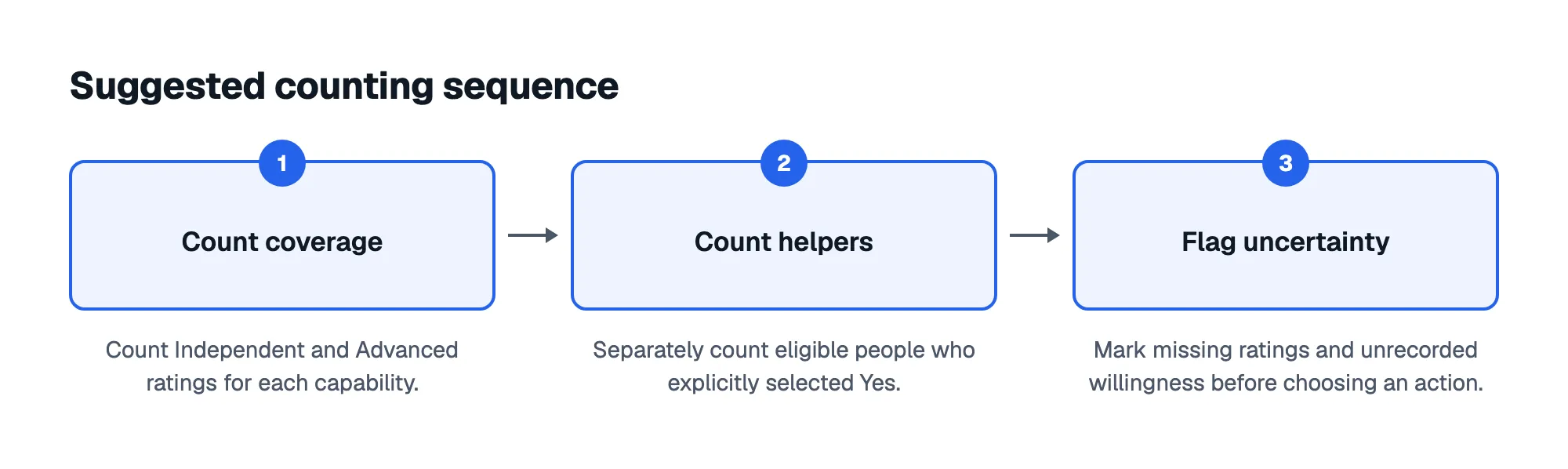
Follow the suggested counting sequence below. We'd keep the two totals separate even when a combined score would look tidier.
Sources: AI Skills Distribution: how it works · AI Adoption Score
Choose support without volunteering anyone
Here's a suggested solution, assuming all four capabilities are needed. Single-person reported coverage is a reason to investigate dependence, not proof of an operational single point of failure.
| Capability | Proposed action | Proposed owner | Review date |
|---|---|---|---|
| Draft proposals | Ask Priya about one bounded session; cross-train a second practitioner | Sales operations manager | 2 November 2026 |
| Check AI claims | Respect Priya's No; arrange another cross-training route | L&D lead | 2 November 2026 |
| Summarize calls | Confirm missing input; seek voluntary support without assigning either practitioner | Team manager | 2 November 2026 |
| Analyze spreadsheets | Check missing input; arrange learning support if the gap remains | L&D lead | 2 November 2026 |
The UK Operational Delivery Profession user guide, last modified 5 October 2026, suggests job shadowing and skill exchanges within organisations. That offers an option to consider here, rather than evidence that this AI exercise improves outcomes.
Sources: AI Skills Distribution: how it works · AI Adoption Score, User guide - Operational Delivery Profession
Finish with an agreed commitment

Complete the exercise with an annotated matrix and an action, owner and review date for every selected capability. Record unresolved inputs and confirm time and participation before assigning support. For reflection, ask: "What work sample would justify relying on this rating?" and "What can this colleague realistically agree to?"
AI Adoption Score's AI Skills Distribution provides a self-reported map of capabilities and tools, including who is willing to help colleagues. It can supply those inputs when you move beyond the fictional worksheet.
Our view is that the useful output is an agreed next action, not a more colourful grid.
Sources: AI Skills Distribution: how it works · AI Adoption Score
Frequently asked questions
Who should maintain the matrix?
Assign one coordinator, such as your L&D partner or team manager. As editorial guidance, let that person manage definitions and follow-up, while employees review their own entries. Give action owners responsibility for updating commitments so the coordinator doesn't have to infer whether a conversation became an agreement.
How often should we refresh the exercise?
Choose a cadence that matches the team's decisions. As editorial guidance, revisit entries when responsibilities, tools or staffing change, and before relying on the matrix for a new assignment. Keep earlier rating dates visible so a recent discussion doesn't make an old response appear newly confirmed.
Should we combine several teams into one matrix?
Start separately unless the teams use the same capability definitions. As editorial guidance, compare shared capabilities only after checking that the work expectations match. Someone counted elsewhere in the organisation may be outside your team's working arrangements, so discuss access before treating that person as an available support option.