
AI skills vs agents: the decision nobody writes down
Imagine a budget meeting where your CFO asks whether this quarter's AI line item should buy training seats for your sales team or agent licenses that take the follow-up emails off their plate. The AI skills vs. agents question usually gets asked about a whole role, when the real decision sits task by task underneath it.
According to the World Economic Forum's 2025 Future of Jobs Survey of employers, covering expectations through 2030, employers expect 39% of workers' core skills to change in that window. That's the kind of number a board waves at you right before asking what you're doing about it.
This article is an editorial exercise, not a validated method: a way to build a per-role decision matrix that sorts individual tasks into training, agent handoff, or both, before you commit a budget line to either.
The common move is to pick one lane for a whole role: either 'this job needs AI training' or 'this job gets automated.' That gets something right — some roles do lean heavily toward one answer.
But most roles mix teachable tasks with ones an agent can already handle, so a role-level call wastes money twice. We think sorting at the role level is where a good chunk of AI training budgets quietly go to waste. Sort by task, not by job title.
Bring a task list, not a job title

Prerequisite: an existing task inventory for each role you're assessing. Pull it from job descriptions, process maps, or survey results on skill and tool-use gaps already sitting in L&D's files. Don't invent tasks from scratch at the whiteboard; you'll just reinvent your own blind spots.
Run this as a short workshop, not a solo spreadsheet exercise. Bring the L&D lead, one manager, one or two frontline employees who actually do the work, and someone who tracks what today's AI tools can realistically do. We'd rather see four people argue about one task for ten minutes than have one person guess silently for an hour.
For every task, bring four pieces of information to the table.
If you want a quick read on what's blocking wider AI use before you build the list, AI Adoption Score's barriers survey is one option for generating that signal.
Four signals that sort a task
A 2025 audit behind the WORKBank database, drawing on preferences from 1,500 domain workers and capability assessments from AI experts across 844 tasks spanning 104 occupations, sorts occupational tasks into four zones: tasks ready for automation, tasks workers want kept human, tasks worth researching further, and low-priority tasks.
Doshi and Moore's human-AI task tensor, submitted in 2025 and published in the Handbook of Artificial Intelligence and Strategy in 2026, organizes the same kind of decision along eight dimensions, including who holds decision-making authority and how much a task's output needs auditing.
Enterprise Knowledge's 2025 analysis, published on the consultancy's own blog, argues that well-defined, repetitive tasks such as data sorting or compliance checks are better handled by rule-based automation than by AI agents, and that agentic AI still needs human oversight for high-risk decisions.
McKinsey Global Institute's 2026 modeling, covering 2025 to 2035, projects automation adoption moving faster in office and administrative, computer and math, and sales occupations than in healthcare. The World Economic Forum's 2025 Future of Jobs Survey of employers also found AI and big data topping the list of fastest-growing skills, one reason AI skills gaps look different team to team.
| Signal | What it asks | Example source |
|---|---|---|
| Codifiability | How repeatable and rule-based is the task? | Enterprise Knowledge's 2025 analysis (rule-based automation vs. LLM agents) |
| Oversight needed | How high are the stakes of an error? | Enterprise Knowledge's 2025 analysis (human oversight for high-risk decisions) |
| Worker preference | Do workers want more or less AI on it? | WORKBank database audit, 2025 |
| Decision structure | Who holds authority, and how is output audited? | Doshi and Moore's human-AI task tensor, 2025/2026 |
Sources: [2506.06576] Future of Work with AI Agents: Auditing Automation and Augmentation Potential across the U.S. Workforce, [2503.15490] Toward a Human-AI Task Tensor: A Taxonomy for Organizing Work in the Age of Generative AI, When Should You Use An AI Agent? Part One: Understanding the Components and Organizational Foundations for AI Readiness - Enterprise Knowledge, AI and the future of US jobs: Skills and pathways | McKinsey, 3. Skills outlook - The Future of Jobs Report 2025 | World Economic Forum
Sort every task into three buckets

With your signals in hand, work through the task list as a group and sort each task into one of three buckets, flagging the ones nobody can agree on.
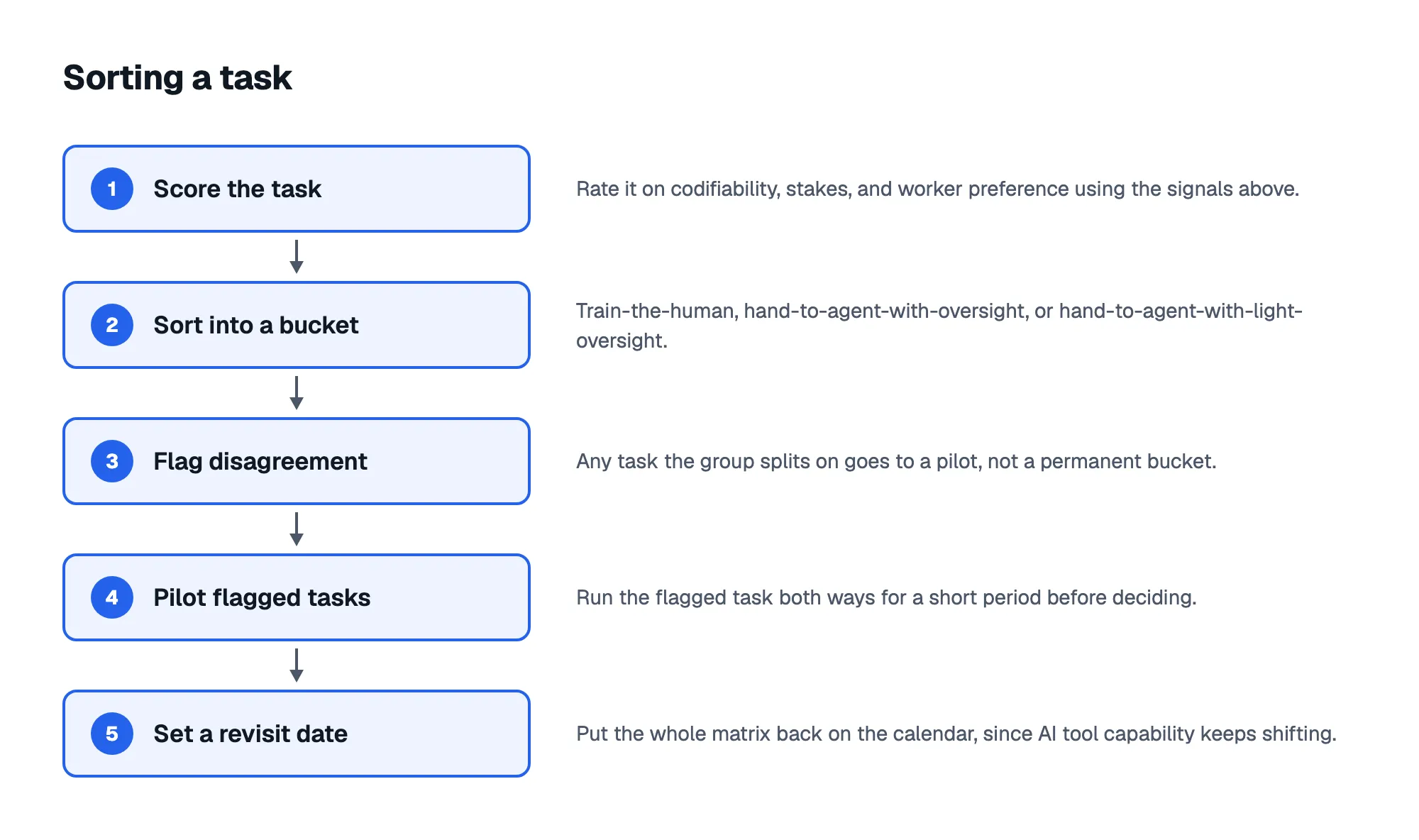
A task that splits the room is more useful than one everyone agrees on instantly. Disagreement is signal, not noise.
Where this framework can mislead you
None of the frameworks above were tested against real training-versus-agent decisions; they're preference surveys, a conceptual model, and a consultancy's own practitioner judgment, not causal proof that one choice beats the other for a given task. Treat every bucket as a working hypothesis, not a verdict.
“So AI training for garden-variety knowledge workers isn’t just dead - it’s necrotic”
— Matt Beane, Author of "The Skill Code" · Source: Training is dead - by Matt Beane - Wild World of Work
Matt Beane, author of 'The Skill Code,' writes on his own newsletter that research he says settled roughly twenty years ago found formal training's effect can't be cleanly separated from the skill people pick up just doing the job. If that's right, a task you bucket as 'train the human' may need a practice loop built into the work itself, not a course.
Judge the training decision itself by whether employees actually exercise that skill in daily work afterward, not by whether they completed a course.
We're skeptical of any claim that a single framework can tell you, once and for all, whether a task belongs to a human or an agent. Capability moves month to month; your matrix should move with it.
Sources: [2506.06576] Future of Work with AI Agents: Auditing Automation and Augmentation Potential across the U.S. Workforce, [2503.15490] Toward a Human-AI Task Tensor: A Taxonomy for Organizing Work in the Age of Generative AI, When Should You Use An AI Agent? Part One: Understanding the Components and Organizational Foundations for AI Readiness - Enterprise Knowledge, Training is dead - by Matt Beane - Wild World of Work
Run the matrix before next quarter's training budget
A finished matrix has every task from your inventory in a bucket, with the signals that put it there written down, and a short list of flagged tasks waiting on a pilot, with a date to revisit it.
Picture a 300-person sales team. 'Draft a first-pass follow-up email' lands in hand-to-agent-with-light-oversight: repeatable, low stakes, and reps already want it off their plate.
'Negotiate final contract terms' lands in train-the-human instead: high stakes, relationship-heavy, and reps split hard on whether they'd trust an agent with it. That's exactly the kind of AI skills vs. agents split this exercise exists to catch.
In our view, a handful of disagreements isn't a failure of the exercise — it's a sign you're looking at the genuinely close AI skills vs. agents calls. Treat any perceived-impact numbers from your own surveys as what employees reported, not as a measured productivity outcome, before committing the next round of budget.
Frequently asked questions
Who should run this exercise?
The Head of L&D should facilitate, but shouldn't build the matrix alone. If a role has no manager to involve, such as a flat team or a solo contributor, bring two peers who do adjacent work instead so the sorting still reflects more than one view. Plan for a single 90-minute session per role.
How often should we redo the matrix?
Quarterly is a reasonable default, given how quickly AI tool capability changes. A task bucketed as train-the-human this quarter may be codifiable enough for agent handoff by next quarter, so treat the matrix as a living document rather than a one-time sort.
What if the team can't agree on where a task belongs?
Disagreement means the task needs a short pilot, not a permanent decision. Run it both ways on a small scale, with a fixed review date, and let what actually happens settle the bucket instead of forcing a vote in the workshop.
Does this replace employee AI skills surveys?
No, it builds on them. Run your existing employee AI surveys first to surface task-level skill and usage signals, then use this matrix to decide what to do with what you find: survey first, sort second.