Results don't build trust until you act on them
You just got results back from your AI adoption survey. Scores are mixed, comments are blunt, and your CPO wants to know what happens next. Build an employee survey action plan now, or the real answer employees will hear is: nothing changes.
McKinsey's analysis of more than 20 academic articles, published May 10, 2021, found that the single biggest driver of survey fatigue wasn't survey length or frequency. It was employees' belief that the organization wouldn't act on what they said. McKinsey's review ties that belief back to past rounds where no visible action followed, not to a dislike of surveys themselves.
The common move is to announce results in an all-hands, thank everyone, then disappear into analysis for weeks. That gets the acknowledgment right and the timing wrong. We'd flip that: name owners and dates before results ever reach a town hall.
The skepticism shows up in the numbers too. In People Insight's global benchmark snapshot, only 53% of employees believe action will follow an employee survey. Half your workforce is already betting against you before week one starts.
The stakes extend past any single survey. Gallup's State of the Global Workplace 2026 report, as cited by Lattice on September 24, 2026, put lost productivity from low engagement at $10 trillion across the world's economy in 2025.
Sources: Survey fatigue? Blame the leader, not the question | McKinsey & Company, Survey Fatigue: What It Is & Preventing It | People Insight
Week one: align leadership before anyone sees the results

Imagine a 300-person engineering org whose AI adoption survey just closed. Before results go wide, the Head of AI and the Head of L&D should sit down with the executive sponsor and agree on two or three priorities that get airtime first. Deciding in public invites debate instead of decisions. A few questions worth raising in that first meeting, offered as suggestions rather than a fixed script:
- "Which finding would we be embarrassed to still be ignoring in six months?"
- "What can we commit to fixing in 30 days versus 90?"
- "Who owns this if it slips?"
Post employee survey action planning works best as a habit, not a one-off, when this alignment happens before results go wide. Block the time for analysis and sign-off before you launch the next wave, so the gap between closing a survey and naming priorities shrinks every round. Even a simple employee survey action plan template, listing owner, metric and date, beats a free-form notes document.
Weeks one to two: tell every group what you found
Treat communicating results as the first step of your employee survey results action plan, not a separate task. Perceptyx's own guidance, published December 30, 2025, recommends sharing survey results with employees within two weeks to build trust. Treat two weeks as the deadline before people decide you've gone quiet again.
A University of Minnesota study, reported secondhand by Perceptyx on December 30, 2025, found that engagement declines when employees feel their feedback was ignored or discounted. Fractional HR consultant Jessica Donahue makes a related point about staying silent after a survey.
““It signals to the team that you’re not actually interested in what they had to say,””
— Jessica Donahue, Fractional HR consultant for venture-backed startups · Source: How to Communicate and Act on Engagement Survey Results | Article | Lattice
When you report back, use plain 'you said, we did' language. Name the specific barrier someone raised, such as unclear guidance on which AI tools are approved, and the specific response, rather than a generic thank-you note to everyone who took part.
Sources: How to Share Employee Survey Results and Drive Action
Weeks two to four: build the employee survey action plan
Perceptyx's own analysis, published March 9, 2026, found that only 29% of organizations act on employee survey feedback within four weeks. We're skeptical committees ever hit that window; a single named owner moves faster than a working group.
Assign one named owner per priority finding, not a committee, with a 30-60-90 day plan, a success metric and a review date. A short table forces the specificity any employee survey action plan needs and a slide deck lets you avoid.
| Priority | Owner | 30-day action | Review date |
|---|---|---|---|
| Unclear AI tool policy | L&D lead | Publish approved-tools list | Day 30 |
| Low confidence using AI day to day | Team manager | Run two hands-on practice sessions | Day 45 |
| No visible leadership use of AI | Department head | Share one public example of own AI use | Day 30 |
If your AI adoption survey already included a dedicated AI Adoption Barriers Survey, you likely have a clearer view of the real barriers behind low adoption, not just guesses from the loudest voice in the room. Use that view to anchor the committee debate instead of re-litigating it from scratch.
Sources: Employee Survey Action Planning: Key Roles & Owners
Weeks three to six: ship quick wins employees can feel

Split your list into quick wins you can ship in two to four weeks and structural fixes that take longer. Announce both together so employees see motion immediately, even while bigger fixes are still underway.
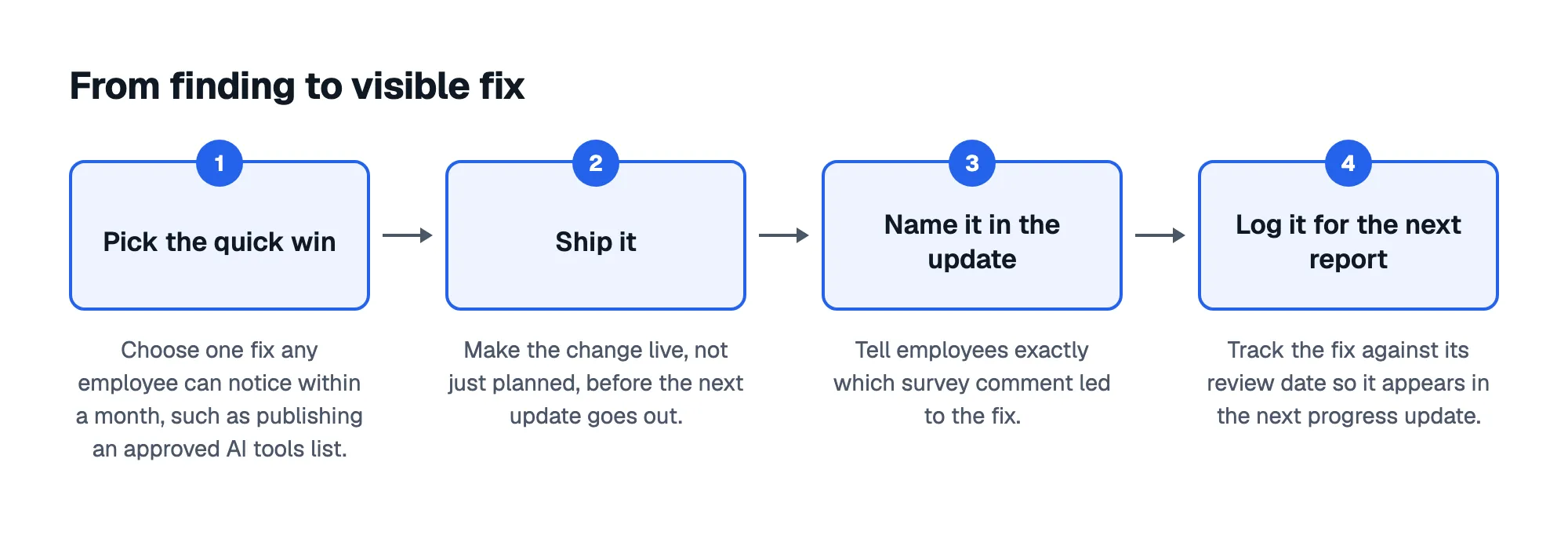
We'd rather see one small fix shipped in three weeks than a flawless roadmap that lands in month three. Momentum changes how the next survey gets answered.
Perceptyx's own analysis, published March 9, 2026, found that organizations mastering its listening-maturity differentiators saw 28% higher engagement scores and 19% lower turnover within 18 months. That's a correlation Perceptyx reports from its own data, not a proven cause, so treat it as a reason to keep going, not a promised outcome.
Sources: Employee Survey Action Planning: Key Roles & Owners
Close the loop before the next AI adoption survey

In our view, a visible 30-day cadence does more for next-wave response rates than any single perfect announcement. Report progress through the same channels you used to launch the survey, including the ones that reach frontline and non-desk teams.
Before the next AI adoption survey goes out, update your employee survey action plan with what actually shipped, then run a short pulse check to confirm employees noticed. That pulse check also quietly signals another wave is coming, instead of surprising people with it.
Keep that next survey short and tied explicitly to what changed. If a question repeats, say why; if one drops, say why. Log perceived-impact and training-effectiveness answers as self-reported sentiment, not as measured productivity, when you report results internally. Before the next wave opens, run through this short checklist.
Frequently asked questions
Who should own the employee survey action plan after an AI adoption survey?
Pick the person closest to the problem, not the highest-ranking person in the room. If a finding spans multiple teams, split it into one owned action per team rather than naming a single owner for something no one person can actually fix.
How soon should we share AI adoption survey results with employees?
Share a partial update within two weeks even if full analysis isn't done. Acknowledge the themes you're already seeing and commit to a date for the full picture, rather than waiting until everything is polished before saying anything.
What counts as a quick win after an AI adoption survey?
Pick one or two fixes you can ship without budget approval or a vendor contract, not the biggest problem on the list. A quick win proves the loop works; save harder structural fixes for the 60- and 90-day marks.
How often should we report on the action plan once it's running?
Even with nothing new to report, send an update saying so and naming the next date. A skipped update reads the same to employees as no action at all, so keep the cadence going even during a quiet stretch.
Should the next AI adoption survey look the same as this one?
Change what you must and keep what you can compare. Dropping every question to seem fresh makes it impossible to track whether anything actually improved, so weigh comparability before you redesign the survey from scratch.
Sources: How to Share Employee Survey Results and Drive Action