
Skip the vendor framework, build the draft first
Your CPO wants a straight answer: which teams can already use AI well, and which can't. You open a vendor's AI skills library product and find generic entries like "prompt engineering" and "AI literacy" that don't match what your sales or engineering teams actually do all day.
The World Economic Forum's 2025 Future of Jobs Survey, which surveyed employers, found AI and big data ranked as the fastest-growing skill employers expect to need. Employers reported that expectation as a forecast; it signals urgency, not what your own team can already do today.
Common practice is to wait for a bought framework, or build one taxonomy for the whole company before anyone uses it. That gets you coverage and shared language fast. It falls short when the labels don't match real work, and the rollout stalls before anyone touches it.
We think buying a framework before testing it against one real workflow is backwards: people end up training against labels nobody recognizes from their actual job.
Independent HR analyst Josh Bersin, writing in 2023, recommends starting taxonomy work from one concrete business problem instead of an enterprise-wide build. This editorial exercise follows that advice: build a first-draft AI skills library for a single team before buying or scaling anything.
Sources: 3. Skills outlook - The Future of Jobs Report 2025 | World Economic Forum, Building A Skills-Based Organization: The Exciting But Sober Reality – JOSH BERSIN
What you need before you start

Before you start building your AI skills library, you need three things: one team willing to pilot a draft, two to three uninterrupted hours, and someone who understands the target use case, such as a marketing manager running AI-assisted drafting.
Udemy Business, a corporate training vendor, recommends pulling skills data from multiple existing sources instead of inventing a list from scratch: self-assessments, manager evaluations, project histories, and performance data.
| Input | Source | Why it helps |
|---|---|---|
| Self-assessments | Team members | Shows what people believe they can do |
| Manager evaluations | Direct managers | Flags gaps self-ratings miss |
| Project histories | Recent work samples | Grounds skills in real tasks |
| Performance data | Existing reviews | Adds an outside check on the list |
Sources: How to Build a Skills Taxonomy for Your Workforce
Build the draft in six steps

With inputs in hand, work through six steps in order. Each one is a specific decision, not a long discussion.
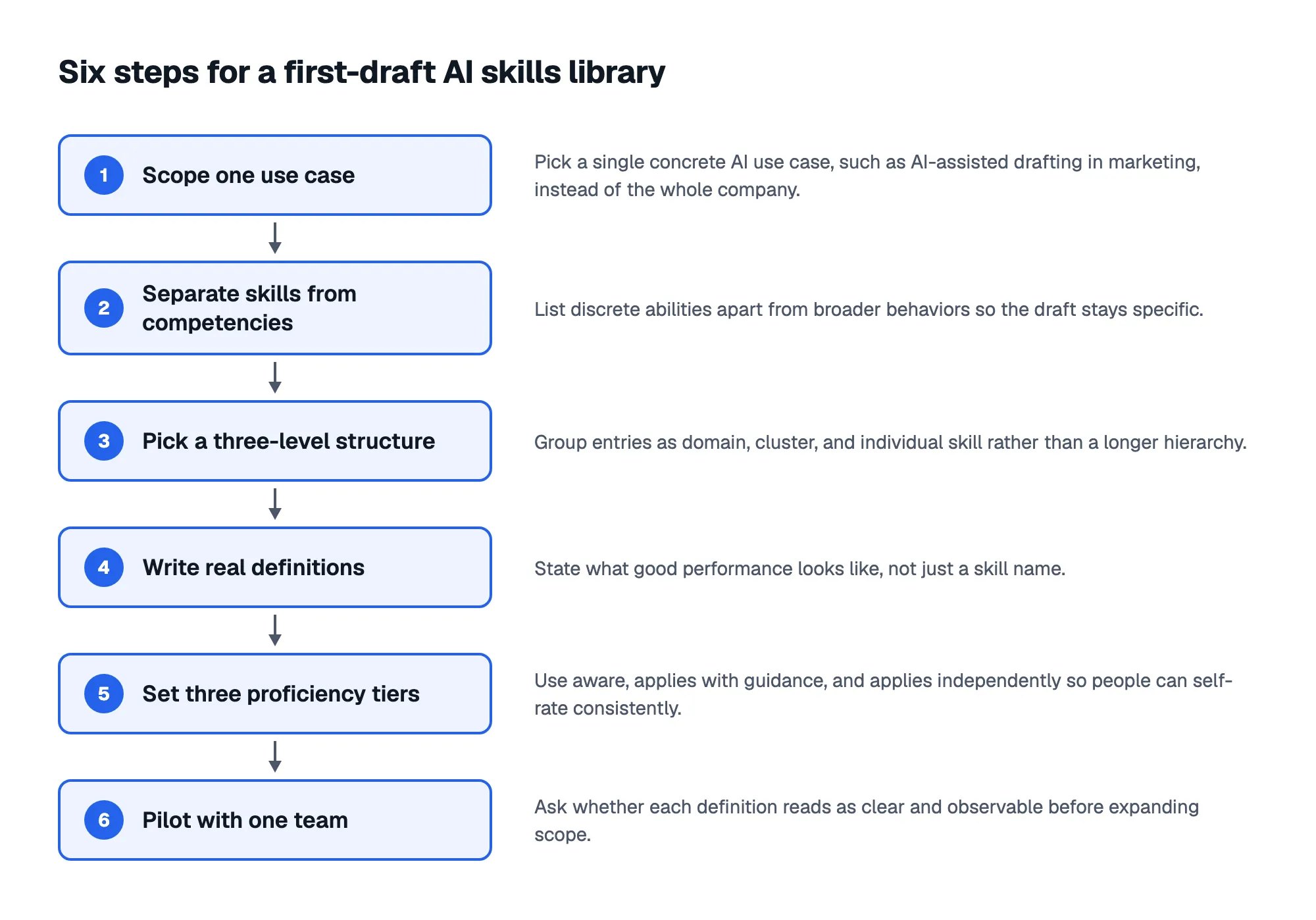
A three-level hierarchy, domain, cluster, skill, is what taxonomy consultancy Upside Learning recommends for most enterprise contexts; going deeper tends to break down. The same guidance suggests writing each entry as verb plus object plus context plus standard, so a reader knows which AI skills to learn first instead of guessing from a label.
Keeping skills and competencies distinct matters here. HackerRank's taxonomy guidance, from 2023, describes skills as specific knowledge and abilities, separate from competencies, which are broader behaviors applied in context. A draft that mixes the two gets harder to self-rate against.
At least one AI-native learning platform vendor claims, in a 2026 podcast interview, that its software can auto-generate a capability model for an organization that has none, as a shortcut past manual taxonomy work.
“So, you don’t have to do a manual skills taxonomy.”
— Josh Bersin, Founder and CEO of The Josh Bersin Company, described on the page as the world's foremost HR and learning technology authority · Source: Podcast 101: Inside AI-Native Learning Platforms with Josh Bersin - Talented Learning
We'd skip outsourcing the first draft to an automated capability model until you've tested one by hand against a real team's work. A few hours of manual effort teaches you more about what you're actually trying to measure than a generated list does.
Sources: What Is a Skills Taxonomy? Practical Guide to Skill Clarity, How to Create a Skills Taxonomy - HackerRank Blog, Podcast 101: Inside AI-Native Learning Platforms with Josh Bersin - Talented Learning
Keep the first draft small enough to finish

Time-box this to a few hours and one team, not the whole company. A sprawling first attempt is harder to pilot and harder to get honest feedback on.
Cap the list at roughly 15 to 20 skills for the first draft.
Udemy Business's taxonomy guidance recommends a review cycle tied to how fast the relevant skill area changes, quarterly or twice a year, rather than a fixed annual cycle. AI skills move faster than most areas; set the shorter end of that range.
Our view: a short list that actually gets piloted beats a comprehensive one sitting unused in a shared drive, even when colleagues ask for more detail up front.
Sources: How to Build a Skills Taxonomy for Your Workforce
What a usable AI skills library looks like
An example first-draft AI skills library for one use case, AI-assisted drafting in marketing, might look like the table below. Treat it as a hypothetical illustration, not a template to copy exactly.
| Domain | Cluster | Skill | Proficiency tiers |
|---|---|---|---|
| AI-assisted content | Drafting | Writes a usable first draft with an AI tool, given a brief and brand voice | Aware / Applies with guidance / Applies independently |
| AI-assisted content | Editing | Edits AI output for accuracy and tone before publishing | Aware / Applies with guidance / Applies independently |
| AI-assisted content | Judgment | Recognizes when a task needs a human draft instead of AI | Aware / Applies with guidance / Applies independently |
This is a hypothetical example to show structure, not a validated instrument or a result from any team. Pilot your own version with the team you scoped in step one, and expect to rewrite half of it after the first round of feedback.
We're optimistic that a rough, team-specific draft like this tells you more about where to put training than a generic enterprise taxonomy does.
Sources: What Is a Skills Taxonomy? Practical Guide to Skill Clarity
Where ongoing measurement picks up from here
Once your first-draft AI skills library has been piloted and revised, hand-building a new version every quarter doesn't scale past one team.
That's where a recurring employee survey can take over: AI Adoption Score's Individual Skills Distribution maps each person's expertise so training gets allocated by an actual gap, not an assumption, across every team you add after the pilot.
Keep the manual draft as your starting language, not your permanent system. The next move is to test it, revise it once, then let ongoing measurement tell you where the gaps shift next.
Frequently asked questions
Who should own building the first-draft AI skills library?
The Head of L&D, or whoever owns the training budget, should own it, working directly with one manager from the pilot team who understands the chosen use case. Keep ownership narrow for the first draft so decisions move fast.
How long should the first draft actually take?
Aim for a few hours of focused work, not weeks. Time-boxing is what keeps the exercise from stalling; if it's taking longer, the scope is probably too wide and needs narrowing to one use case.
Should we just let an AI platform generate the taxonomy instead?
You can, but doing so skips the diagnostic value of building the list yourself: walking through each skill by hand surfaces gaps in how your team actually works that a generated model won't flag. If you still want to try auto-generation, treat its output as one more input to review, not a finished taxonomy.
What's the difference between a skill and a competency in this draft?
A skill here is a specific, observable action, like editing AI output for tone, while a competency bundles several skills into a broader job expectation, like overall content judgment. Stick to skills for a first draft and save competency bundling for later, once you're combining drafts across teams.
How often should we revisit the first draft?
Set a review trigger around events, not just a calendar: a new AI tool rolling out, a pilot team flagging unclear definitions, or a shift in the use case you scoped. Treat the 60 to 90 day date as a backstop review if none of those triggers happens sooner.
Sources: Podcast 101: Inside AI-Native Learning Platforms with Josh Bersin - Talented Learning, How to Create a Skills Taxonomy - HackerRank Blog, How to Build a Skills Taxonomy for Your Workforce