

An AWU isn't an accepted business outcome
Your board asks whether Salesforce Agentic Work Units prove that AI is delivering useful work. Start with the distinction in Salesforce's February 25, 2026 explanation: an AWU represents a discrete agent task, which can include processing a prompt, completing a reasoning chain or invoking a tool.
CIO's February 27, 2026 reporting quotes Salesforce CMO Patrick Stokes explaining that one business outcome can require many AWUs. Counting those actions therefore doesn't give you a count of accepted business outcomes.
We think counting execution is a useful start, but calling it value skips the decision that matters: whether the work meets your acceptance criteria. Use AWUs as an activity signal, not a verdict on business impact.
Sources: The Agentic Work Unit: Converting Raw Intelligence into Real Work, AWU by Salesforce: A shiny new metric that tells CIOs little of value | CIO
How Salesforce counts AWUs needs scrutiny

Salesforce's February 25, 2026 results release reported 2.4 billion AWUs delivered to date across Agentforce and Slack. That is Salesforce's cumulative count; the precise cutoff for “to date” is unspecified.
In CIO's February 27, 2026 reporting, Moor Insights and Strategy analyst Robert Kramer assesses Salesforce Agentic Work Units as measuring execution rather than accuracy. His criticism puts Salesforce AWU metric limitations in focus: an action count doesn't establish whether its output was correct.
Treat the February 2026 descriptions as a starting point, rather than a reproducible counting specification or confirmation of today's implementation. These February 2026 disclosures do not establish independently verified accuracy or comparability across deployments. We'd ask for the following counting details before comparing totals.
Sources: The Agentic Work Unit: Converting Raw Intelligence into Real Work, Salesforce.com, Inc. - Salesforce Delivers Record Fourth Quarter Fiscal 2026 Results, AWU by Salesforce: A shiny new metric that tells CIOs little of value | CIO
Make inference to work an acceptance test

For your evaluation, turn the Salesforce inference-to-work question into an acceptance test: what happened between model processing and a result your business accepts? We'd keep token consumption, counted actions and accepted outcomes separate, then inspect the connections between them.
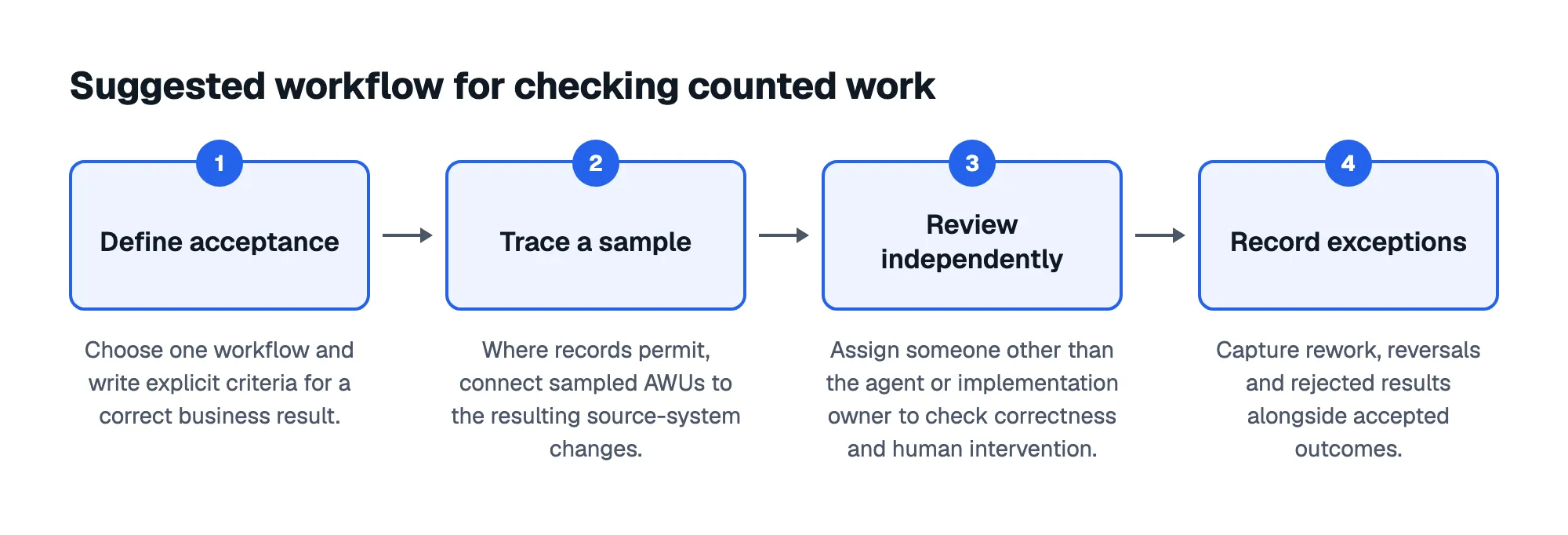
The following is our suggested verification workflow, not a validated standard. Imagine a service team using an agent to update customer records: acceptance could mean the intended fields changed correctly, with no unauthorized edits.
Keep volume separate from quality and cost

Build your scorecard around distinct questions. Our suggested framework below keeps Salesforce Agentic Work Units visible without letting their volume stand in for acceptance, speed or economics.
| Measure | Question | Suggested evidence |
|---|---|---|
| AWU volume | How much activity was counted? | Supplier count and counting rules |
| Accepted outcomes | What met your criteria? | Reviewed source-system records |
| Quality failures | What needed correction? | Rework and reversal records |
| Cycle time | How long did completion take? | Consistent start and acceptance timestamps |
| Cost per accepted outcome | What did accepted work cost? | Defined total costs divided by accepted outcomes |
Compare similar workflows and disclose changes in task mix. Treat before-and-after differences as descriptive unless your evaluation supports causal attribution.
Choose the evidence your decision needs
In our view, your next measurement should answer the unresolved decision, rather than add another total. If acceptance is uncertain, inspect work; if employees need help, investigate capabilities and obstacles.
AI Adoption Score's AI Skills Distribution maps self-reported capabilities and willingness to help colleagues. Those reports aren't independent verification of expertise or causal productivity evidence.
Give the next check an owner and a defined workflow.
Frequently asked questions
Who should own the acceptance criteria?
Assign ownership to the business role accountable for the workflow's result. As editorial guidance, involve operations and risk colleagues where relevant. Agree how disagreements will be resolved before reviewing agent-produced work, including who makes the final decision when business owners and technical reviewers interpret a requirement differently.
How often should we review the scorecard?
Choose a cadence that matches the workflow's risk and rate of change. We suggest reviewing after material changes to agent behavior, acceptance rules or counting definitions, with routine checks between changes. Keep the review conditions consistent enough that a difference in results has an interpretable context.
What should finance agree before an ROI review?
Agree on accepted benefits, attributable costs and a comparison before starting the review. As editorial guidance, ask finance to specify the evaluation period, which implementation and operating costs belong in scope, and how uncertain benefits will be treated. Document those choices before interpreting the financial result.