
AI board reporting should support a decision
Your board sees more AI licenses deployed, then asks, "Are people actually using what we've bought?" If regular use looks uneven, your AI board reporting needs to connect access, employee practice and the decision you're asking directors to support.
Deployment-led updates get something right: access matters. Microsoft's Copilot documentation distinguishes enabled users through licensing from active users through a user-initiated feature within a selected period. That activity definition doesn't establish repeated use.
We'd lead with an adoption-led update and retain a compact deployment section. Make the intervention decision the headline, with rollout progress as supporting context.
Sources: Microsoft Copilot Usage Report - Microsoft 365 admin | Microsoft Learn
Compare the decisions each approach supports

Deployment-led and adoption-led are editorial reporting approaches here, not standardized frameworks. This comparison is our editorial recommendation, not a tested ranking of board-update effectiveness. Use the criteria below to decide what your AI board reporting should emphasize.
| Criterion | Deployment-led update | Adoption-led update |
|---|---|---|
| Decision usefulness | Where to extend or adjust access | Which obstacle to investigate and address |
| Evidence quality | License records and defined activity windows | Repeat-use observations and employee feedback |
| Limitations | Needs a separate recurrence measure | Feedback needs checking; recurrence needs a definition |
Sources: Microsoft Copilot Usage Report - Microsoft 365 admin | Microsoft Learn, AI in the Workplace: What Separates Adopters and Holdouts
Define recurrence before presenting progress

For AI board reporting, choose a recurring-use criterion that fits the work being assessed before presenting a trend. Ask, "What pattern of use would count as recurring practice for this team?"
As an editorial example, you could define recurrence as activity in each reporting week for a role with weekly AI-suitable tasks. That's a proposed rule, not a validated threshold. Report the eligible population, denominator, window and tool coverage beside it.
We think a stable definition is more useful than a flattering total. Compare similar roles over time, and flag changes in respondents or tool coverage before interpreting movement.
Turn barriers into a bounded request

Gallup's February 2026 study of U.S. employees suggests why access alone leaves a question unanswered: employees with AI available still reported habits as an obstacle. Employee reports describe perceived barriers, not proven causes; repeated self-reports also don't independently verify sustained behavior.
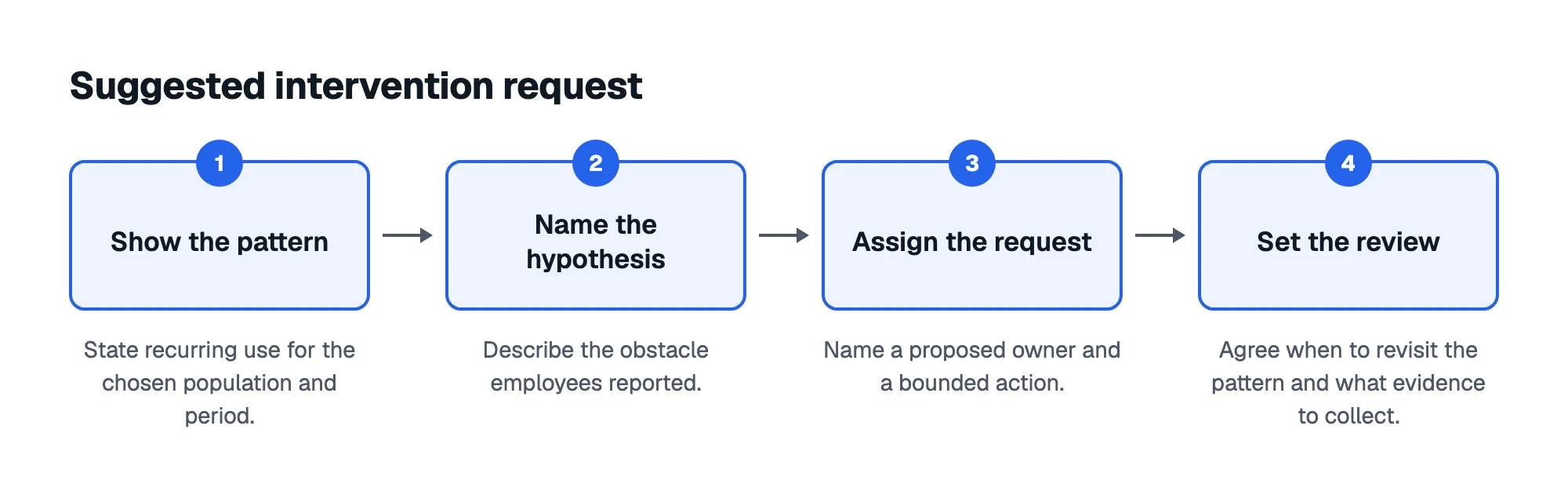
Imagine a sales team with broad access but patchy recurring use. A suggested board request could connect an observed pattern to a reported obstacle, an owner and a review point. Use this editorial sequence to keep the request specific.
Keep perceived impact and financial outcomes in separate rows of your update. A reported improvement can justify investigation; it shouldn't become a savings claim without separate financial evidence.
Sources: AI in the Workplace: What Separates Adopters and Holdouts
Ask for an action you can revisit
AI Adoption Score's 360° AI Maturity Assessment gives people, teams and the organization a maturity level across Usage, Skills, Impact, Culture and Vision. Its round comparisons can support a repeatable adoption baseline for your board update.
AI Adoption Barriers identifies reported obstacles and who can remove them. It isn't a validated scale, and its top-five lists always fill, so check the substance before turning a ranking into a spending request.
We'd close the update with the action you want approved and the evidence you'll bring back. Give the board a decision it can revisit.
Sources: 360° AI Maturity Assessment: how it works · AI Adoption Score
Frequently asked questions
Who should own the board update?
Give one AI program owner responsibility for assembling it. As editorial guidance, ask IT to confirm access definitions, team managers to explain work patterns and finance to review any monetary claims. Keep those contributions distinct so directors can see who stands behind each part of the evidence.
How often should we refresh the evidence?
Choose a cadence that matches the decision and allows enough time for the proposed action to take effect. Keep the board schedule separate from operational checks. Investigate emerging issues between meetings, and schedule the next evidence review when you assign the action, rather than waiting for the next board deadline.
How should we present evidence we don't have?
Mark it as unknown and explain what would resolve it. As editorial guidance, distinguish evidence you haven't collected from evidence you can't currently obtain. Name an owner and a collection date where feasible, and tell directors whether the missing information should delay the decision or limit its scope.