How Is AI Used in the Workplace? Why Tool Logins Fall Short
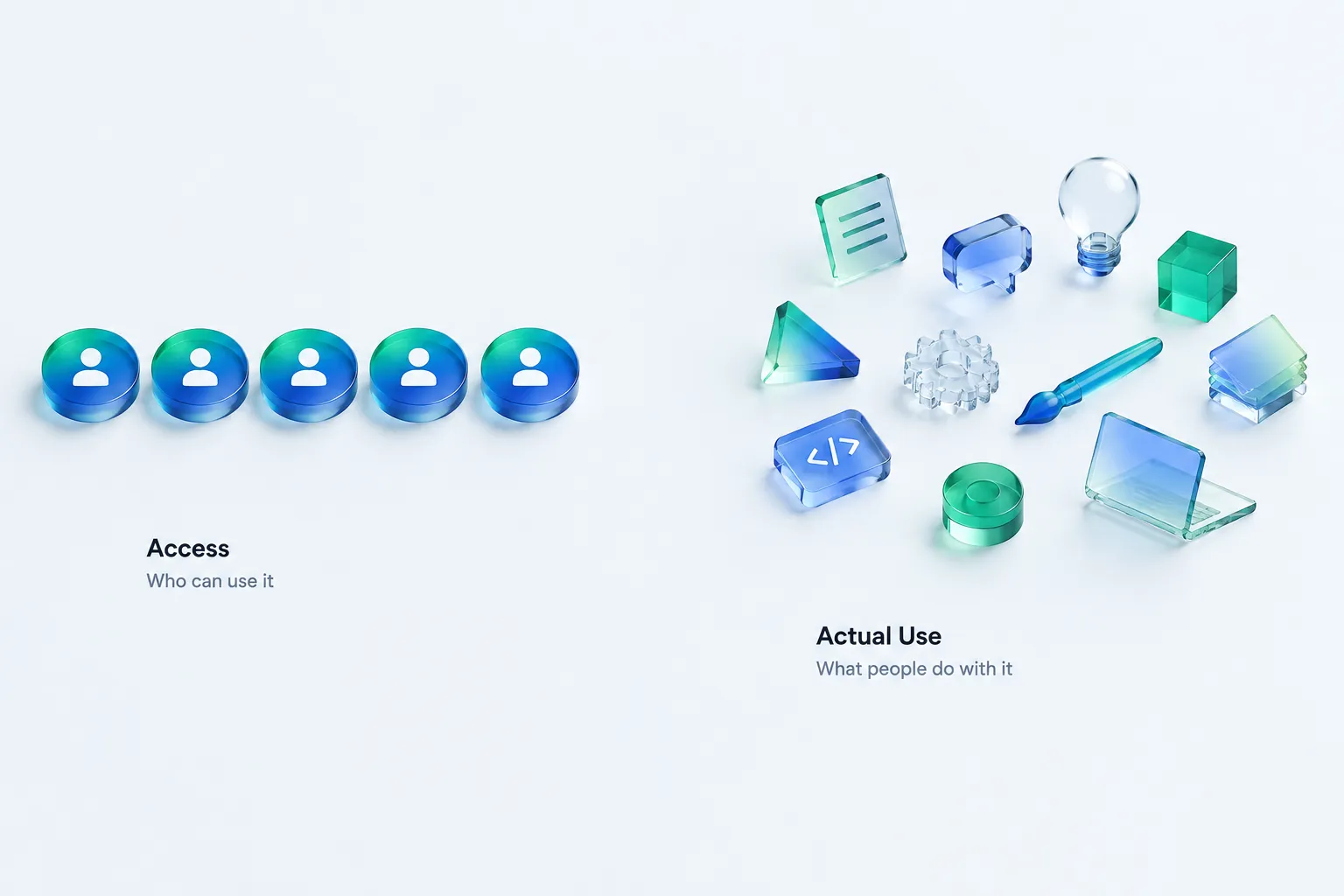
If you're a CIO or CTO trying to answer how is AI used in the workplace, your first instinct is probably to pull license and login data from your AI vendors. That tells you who has access and how often they authenticate, but it stops there.
Gallup's workplace research points out that broad organizational rollout of AI does not guarantee individual use: implementation doesn't guarantee use, even when access is widespread across a company.
“If leaders want greater AI adoption, they will have to help employees find the value.”
— Ryan Pendell, Senior Workplace Science Editor at Gallup, author of the article · Source: AI Use at Work Has Nearly Doubled in Two Years
A March 2026 Epoch AI and Ipsos survey of 2,021 respondents found that among employed Americans who had used AI recently, half reported using it at least as much for work as for personal tasks.
That kind of split, work use versus personal use, or a single trial versus daily reliance, is invisible in login counts. It only surfaces when you ask employees directly.
Sources: Global Indicator: Artificial Intelligence - Gallup, Half of employed Al users now use it for work
What Employee Surveys Add to the Picture
Surveys close the gap that login data leaves open. Instead of counting authentications, a well-designed employee survey asks directly how is AI used in the workplace: which tasks, how often, and with what perceived effect.
The table below sketches where telemetry stops and where survey questions pick up, based on the kinds of signals recent workplace research has examined.
| Signal | What login or license data shows | What an employee survey adds |
|---|---|---|
| Usage frequency | Number of authentications or active sessions | Self-reported frequency band and typical use occasions |
| Task type | Not captured | Which activities employees say they use AI for |
| Perceived barriers | Not captured | Reasons employees give for not using AI more, such as an unclear use case |
| Manager support | Not captured | Whether employees feel encouraged or coached by their manager to use AI |
Sources: How Gallup Developed Global Survey Questions About AI, Global Indicator: Artificial Intelligence - Gallup, AI Use at Work Has Nearly Doubled in Two Years
Usage Frequency and Task-Level Detail
Before Gallup could ask employees how they use AI at all, its research team had to fix a wording problem. A small cognitive-interview pretest across four countries found that an abstract definition of AI confused respondents.
Gallup's revised approach instead describes AI through concrete use cases and named tools, such as writing text, creating images, audio or video, or answering questions, rather than an abstract concept.
The same pretesting found that a single 'daily' usage category was too broad to distinguish meaningfully different types of users, which pushed Gallup toward a more granular frequency scale.
These are useful starting points for question design, not a validated survey instrument, but they illustrate the kind of specificity that helps employees answer accurately.
- Ask how often employees use AI for work tasks using several frequency bands, not just a daily-or-not split
- Ask which specific tasks employees use AI for, such as drafting text, summarizing documents, or analyzing data
- Ask which named tools employees rely on most, rather than asking about AI in the abstract
Sources: How Gallup Developed Global Survey Questions About AI
Manager Support and Organizational Integration Signals
Manager behavior appears to matter for how often employees actually use AI, based on Gallup's workplace research linking manager engagement with more frequent tool use.
“Manager enablement is critical to turning AI investment into real business value.”
— Andy Kemp, Research Analyst at Gallup, author of the article · Source: Global Indicator: Artificial Intelligence - Gallup
This suggests a workplace survey is more useful when it also asks whether employees feel their manager encourages, models, or coaches AI use, rather than only asking whether the company has rolled tools out.
As noted earlier, having AI available across an organization does not by itself ensure employees adopt it; manager-level signals help explain part of that gap.
Sources: Global Indicator: Artificial Intelligence - Gallup
How Reliable Are Self-Reported AI Impact Numbers?
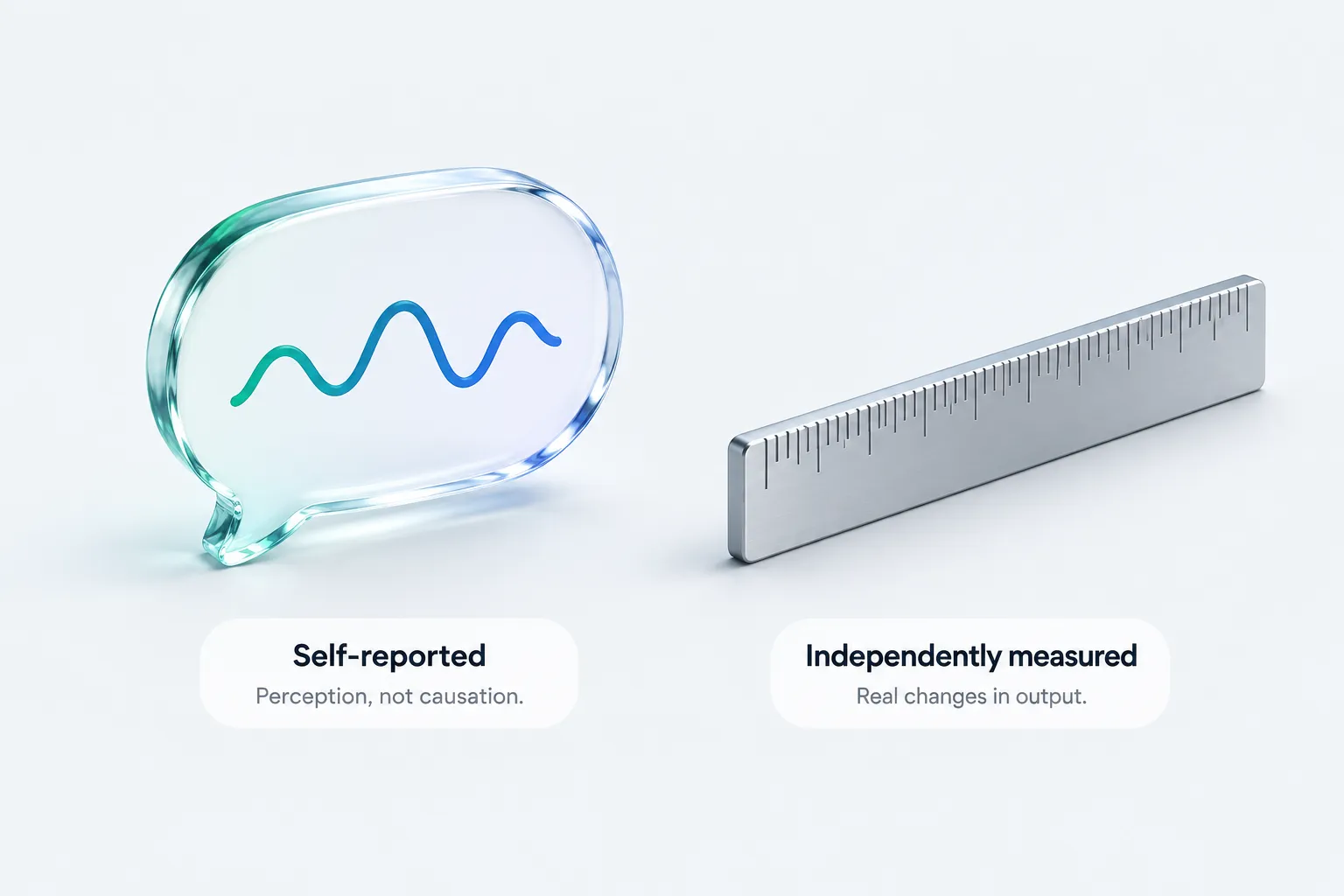
How to read these results: employee surveys measure perception, not causation. When someone reports that AI made them twice as productive, that describes what they believe happened, not an independently verified change in output.
METR's own research explicitly cautions that self-reported estimates of AI's productivity impact are not necessarily accurate reflections of real-world effects.
METR fielded this work between February and April 2026 among 349 technical workers, according to METR's 2026 survey, covering software engineers, researchers, academics or PhD students, and founders or managers.
METR also flags that its sample likely carries meaningful selection bias: roughly 70% of respondents were paid to participate, and the response rate to emailed invitations was only about 2%.
Sources: Measuring the Self-Reported Impact of Early-2026 AI on Technical Worker Productivity - METR
Self-Reported Value vs. Self-Reported Speed Gains
Some surveys ask about AI's impact using different framings, such as how much more value someone feels their work created versus how much faster a task went. Both are self-reported estimates, and the specific framing a survey uses can shape the answer employees give.
These figures carry the same limitations described above: they reflect employees' own impressions rather than independently verified output, and they come from samples that may not represent typical AI use.
For a workplace survey, treat any such multiplier, however it is framed, as one signal for identifying where employees feel AI helps most, not as a validated measurement of productivity change.
Sources: Measuring the Self-Reported Impact of Early-2026 AI on Technical Worker Productivity - METR
Building a Combined Measurement Approach
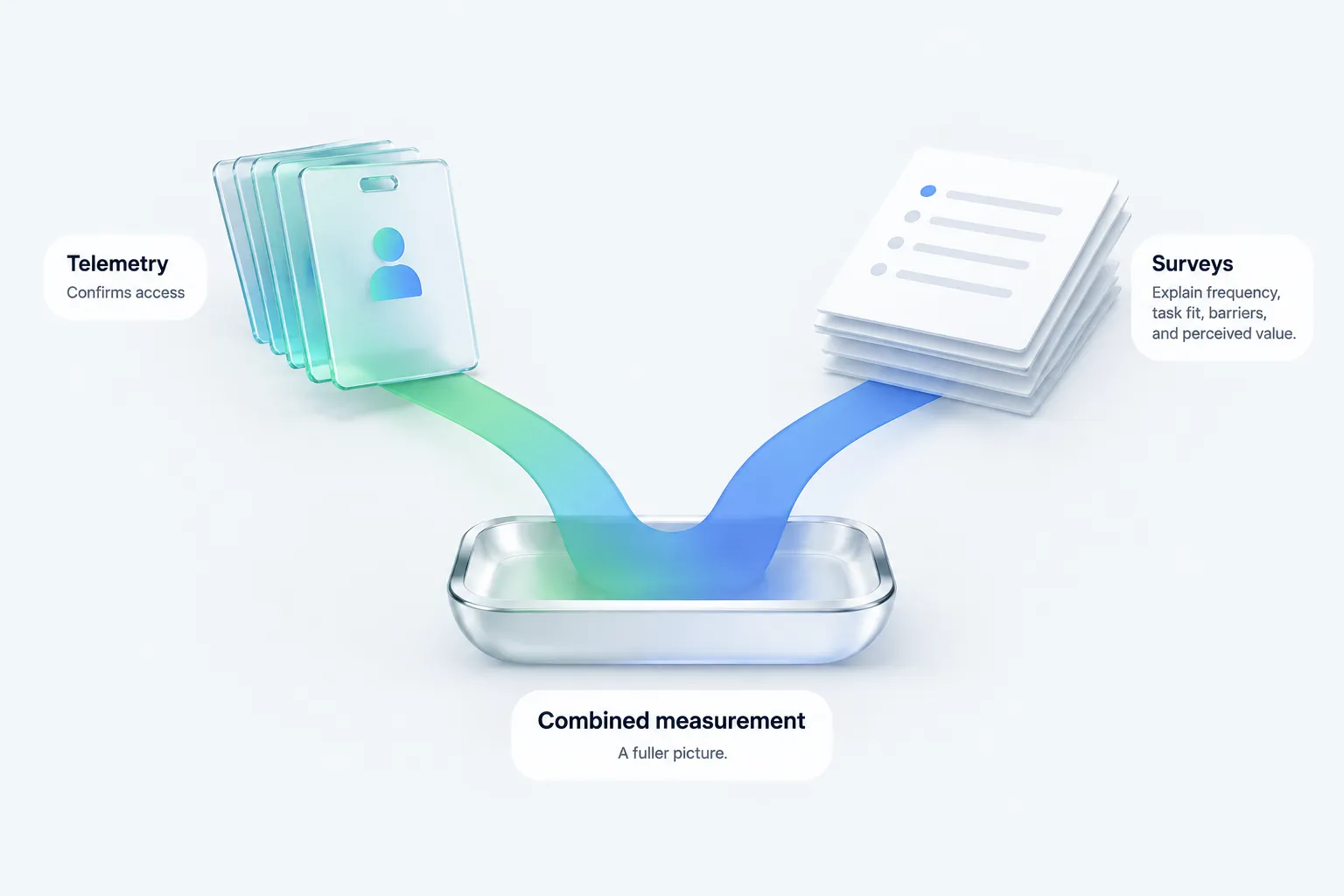
A combined approach treats telemetry and surveys as complementary, not interchangeable. Telemetry confirms access; surveys explain frequency, task fit, barriers, and perceived value.
Gallup's panel research found that employees most often cite an unclear use case or value proposition as the top barrier to using AI more, ahead of other obstacles employees might report.
Sources: AI Use at Work Has Nearly Doubled in Two Years
Putting It Into Practice
For a CIO or CTO, the practical question is how is AI used in the workplace across your own teams, not just how many seats are activated. Answering that takes both data types working together.
The stages below sketch one way to sequence that work, drawing on the design choices and barrier data discussed above.
Sequencing a combined AI usage measurement effort
- Define concrete use cases: Describe AI use with named tools and specific tasks rather than an abstract definition, since vague wording has confused survey respondents in testing.
- Field a structured survey: Ask about frequency, task type, barriers, manager support, and perceived impact within one instrument.
- Segment the results: Break findings down by role, seniority, and tool access tier to see where usage and barriers differ.
- Compare with telemetry: Set survey findings alongside login and license data to see where perception and access diverge.
- Repeat on a cadence: Schedule a follow-up survey to check how usage and perception have changed since the last round.
Sources: How Gallup Developed Global Survey Questions About AI, Global Indicator: Artificial Intelligence - Gallup, AI Use at Work Has Nearly Doubled in Two Years
Frequently asked questions
Who inside the organization should own this kind of AI usage survey?
Ownership typically sits with whoever is accountable for AI strategy or workforce enablement, such as a CIO, CTO, or Head of L&D, working with People or HR teams to distribute the survey and interpret results across departments.
How often should we re-run an AI usage and perception survey?
Editorial guidance suggests a quarterly or semi-annual cadence, since reported AI usage patterns have shifted over short periods in recent workplace research; a single one-off survey risks describing a moment that has already passed.
Should we survey every employee or a representative sample?
A full census gives segment-level detail by role, seniority, and tool tier without sampling assumptions, but a representative sample is a reasonable alternative for very large organizations where full coverage isn't practical.
Can survey results replace tool usage telemetry entirely?
No, they complement it. Telemetry only captures activity inside tools your organization has licensed, so it misses unsanctioned or free-tier AI use entirely; a survey can ask employees directly what they use, regardless of official access.
What should we do if self-reported productivity gains look inflated?
Treat the figure as a signal of where employees feel value or friction, not as a verified output measurement, and check it against any independent performance data you already track before drawing conclusions.
Sources: Measuring the Self-Reported Impact of Early-2026 AI on Technical Worker Productivity - METR