
What Counts as an AI Skill Today?
Ask five people what AI skills are in demand and you will likely get five different answers, because the term covers two very different kinds of ability. Sorting between them is the first step toward a training plan that targets a real gap.
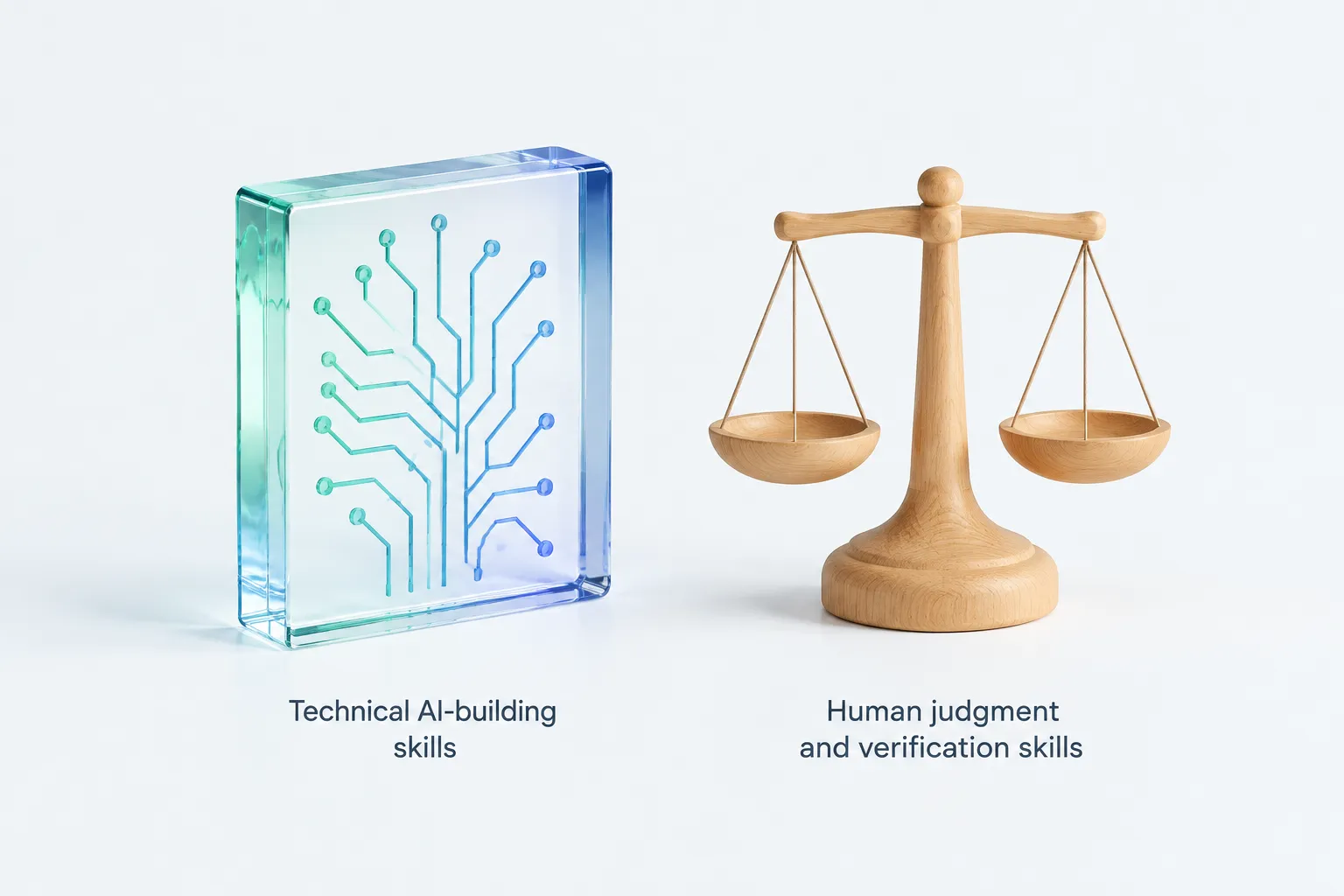
The first bucket is technical AI-building skill: knowing how to use, configure or develop AI systems directly, from prompt engineering to working with large language models. The second bucket is AI-augmented human skill, meaning judgment about when to trust, verify or override an AI-generated output.
Most employees need some of the second bucket even if they never touch the first. The skills required for AI engineer roles sit mostly in the first bucket, while most other employees need more of the second. Knowing which AI skills in demand belong to which bucket determines whether training should focus on tool mechanics or on judgment and verification.
What the Data Says About AI Skills in Demand
Understanding what AI skills are in demand starts with how employers describe their own hiring and training priorities. Employers surveyed for the World Economic Forum's Future of Jobs Report rank AI and big data as the fastest-growing skill category through 2030, ahead of many other technical and human skills.
That growth expectation is pushing employers toward action: a large majority surveyed say upskilling their workforce is now a top priority as skill needs shift.
The shift is reaching entry-level hiring too, according to a NACE survey of 185 respondents, mostly NACE employer members, focused on entry-level hiring; the findings may not generalize across all companies or seniority levels.
Employer respondents reported that AI-skill requirements for entry-level jobs have grown sharply in a short period, and that employers are already assigning interns project work that uses AI tools.
“more than one-third of entry-level jobs require AI skills”
— Mary Gatta, Director of research and public policy for NACE (National Association of Colleges and Employers), with over 20 years of teaching, research, and advocacy experience in career education and workforce development · Source: Demand for AI Skills in Entry-level Jobs Nearly Triples Since Fall 2025
Separately, platform data on hiring and skill additions points to two distinct trends: growth in technical and strategic AI skills such as prompt engineering and large language model work, and separate growth in AI business-strategy skills as companies integrate AI into products and processes. These are reported as two different rising skill clusters, not a single expanded role description.
Even so, comfort with AI tools has limits. Software developers who use AI daily still show the most reluctance to hand AI full control of high-responsibility, systemic tasks such as deployment and monitoring, suggesting technical fluency and willingness to delegate judgment are not the same thing.
| Skill category | What it looks like | What employers report |
|---|---|---|
| Technical AI-building skills | Prompt engineering, working with large language models | Fastest-growing technical and strategic skill category reported |
| AI-augmented judgment | Deciding when to trust, verify or override AI output | Developers who use AI daily still resist full delegation on high-responsibility tasks |
| Entry-level AI requirement | Job postings and descriptions requiring AI skills | Reported to apply to more than a third of entry-level roles, per a small NACE survey |
| Intern AI project work | Interns assigned AI-related project work | Reported by employers in the same small NACE survey, without a specific share given |
Sources: The Future of Jobs Report 2025 | World Economic Forum, Demand for AI Skills in Entry-level Jobs Nearly Triples Since Fall 2025, Skills on the Rise: The Fastest-Growing Skills in 2026, AI | 2025 Stack Overflow Developer Survey
Self-Reported Confidence vs. Verified Skill Levels
Most of the findings above come from surveys asking employers or employees to describe their own plans, perceptions or comfort levels, not from independent tests of applied skill. A survey can tell you what people believe or intend, but not whether a skill has actually been learned or applied on the job. Keep that distinction in mind whenever you read a percentage in this space.
The pattern shows up clearly among developers. Developers who use AI agents at work reported a perceived increase in productivity.
Sentiment is shifting too. Most developers surveyed still do not see AI as a threat to their jobs, though that confidence softened slightly year over year.
For a Head of L&D, the practical takeaway is not to discard self-reported data, but to treat it as a starting signal that needs corroboration before it drives training budget decisions.
Sources: AI | 2025 Stack Overflow Developer Survey, Stack Overflow’s 2025 Developer Survey Reveals Trust in AI at an All Time Low - Press release - Stack Overflow
A Practical Approach to Checking Whether Your Workforce Has These Skills
Before deciding what AI skills are in demand inside your own organization, collect the same kind of signal employers report externally, but scoped to your own teams and departments rather than only IT or engineering.
A structured employee survey can capture current AI usage, self-rated skill and confidence levels, and perceived barriers across every function, since market data suggests demand is spreading well beyond technical roles.
Sources: The Future of Jobs Report 2025 | World Economic Forum, Skills on the Rise: The Fastest-Growing Skills in 2026
Turning Survey Results into Targeted Training Decisions

Once you have workforce-level data on usage, confidence and barriers, the next step is deciding where to intervene rather than rolling out one generic AI training program for everyone.
None of the sources here validate a single scoring method, but together they suggest a general sequence: identify low-usage or low-confidence clusters, prioritize training there, and re-check results after training rather than assuming the gap closes on its own.
From survey signal to targeted training
- Segment: Split results by function, seniority and tenure since expectations differ sharply between entry-level and experienced staff.
- Corroborate: Cross-check self-reported confidence against manager observation or completed skills modules before treating it as verified.
- Prioritize: Direct training toward clusters showing low usage, low confidence or reluctance to apply AI, instead of a blanket rollout.
- Re-measure: Repeat the survey on a set cadence, such as every six months, to see whether targeted training is closing gaps.
Frequently asked questions
Who should own an AI skills survey, L&D or IT?
Ownership works best as a shared effort: L&D typically designs and interprets the survey since it feeds training decisions, while IT or a digital transformation lead can validate which tools and use cases to ask about. Neither function alone captures the full picture across departments.
How often should we re-run an AI skills survey?
AI-skill demand is reported to shift on a year-over-year basis in platform hiring and skill-addition data. If results stay stable across two consecutive survey cycles, stretching the interval is reasonable; if tool adoption is moving quickly in your organization, shorten it instead of defaulting to a fixed schedule.
Should the survey cover every department or just technical teams?
Yes, extend it beyond technical teams. When rolling it out more broadly, adjust question wording so non-technical staff can answer without engineering jargon, and consider staggering departments so teams that have not yet piloted any AI tools are not overwhelmed by the first round.
How much employee time should an AI skills survey take?
There is no universally validated length, but keeping a survey short and focused, covering usage, confidence and barriers, makes it more likely employees across busy departments will complete it honestly rather than skipping questions.
Sources: Skills on the Rise: The Fastest-Growing Skills in 2026