
What Are AI Skills, and Why Define Them First
Before you can measure anything meaningfully, you need to answer a simpler question: what are AI skills in your organization? Different teams often mean very different things by the phrase, and that gap quietly undermines any assessment built on top of it.
A useful reference point comes from SFIA, a skills and competency framework, which describes AI-related skills as enduring capabilities tied to tasks and levels of responsibility rather than to specific AI tools or technologies.
The same framework explicitly extends this thinking beyond AI specialists, stating that non-specialist professionals also need a foundational level of AI literacy to apply the technology responsibly within their own domain.
If L&D skips this step, an assessment risks measuring who has tried a chatbot rather than who can apply AI output responsibly to real work, which weakens every training or policy decision that follows.
Sources: SFIA - a framework for AI skills — English
Two Layers to Separate: Baseline AI Literacy vs. Role-Specific AI Skills
One practical starting point is a national reference: the U.S. Department of Labor published an AI Literacy Framework intended as a resource for organizations designing their own workforce AI-skills programs.
That guidance defines AI literacy as a foundational set of competencies for using and evaluating AI technologies responsibly, distinct from the deeper technical expertise needed to build or fine-tune AI systems.
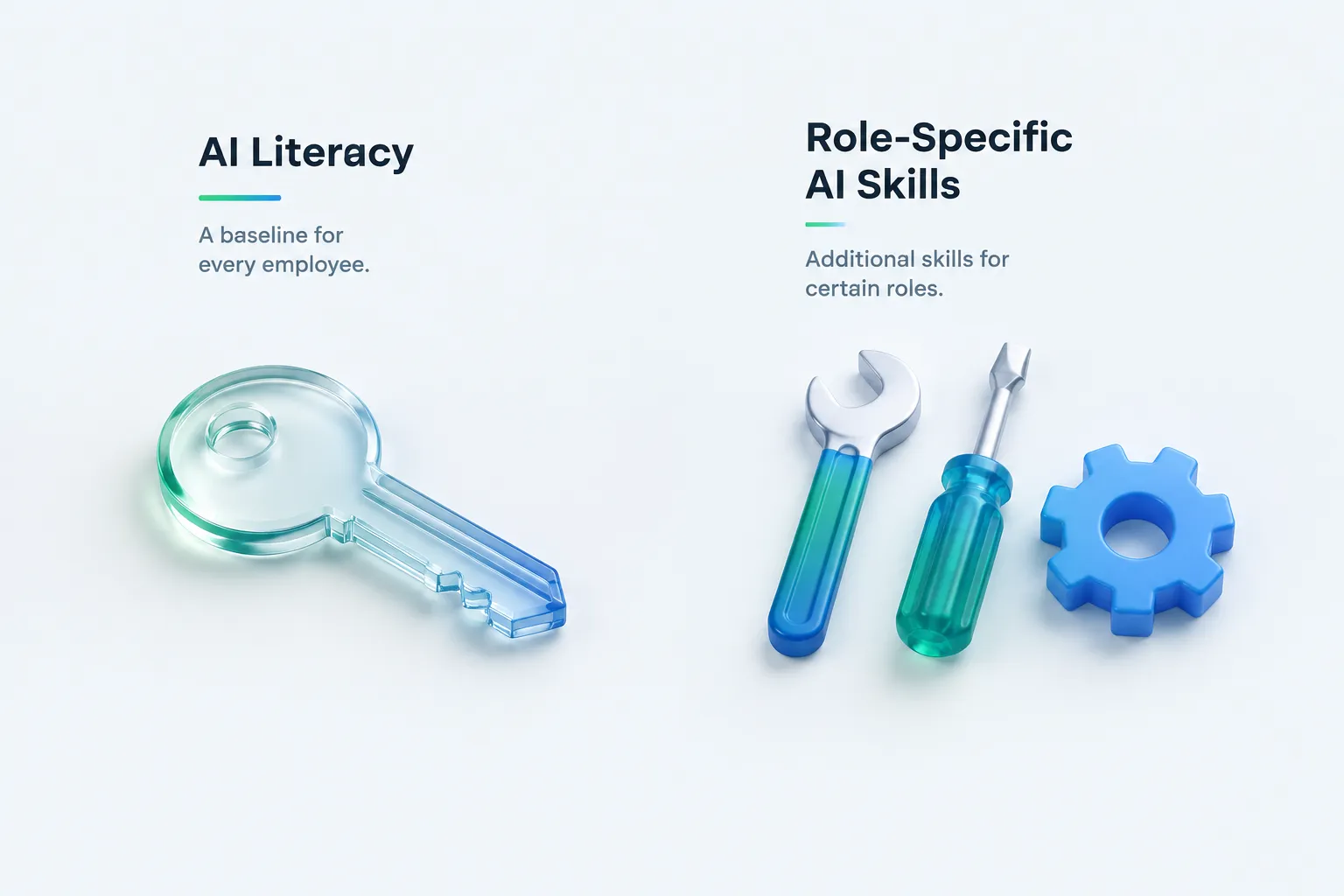
Crucially, the Department frames this foundational literacy as a baseline every employee needs for any job, while some roles require additional, more specific AI skills layered on top of that baseline.
| Layer | Definition | Example signal | Who it applies to |
|---|---|---|---|
| Baseline AI literacy | Foundational ability to use and evaluate AI tools responsibly | Employee can judge when AI output needs review before use | Every employee, regardless of role |
| Role-specific AI skills | Additional capability tied to a particular function's tasks | Marketer can brief and refine AI-generated campaign drafts | Only roles where AI materially changes daily tasks |
Sources: TEN 07-25 | U.S. Department of Labor, New DOL Guidance Encourages Employer ‘AI Literacy’ Training - Ogletree
What Frameworks and Industry Data Say About Defining These Skills
Beyond regulatory-style guidance, hiring-platform data offers another angle on how skill categories are shifting. Community reporting from LinkedIn's own profile and hiring data points to AI business strategy, the ability to integrate AI into products and processes, as a rising skill category distinct from technical AI or machine-learning skills.
How to read this: that pattern reflects skills people choose to add to their own profiles and employer hiring activity, not independently tested competencies. It's useful for spotting emerging categories, not for validating any individual employee's actual skill level.
On the enterprise side, one executive perspective argues for a shared skills taxonomy that links categories to concrete value areas, giving business, HR and technology leaders common language for what counts as a skill.
“A shared skills taxonomy, linked to value pools such as AI-enabled operations, industry-specific AI solutions or intelligent engineering”
— C. Vijayakumar, Chief Executive Officer and Managing Director, HCLTech, as stated on the page · Source: Invest in the workforce for the AI age: A blueprint for scale, skills and responsible growth | World Economic Forum
Sources: Skills on the Rise: The Fastest-Growing Skills in 2026, Invest in the workforce for the AI age: A blueprint for scale, skills and responsible growth | World Economic Forum
A Practical Way to Break AI Skill Into Assessable Categories
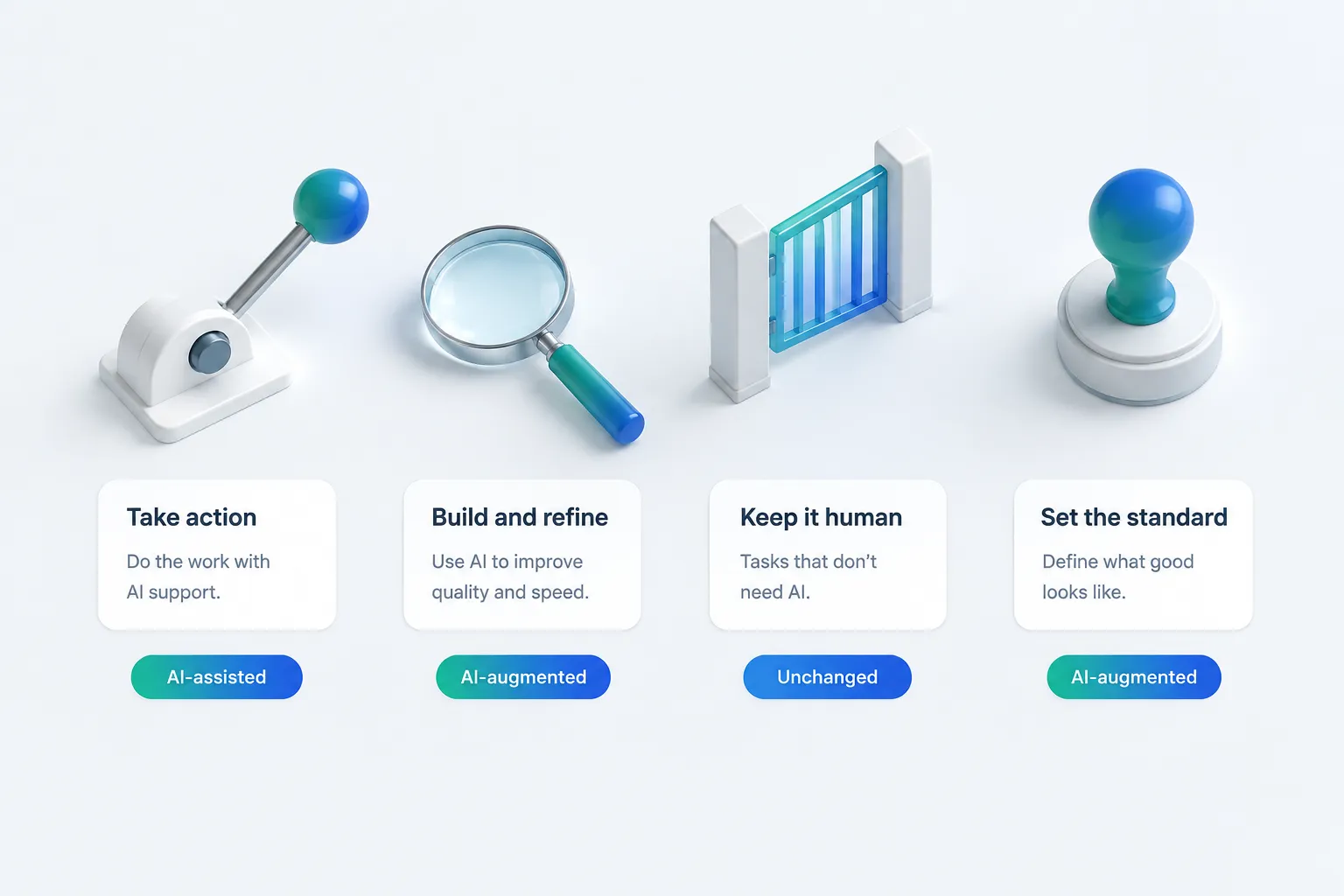
Once the two layers are set, translate what are AI skills into categories an assessment can actually measure. Describe each category by observable work behavior rather than naming a specific tool or platform, since tools change faster than the underlying skill.
Anchor every category to tasks your employees already perform, then classify which of those tasks are AI-assisted, AI-augmented or unchanged. This keeps the definition grounded in real work instead of abstract fluency claims.
Common Pitfalls That Make AI Skill Definitions Too Vague
Several habits quietly weaken a definition of what are AI skills before an assessment is even built. Watching for these early saves rework once surveys or training plans depend on the categories.
The most common issue is reaching for catch-all labels like AI fluency instead of graded levels of autonomy that distinguish basic use from independent judgment over AI output.
- Naming specific tools or products instead of describing the underlying behavior
- Writing the definition inside L&D alone, without input from function leads who see daily AI use
- Using single catch-all terms like AI fluency instead of graded skill levels
- Treating the definition as finished rather than revisiting it as tools and use cases change
Next Steps for L&D Leaders
Draft the definition with a small cross-functional group, typically L&D, People or HR, and a few function leads, so the categories reflect how AI is actually used across departments rather than one team's assumptions.
Treat frameworks like SFIA and the DOL model as adaptable references, not mandates. The DOL guidance is explicitly voluntary, offered for organizations to shape to their own context rather than adopt unchanged, and the same practical approach works well for SFIA.
With categories defined, the next decision is how to check where employees actually stand against them, and how often to repeat that check as AI use evolves.
Sources: SFIA - a framework for AI skills — English, TEN 07-25 | U.S. Department of Labor, New DOL Guidance Encourages Employer ‘AI Literacy’ Training - Ogletree
Frequently asked questions
Who should own the AI skills definition inside a company?
L&D usually drives the process, but final sign-off works best as a shared decision with People or HR and a few function leads, since they can confirm the categories match daily reality in their teams. Avoid leaving the definition solely with one function that doesn't use AI day to day.
How often should we revisit the definition once it's set?
There's no fixed rule, but because AI tools and use cases change quickly, treat the definition as a living document and review it on a regular cadence, such as every one or two quarters, rather than finalizing it once.
Should the definition apply the same way to every department?
The baseline AI literacy layer can be common across the company, but role-specific AI skills should vary by function, since what counts as skilled use in finance looks different from marketing or engineering.
Do we need a formal framework like SFIA or the DOL model to get started?
No. Frameworks like SFIA and the DOL model exist mainly to give you a common vocabulary and level structure, which saves time building categories from scratch. If you skip them, make sure your definition still distinguishes baseline use from role-specific skill, since that split is the useful part.
Sources: New DOL Guidance Encourages Employer ‘AI Literacy’ Training - Ogletree, SFIA - a framework for AI skills — English, TEN 07-25 | U.S. Department of Labor