
Before Day 1: Scope What AI Adoption Means for Your Organization
Every newly appointed chief AI officer, whether full-time or a fractional chief AI officer, starts with a broad mandate: help the organization use AI well. Before you can measure progress, you need to define what "AI adoption" means for your specific organization — which tools count, which teams matter most, and which behaviors signal real use rather than one-off experimentation.
IBM's guidance for newly appointed chief AI officers recommends opening the role with an organizational maturity assessment rather than jumping straight to tools or training. That advice was written for U.S. federal agency leaders under a specific executive order, so private-sector chief AI officers should treat it as a useful starting template, not a universal standard.
- Usage: which AI tools employees actually open, and how often
- Skills: how confident employees feel using AI for their own tasks
- Culture: whether teams feel encouraged or discouraged from experimenting
- Governance: what policies already exist for safe, approved AI use
Sources: Where to begin: 3 IBM leaders offer guidance to newly appointed chief AI officers | IBM
Days 1–30: Governance and a Baseline Plan for the Chief AI Officer
In the first 30 days, pull together a small cross-functional group — someone from AI or IT, someone from HR or people operations, and a sponsor from a business unit. Their job is to agree on the definitions from step one before anyone drafts a survey question.
Alongside that group, publish a short governance and responsible-use statement within the first month. It doesn't need to be exhaustive, but it gives your later baseline survey something concrete to reference when asking employees about policy awareness and trust. IBM's own guidance for newly appointed chief AI officers stresses this same early governance focus, as IBM Fellow Kush Varshney has written:
“Consider safety, inclusivity, trustworthiness, and governance from the beginning rather than as considerations to be tacked on to the end.”
— Kush Varshney, IBM Fellow, Distinguished Research Staff Member, IBM Research · Source: Where to begin: 3 IBM leaders offer guidance to newly appointed chief AI officers | IBM
Together, these first 30 days set the shape of the full 90-day measurement plan, moving from scoping to governance, then to a measured baseline, and finally to triangulation with other signals.
A 90-day sequence for measuring AI adoption
- Scope: Agree what adoption means for your organization before choosing survey questions.
- Govern: Form a cross-functional group and publish a short responsible-use statement.
- Baseline: Run one employee survey covering usage, skills, barriers, and perceived impact.
- Triangulate: Compare survey results against whatever usage signals are already available.
Days 30–60: Deploy an Employee-Survey Baseline
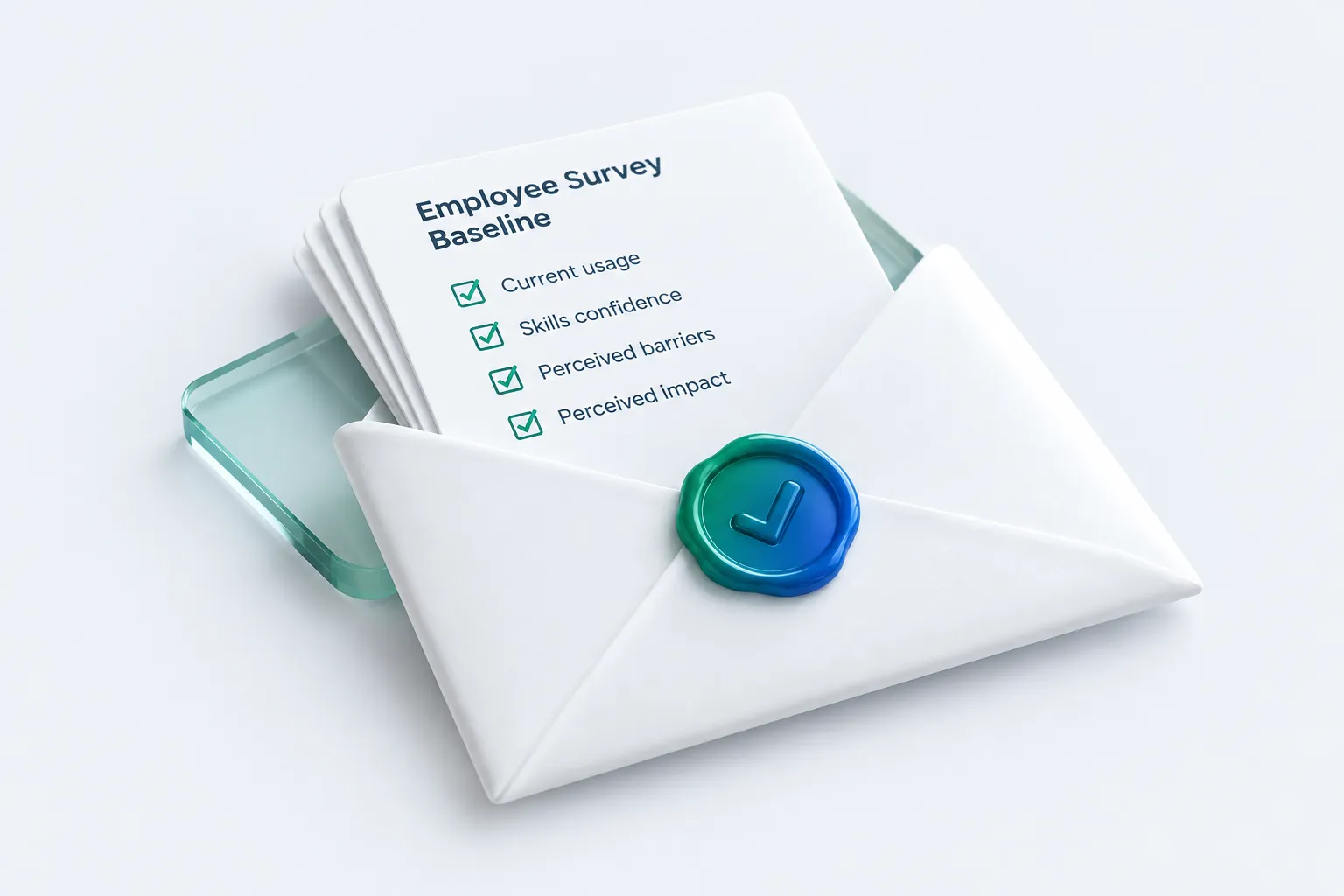
Between days 30 and 60, run one baseline employee survey covering current usage, skills confidence, perceived barriers, and perceived impact. As chief AI officer, you'll use this single baseline as the fixed point every later survey compares against, so it's worth getting the setup right before launch.
Days 60–90: Triangulate Self-Report With Usage Signals
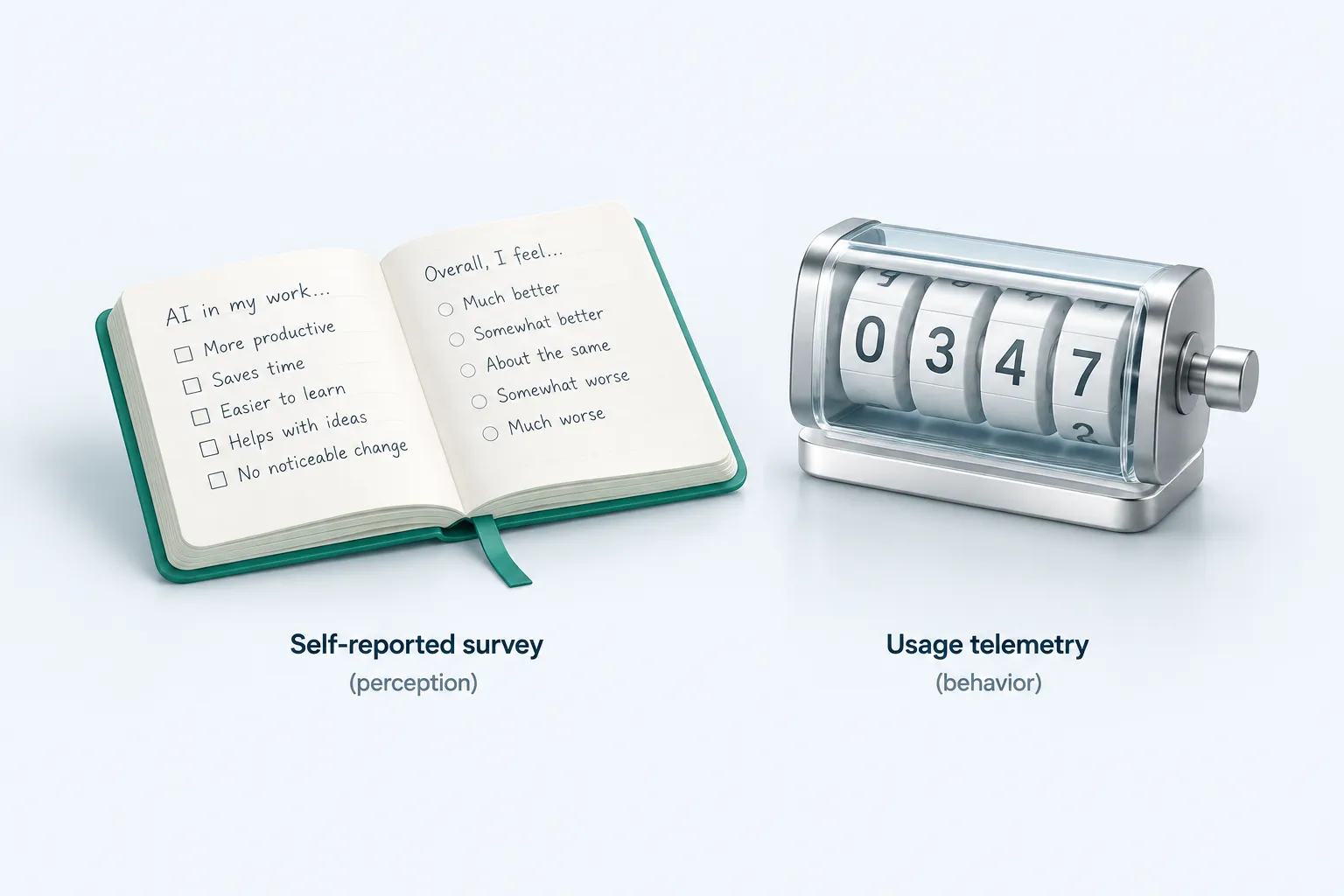
By days 60 to 90, pair your survey baseline with whatever objective usage signals you already have — license counts, tool activation logs, or IT-approved app usage. This matters because employee-owned personal AI tools create a visibility gap: Worklytics, a vendor of behavioral-analytics software, reports that a large share of AI users bring their own tools to work, which can cause survey-based counts to undercount actual usage.
Attributing productivity gains specifically to AI usage is a separate, harder challenge than tracking whether people use a tool at all. The same vendor blog names this attribution gap as a recognized measurement difficulty, a theme this checklist returns to below.
Microsoft's AI adoption score for Copilot illustrates one way to keep these apart. It is built entirely from behavioral telemetry — how often licensed users actively use Copilot features — and Microsoft runs it alongside a separate sentiment survey asking users to rate statements about perceived productivity gains, keeping usage data and self-reported perception distinct.
| Dimension | What it captures | Example source |
|---|---|---|
| Self-reported usage and skills | Employees' own description of how and how often they use AI | Baseline employee survey |
| Perceived impact | Employees' opinion of whether AI helped them work faster | Sentiment survey item |
| Behavioral telemetry | Actual feature-activation counts from a licensed tool | Product usage logs, such as Copilot activity data |
Sources: Benchmarking Employee AI Adoption: Closing the Gap Between Daily Usage and Leadership Estimates in 2025 | Worklytics, AI Adoption Category in Adoption Score - Microsoft 365 admin | Microsoft Learn
What Survey Baselines Can Credibly Show — and What They Cannot
A short note on how to read these results: employee surveys capture what people report about their own behavior, attitudes, and perceptions. That is genuinely useful, but it is not the same as a controlled, causal measurement of productivity or business outcomes. As chief AI officer, keep that distinction in mind throughout your 90-day reporting.
None of the sources behind this article include a controlled study connecting survey responses to verified productivity outcomes. Present perceived-impact findings to leadership as sentiment, consistent with the note above.
- Can show: self-reported usage patterns, skills confidence, and awareness of barriers
- Can show: how sentiment shifts over time when the same questions are re-run
- Cannot show: which specific productivity or business outcomes employees' reported AI use actually produced
- Cannot show: total usage volume with full accuracy, since unreported personal tool use can hide
Sources: Benchmarking Employee AI Adoption: Closing the Gap Between Daily Usage and Leadership Estimates in 2025 | Worklytics, AI Adoption Category in Adoption Score - Microsoft 365 admin | Microsoft Learn
Reducing Bias in Your Baseline Survey
Self-report data carries a well-documented risk called social-desirability bias — the tendency for people to answer in ways they think will be viewed favorably rather than describe their behavior accurately. This is a general survey-design finding, not specific to AI, but it applies directly to adoption baselines.
The clearest defense is confidentiality. Administering your baseline survey anonymously, or with strong confidentiality assurances, reduces the incentive for employees to over-report AI use they think looks good, or under-report use they worry looks like cutting corners.
- Keep individual responses anonymous or aggregate before sharing with managers
- Avoid framing questions as a performance or compliance check
- Explain plainly how results will and will not be used
- Re-run identical question wording each cycle so trends stay comparable
Sources: Social-desirability bias - Wikipedia
Frequently asked questions
Who should own the AI adoption baseline survey — the chief AI officer or HR?
Ownership usually sits with the chief AI officer, but the cross-functional group formed in the first 30 days, including HR or people operations, should co-design and interpret the survey so results reflect more than one department's view.
How often should the baseline survey be repeated after the first 90 days?
Base the interval on how quickly your AI initiatives are changing: rerun sooner after major tool rollouts or new training pushes, and space out once usage patterns settle. Keep the same question wording each wave so trend comparisons stay valid across cycles.
Does this 90-day approach apply to a fractional chief AI officer working part-time?
Yes, though a fractional chief AI officer may need to compress or delegate steps. The same sequence of scope, govern, baseline, and triangulate still applies, with the cross-functional group carrying more day-to-day ownership between engagements.
What should be reported to the board or executive sponsor after day 90?
Report the trend direction rather than a single score: show how usage, skills, and sentiment moved since the prior wave, flag any wording or timing changes that could affect comparability, and note which teams shifted most. Present perceived-impact figures as reported sentiment, not proof of outcomes.