
Your board's barrier list isn't your workforce's
Imagine a Chief People Officer sitting through a board meeting where someone pulls up the WTW AI adoption barriers list from a February 2026 Forbes commentary: many board members and senior leaders now name skill deficits as their top barrier. The board's question lands on your desk: "Does that match our people?"
The instinct to borrow is understandable. A respected firm has already done the thinking, named the categories, and handed the board a story it half-believes already.
Here's the problem: treat the WTW AI adoption barriers list as one executive's read of the boardroom, not a diagnosis of your workforce. It tells you what senior leaders worry about, not what your engineers, claims handlers or analysts ran into last Tuesday.
We're skeptical of any barrier list built entirely from leadership perception; it tells you what the board worries about, not what blocks the people doing the work.
Map your own barriers first, then check them against the published ones, not the other way round.
Sources: How business leaders overcome barriers to AI adoption - WTW
What the WTW AI adoption barriers actually cover
"The WTW AI adoption barriers" isn't one named survey with a single, universal category list. It's actually two different things wearing the same label.
- A WTW executive's opinion commentary citing general leadership perception, without a published sample
- WTW's own 2026 benefits-sector survey, with a stated sample of 312 employers and 4.6 million employees
- An outside Kyndryl survey of over 1,000 executives, reported separately by HR Dive
The first is the Forbes commentary already mentioned: a bylined opinion piece by WTW's Chief Innovation and Acceleration Officer, John M. Bremen, laying out five barriers he says executives face, without a published sample size or survey design.
“Many board members and senior leaders cite organizational skill deficits as the leading barrier to AI adoption in 2026”
— John M. Bremen, Senior Managing Director and Chief Innovation and Acceleration Officer, WTW · Source: Overcoming Barriers To AI Adoption In 2026
The second is a real WTW survey, but a narrower one. WTW's 2026 AI Use in Health and Benefits Survey, covering 312 employers representing 4.6 million U.S. employees and fielded in January and February 2026, found that those benefits-team leaders named data privacy and security (70%), AI mistakes or errors (66%), and legal compliance and fiduciary exposure (64%) as their top barriers.
A separate Kyndryl survey of more than 1,000 senior business and technology executives, published in May 2025 and reported by HR Dive in June 2025, settled on three barriers instead: change management, employee trust, and skills gaps. Like the WTW commentary, these are executives' impressions of their own organizations, not measured employee behavior, so read them as perception data, not proof of what's actually stopping adoption.
Both lists come from boards, executives and benefits teams, not from the people actually prompting a model or quietly avoiding one. That gap is exactly what a workshop closes. Our view: the real value of these published lists isn't their categories, it's the reminder that every executive survey asks executives, never the team stuck on a broken handoff.
Sources: How business leaders overcome barriers to AI adoption - WTW, Employers set to rapidly expand AI use in health and, Nearly half of CEOs say employees are resistant or even hostile to AI | HR Dive
Run this workshop to map your own barriers

Here's an editorial exercise an L&D lead or CPO can run before adopting anyone else's category list. The task: facilitate a 90-minute silent-sort session that surfaces the specific moments your own people hit a wall with AI, then clusters those moments into categories that belong to your organization, not someone else's.
This borrows from affinity diagramming, a facilitation technique that Nielsen Norman Group's guidance, as of 2023, describes as effective for organizing large amounts of input, provided the group works from one clear focus question.
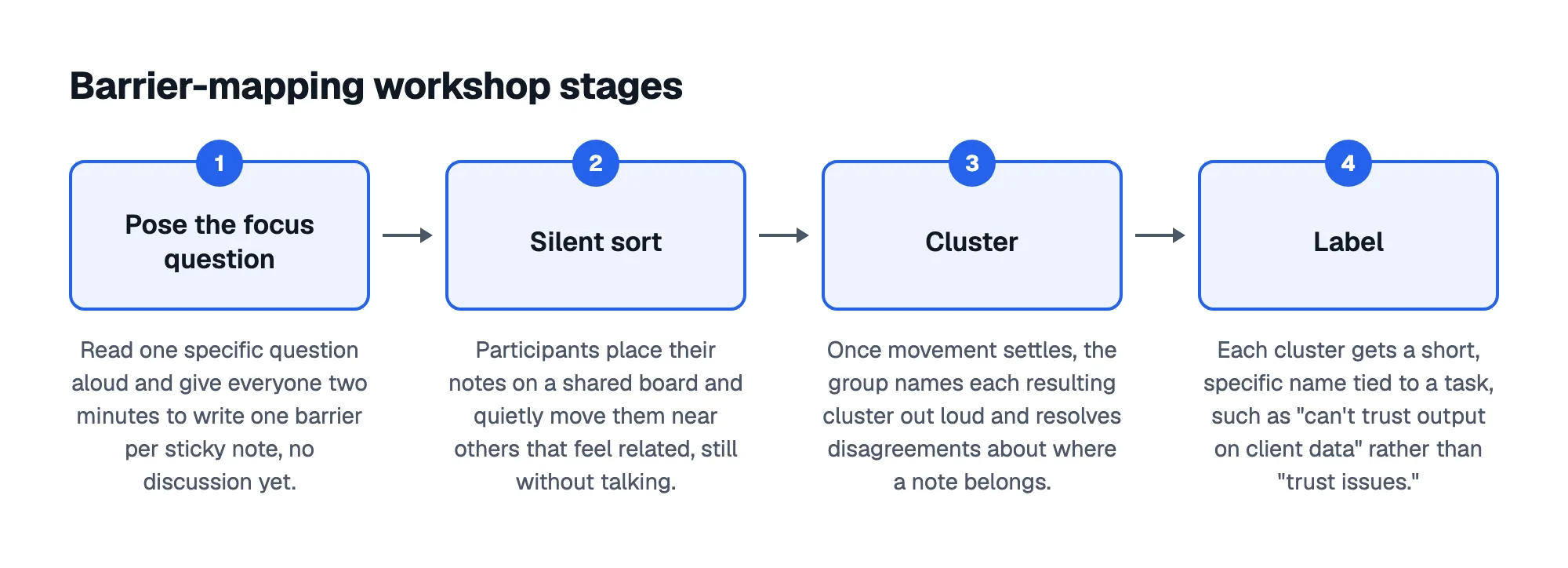
The session runs in four short stages, each quick enough to keep people honest instead of performing for the room.
- Prerequisites: eight to twelve participants, weighted toward managers and individual contributors, not only senior leaders, since every published list above comes from executives describing their own organizations
- Inputs: sticky notes or a shared digital board, a timer, and one explicit focus question per round, for example, "what stopped you from using AI on a real task this month?"
- Constraints: sort silently before any discussion starts, and push back on vague labels such as "resistance" until someone names the specific task behind it
Sources: Avoiding 3 Common Pitfalls of Affinity Diagramming - NN/G
What a usable barrier map looks like
A workshop like this succeeds or fails on whether the clusters survive contact with daylight. Here's how you know you have something usable.
If your map comes out thin, that's useful too. It tells you the group didn't have specific enough stories yet, which is itself worth sitting with before you run a wider survey.
Check your clusters against WTW, Kyndryl and PEX
Once your clusters exist, hold them up against the lists you started with. A secondhand figure from the PEX Report 2025/26, cited inside WTW's own commentary, puts the share of organizations naming data quality and availability as their primary AI adoption barrier at 52%, though the commentary gives no detail on PEX's sample or method.
| Source | Population and date | Top barriers named |
|---|---|---|
| WTW Forbes commentary | Board members and senior leaders, 2026 | Skill deficits |
| WTW AI Use in Health and Benefits Survey | 312 employers / 4.6 million U.S. employees, Jan–Feb 2026 | Data privacy and security; AI mistakes; legal and fiduciary exposure |
| Kyndryl survey | 1,000+ senior executives, May 2025 | Change management; employee trust; skills gaps |
| PEX Report 2025/26 (secondhand) | Unknown | Data quality and availability |
We think it's a mistake to adopt Kyndryl's three categories wholesale just because the survey ran across more than a thousand executives; a bigger sample of the wrong population still isn't your organization's data.
Where your clusters land close to one of these published lists, treat that as a useful cross-check, not proof you've found the same thing for the same reason. Where they diverge, trust your own workshop over the published categories: your people, not a board survey, are the ones running into the wall.
Sources: How business leaders overcome barriers to AI adoption - WTW, Employers set to rapidly expand AI use in health and, Nearly half of CEOs say employees are resistant or even hostile to AI | HR Dive
Send the survey after the workshop, not instead of it

A workshop gives you depth from a room of ten or twelve people. It won't tell you whether the barrier that cluster surfaced is a quirk of that room or something affecting the other two hundred people in the department.
That's the gap a structured employee survey closes: AI Adoption Score's AI Adoption Barriers Survey is built to surface the real reasons a team isn't using AI more effectively, and running it after your workshop lets you check whether your clusters hold up across the wider organization.
Our bet is that the combination beats either tool alone: workshops supply the specific language your people actually use, and a survey tells you how far that language travels.
Map first. Borrow categories only to sanity-check what you found. Then survey wide enough to know whether it's worth fixing.
Frequently asked questions
Who should facilitate the barrier-mapping workshop?
Someone outside the immediate reporting line of the participants works best, such as an L&D lead or an outside facilitator, so people sort and label honestly rather than toward what a direct manager wants to hear. This is editorial guidance, not a documented requirement.
How long should the workshop take?
Around 90 minutes is usually enough for eight to twelve people to move through posing the question, silent sorting, clustering and labeling without the session dragging and energy dropping before the labeling stage, which is where the real clarity shows up.
What if the group can't agree on a cluster's name?
Treat disagreement as information: it usually means the cluster is hiding two different barriers. Split it into two clusters rather than forcing a vague label everyone can live with, since a vague name defeats the point of the exercise.
Should we run this workshop more than once?
Running it again after a few months is reasonable once you've acted on what the first map showed, since barriers shift as tools, teams and tasks change. There's no documented interval that fits every organization, so treat timing as your own call.