A rollout without a baseline proves nothing later
Six months after your AI rollout wraps, someone on the leadership team will ask whether anything actually changed. If the only survey you ever ran was the one after training ended, you have opinions, not a comparison. That's usually the moment someone goes looking for an AI adoption questionnaire PDF, once the rollout is already underway and it is too late to capture where people actually started.
Tom Whelan, director of corporate research at Training Industry, captured that uncertainty well when describing how organizations approach AI adoption.
“We’re all jumping in the pool, but we’re not quite sure of our swimming abilities.”
— Tom Whelan, Ph.D., Director of corporate research, Training Industry · Source: Ready for AI in L&D? Ask These 4 Questions First
The common practice is to send one survey after training and call the resulting numbers 'adoption.' That survey tells you what people think right now. It cannot tell you what moved, because nothing was measured before the rollout started.
We think a single post-rollout survey, with no earlier measurement to compare against, mistakes a snapshot for a trend.
A pre-rollout baseline fixes that: the same questions, asked once before anyone touches the new tool, then asked again later in identical wording. Below is what that baseline should actually ask.
Who to survey, and when before launch

Imagine a 300-person sales team about to get access to a new AI meeting assistant. Survey everyone with access, not a 'representative sample': frontline reps, team leads, and the managers who will be expected to coach the new behavior.
- Everyone getting tool access at rollout, not a sample
- Managers and team leads who will coach the new behavior
- Anyone already using AI informally, to capture existing habits
Field the baseline before any rollout announcement goes out, while answers still reflect life before AI tools arrived. Use identical wording when you repeat the survey later, so differences reflect time passing, not changed questions.
LinkedIn Learning's 2024 Workplace Learning Report, reported secondhand by Training Industry, found that four in five workers want to learn more about using AI in their job. That appetite is a reason to survey broadly rather than only the people already experimenting.
We'd rather survey everyone who will touch the new tool than defend a 'representative sample' to skeptics later.
Sources: Ready for AI in L&D? Ask These 4 Questions First
What the AI adoption questionnaire PDF should include

The five areas below make up a simple AI adoption questionnaire PDF you can adapt in a spreadsheet or document. Nothing here is a validated psychometric instrument, so treat it as a starting point, not a certified scale.
| Area | Suggested question | Response options | Who answers |
|---|---|---|---|
| Current usage | Which of these AI tools have you used for work in the past two weeks? | Named tools plus 'None' (pick one primary tool) | All employees with tool access |
| Skills and confidence | How confident are you using AI tools for tasks in your role? | Not at all / Slightly / Moderately / Very confident | All employees with tool access |
| Perceived barriers | What is the single biggest reason you don't use AI more in your work? | Unclear use case, lack of time, lack of training, accuracy concerns, ethical or trust concerns | All employees |
| Manager and organizational support | Does your manager actively encourage you to try AI tools for your work? | Yes, clearly / Somewhat / No / Not sure | All employees |
| Governance awareness | Do you know which AI tools are approved, and what should never be entered into them? | Yes to both / Yes to one / No | All employees |
On barriers, Gallup's May 2025 workforce survey found U.S. employees most often named an unclear use case or value proposition as the single biggest barrier to AI adoption, at 16%. Gallup's February 2026 survey of 23,717 U.S. employees also found non-users were far more likely than infrequent users to say they are ethically opposed to AI, 43% versus 25%.
Both figures describe self-reported attitudes, not a measured cause of lower adoption. Treat a high 'unclear use case' score as a prompt to ask why, not a finished diagnosis.
On skills, SAP's vendor-published survey research reports employees with low AI literacy were six to seven times more likely to say they feel apprehensive or afraid of AI at work. A low confidence score on your baseline is a flag for targeted training, not a judgment on anyone's effort.
Sources: Manager Support Drives Employee AI Adoption, AI in the Workplace: What Separates Adopters and Holdouts, Top obstacles to AI readiness for HR professionals | SAP
Choose forced-choice wording over agree-or-disagree lists

A Pew Research Center study from 2019 found that forced-choice questions produced more accurate answers than select-all-that-apply lists, especially on sensitive topics. That is general survey-methodology guidance, not AI-specific, but it applies directly to a question like asking whether employees disclose AI-generated work.
We're skeptical of long agree-or-disagree scales for anything sensitive; forced choice is harder to answer in the direction that just sounds good.
Run the baseline anonymously and say so plainly. That single line does more to reduce socially desirable answers on usage and disclosure questions than any amount of clever wording.
Sources: Writing Survey Questions | Pew Research Center
Turn the baseline into your first intervention

Your manager-support question matters more than it looks. In Gallup's Q2 2025 survey of U.S. employees at organizations investing in AI, only 28% strongly agreed their manager actively supports their team's AI use. If your own baseline numbers look similar, employees reported a support gap worth acting on before you commit a training budget.
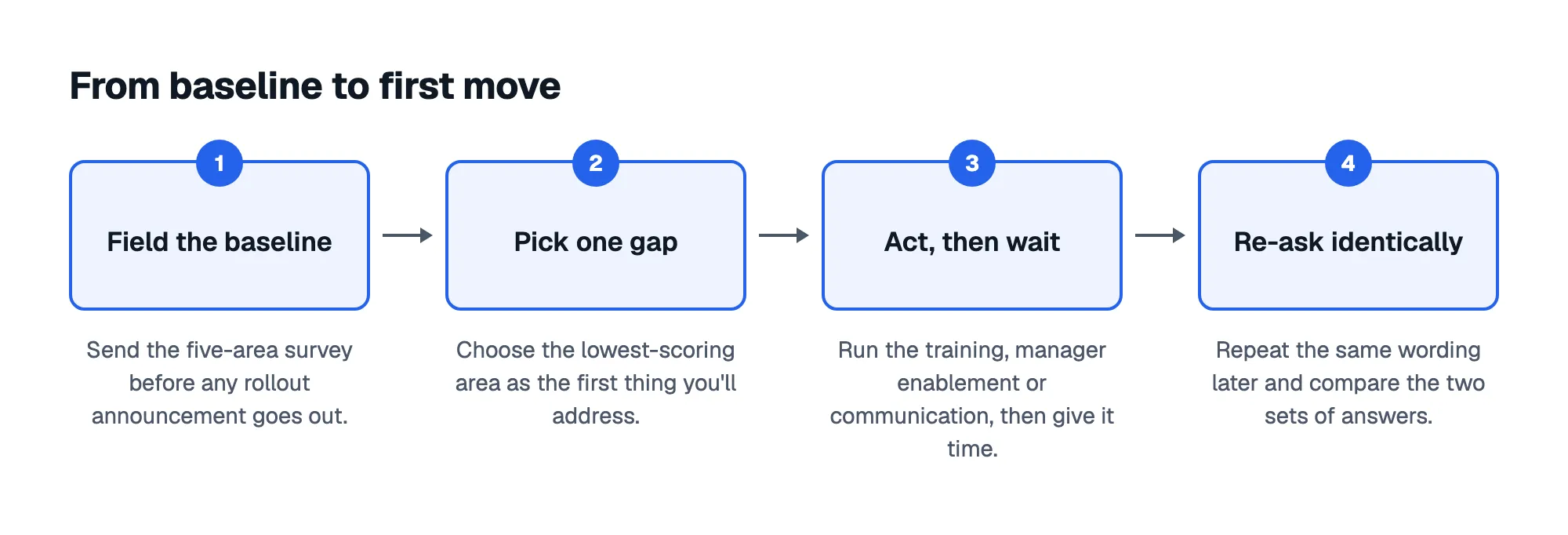
Our bet is that a real pre-rollout baseline will point you to one or two interventions worth funding, not a long wish list.
Once your AI adoption questionnaire PDF results are in, resist turning every low score into a training line item: a low 'unclear use case' score calls for role-specific communication, not another course.
AI Adoption Score is intended to help companies identify AI adoption problems and select interventions like this before investing further, using the same predefined surveys for a baseline and a later comparison.
Frequently asked questions
How long should the baseline survey take employees to complete?
Keep it short enough to finish in one sitting, roughly the length of the five areas covered here. Longer forms take more time to complete, so keeping the survey brief helps more employees finish it without rushing through the later questions.
Should the baseline survey be anonymous?
Yes, but when a team is small enough that answers could identify someone, say so upfront and aggregate results by department rather than by individual team. For groups under about ten people, widen the reporting group before you promise anonymity you can't actually deliver.
How soon after the baseline should training start?
There's no fixed interval; what matters is that the questions themselves don't change between baseline and follow-up. Leave enough time between rollout steps for behavior to settle before you re-ask the identical survey.
Can the same questionnaire work for teams at different starting points?
Yes. Ask every team the same questions and compare their starting points rather than assuming teams are equal going in. The baseline's job is to surface those differences, not flatten them before you've even measured.