
What is an AI adoption assessment?
Your CIO wants proof the AI rollout is paying off, not just that people attended the kickoff. Your L&D lead wants to know who still needs training. The board wants one answer to "is this worth the budget," and login counts won't give it to them. Before any of that, you need to know what an adoption assessment actually checks.
So, what is an AI adoption assessment, in plain terms? It's a structured check on how your employees actually use AI tools once they're in their hands: which tasks they apply AI to, how confident they feel, and what's stopping wider use.
Herrmann International's 2026 guide frames the broader category as a structured evaluation of an organization's readiness to deploy, integrate and sustain AI tools across technical, workforce, leadership and cultural dimensions, though that's one vendor's framing rather than an agreed industry definition.
The answer to what an adoption assessment is actually blends two different jobs: checking if you're ready to deploy AI, and checking if people are actually using it. The next section pulls those apart.
Sources: AI Adoption Assessments for Enterprise Rollouts | Herrmann
What is an AI readiness assessment, and how does it differ from an adoption assessment?

An AI readiness assessment runs before you commit budget or flip the switch. UNESCO's AI Readiness Assessment Methodology, published 2026-09-13, is built for national governments to gauge preparedness to govern AI ethically before acting on it, which shows the same logic scaled up to country level.
That pre-deployment logic isn't new. A 2020 interview study of 25 AI experts by Hofmann and colleagues, published in Business & Information Systems Engineering, found, as of 2020, that readiness assessments are meant to surface gaps proactively before the adoption decision, so teams aren't fixing infrastructure after the fact.
| Dimension | Readiness assessment | Adoption assessment |
|---|---|---|
| Timing | Before deployment or budget commitment | After tools are in employees' hands |
| Core question | Are we prepared to govern and deploy AI responsibly? | Are people actually using it, and what's stopping them? |
| Example source | UNESCO's AI Readiness Assessment Methodology, national government level | Employee usage and barrier surveys |
We think folding readiness and adoption into one combined score is a mistake you'll untangle later: a strong infrastructure score can quietly cover for weak manager support or low actual usage, and you won't see which one is dragging the other down.
Sources: AI Readiness Assessment Methodology | Global AI Ethics and Governance Observatory, Ready or Not, AI Comes— An Interview Study of Organizational AI Readiness Factors | Business & Information Systems Engineering | Springer Nature Link
What does an adoption assessment actually measure?

Once tools are live, usage itself becomes the question, and it varies more than most leaders expect. Gallup's February 2026 survey of 23,717 U.S. employees found that actual usage varies sharply by role, with leaders far more likely than individual contributors to report using AI frequently, a usage gap a rollout announcement alone won't close.
Adoption assessments also surface what's blocking wider use. In Gallup's WF Q2 2025 survey of U.S. employees, conducted May 7 to 16, 2025, the top self-reported barrier was an unclear use case or value proposition, cited by 16% of respondents.
Consultant Gethyn Ellis's 2026 analysis draws a useful line here: adoption tracking covers access and activity, such as licenses, logins and prompts run, while a separate question, whether real capability got built, belongs to enablement, not adoption.
- How often people actually use AI tools, not just whether they have access
- Which skills are strong and which are missing, person by person
- What employees say is blocking wider use
- Whether a culture of sharing AI knowledge exists across teams
Think of an AI adoption assessment toolkit as the specific instruments you deploy, not one catch-all form. Tools built for this, including AI Adoption Score, offer nine predefined survey types so you can target usage, skills, barriers or culture separately instead of guessing.
Sources: Manager Support Drives Employee AI Adoption, AI in the Workplace: What Separates Adopters and Holdouts, Adoption Is Not Enablement: Why AI Rollouts Plateau - Gethyn Ellis
What results should you expect from the assessment, and what won't it tell you?
Results usually arrive as tiers, not a single pass or fail. Cisco's 2025 AI Readiness Index, a vendor-run self-assessment, scores companies 0 to 100 and sorts them into four preparedness tiers, with 'Pacesetters' needing a score above 86.
Cisco's analysis of that same index found that Pacesetters outperform peers by balancing strategy, infrastructure, data, governance, people and culture together, not by excelling at any single pillar.
Herrmann's 2026 guide reports a sharper finding, attributed to Section's AI Proficiency Report, that a manager who visibly disapproves of AI use can cut a team's proficiency in half, even when company policy favors AI.
Some platforms, including AI Adoption Score, map every person, team and department to one of five maturity levels across dimensions such as Skills, Usage and Culture.
Keep in mind these figures come from what employees and leaders reported about their own behavior, not independently measured productivity gains. We'd treat that kind of perception data as a starting hypothesis for where to dig, never as the final verdict on whether AI adoption actually improved anyone's output.
Sources: Cisco AI Readiness Assessment - Cisco, Cisco AI Readiness Index 2025 - Realizing the Value of AI, AI Adoption Assessments for Enterprise Rollouts | Herrmann
When should you run a readiness check versus an adoption assessment?
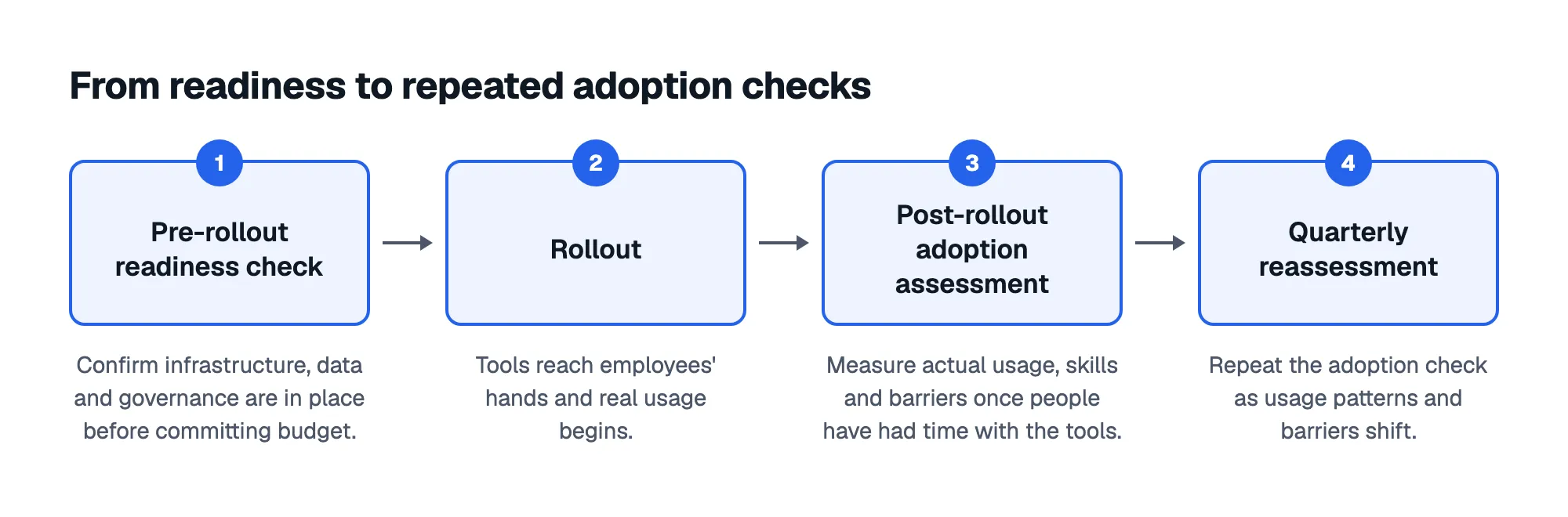
Run the readiness check first, before you commit budget, and the adoption assessment after the tools reach employees' hands. That sequencing matches what the 2020 expert-interview study by Hofmann and colleagues describes: readiness work exists to surface gaps proactively, ahead of the adoption decision itself.
Don't stop at one pass. Reassess on a cadence, quarterly works well, since usage patterns and barriers shift as employees gain more hands-on experience with the tools.
What common mistakes do these assessments make, and how do you avoid them?
Once you know what an adoption assessment is, the biggest mistake is averaging everything into one number. A high overall score, like Cisco's tiered 0-100 index, can still hide a weak people-and-culture pillar, even though Cisco's own analysis found Pacesetters succeed by balancing every pillar together.
The second mistake is skipping management behavior. As the manager-disapproval finding above shows, an assessment that only scores tools and training is measuring half the picture.
We're skeptical of any single score that claims to capture skills, culture and governance in one number: it reads clean on a slide, but it hides exactly the trade-off a leader needs to see.
Sources: Cisco AI Readiness Assessment - Cisco, Cisco AI Readiness Index 2025 - Realizing the Value of AI, AI Adoption Assessments for Enterprise Rollouts | Herrmann
Frequently asked questions
Who should own an AI adoption assessment inside the company?
Ownership usually sits with whoever is accountable for the rollout's outcome, often a digital transformation leader, CIO or Head of L&D, working with people leaders who can act on the results. No source here prescribes one correct owner, so match ownership to whoever can actually change training, tooling or manager behavior afterward.
Can one survey cover both readiness and adoption questions?
Yes, you can run both in the same project, as long as you score them separately rather than blending them into one index. Readiness questions ask whether you're prepared to deploy responsibly; adoption questions ask whether people are using the tools and what's stopping them, and keeping the scores apart protects each one's purpose.
How much employee time does an adoption assessment take?
Not documented in the sources reviewed here, and it varies by survey length, question format and organization size. As a practical matter, shorter, more structured questions tend to take less time to complete than long open-ended ones, a general design trade-off to weigh against how much depth you need, not a documented benchmark from these sources.
Does a good adoption score guarantee better AI results?
No. A higher score reflects current stated behavior and perception, which naturally shifts as employees gain more hands-on experience with the tools. Look for whether the score moves across repeated quarterly waves and whether the specific barriers employees named actually get addressed, rather than treating any single snapshot as proof that adoption improved results.