
A high response rate can still lie to you
A board member asks you a direct question: "Did people actually use the AI tools we rolled out?" You point at the adoption survey's 61% response rate and mostly upbeat answers, already thinking about how to improve employee survey response rates next time, until someone asks who didn't answer.
Most advice on how to improve employee survey response rates treats the percentage itself as the win. Push the number up, call it done. But U.S. federal guidance on statistical survey methodology states that response rates and nonresponse bias aren't always correlated, so a survey can climb and still misrepresent your workforce.
Worse, adding more respondents doesn't automatically fix anything: the same federal guidance notes that boosting a response rate with additional cases can leave bias unchanged, or deepen it, if the new answers still skew toward people who were always going to reply. That guidance was written for government statistical surveys, not workplace AI polls, though the mechanism travels well.
Treating response rate as the finish line is how a clean-looking dashboard ends up built on the opinions of your most enthusiastic AI users. In our view, representativeness, not volume, is the number worth defending in front of a board.
Sources: Best Practices for Nonresponse Bias Reporting
How to improve employee survey response rates fairly

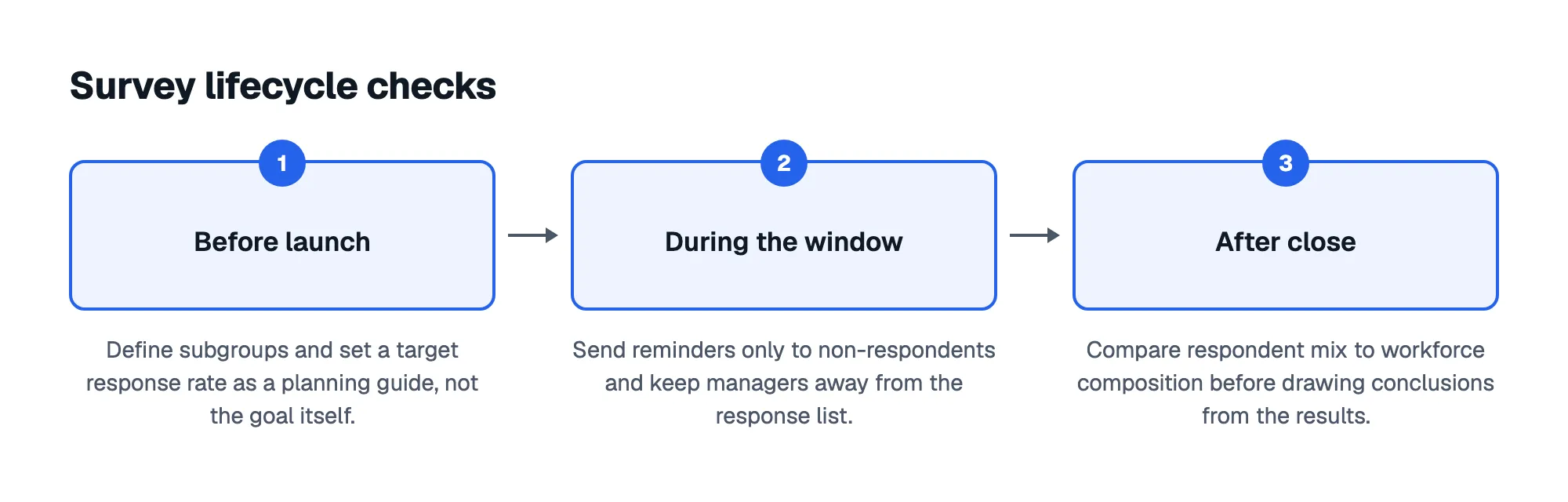
Before you launch, decide what 'done' looks like beyond a topline number. That's the real question behind how to improve employee survey response rates fairly: not just more answers, but the right mix of answers across frequent AI users, occasional users, non-users, roles and tenures.
| Approach | What it optimizes | What it can miss |
|---|---|---|
| Chase the topline rate | A bigger percentage overall | Whether the extra answers came from the same kind of person |
| Stratified oversampling | Balanced data across a key group, such as seniority | Other gaps, like tenure or AI usage frequency, if you don't also track those |
| Subgroup comparison after close | Whether each group's share of respondents matches its share of the workforce | Requires knowing your workforce composition up front |
SHRM's 2025 benchmarking survey of its own members shows one way to do this deliberately: rather than count on raw volume, it used stratified oversampling of vice-president-and-above roles to get robust data across seniority levels. That's a design choice you can borrow even without SHRM's scale.
If you're picking which survey to run first, AI Adoption Score offers nine predefined survey types, covering usage, skills, barriers and readiness, so you're choosing an instrument rather than designing one from scratch.
We'd rather see a 45% response rate that mirrors your workforce on role and AI usage than a 70% rate stacked with people who already loved the rollout.
Sources: SHRM Releases 2025 Benchmarking Reports: How Does Your Organization Compare?, Best Practices for Nonresponse Bias Reporting
Leadership sponsorship, not manager pressure

Get a senior leader, not the project team, to explain why the survey matters and what decisions it will inform. That sponsorship carries weight an L&D email never will.
- Ask one senior leader to record or send a short note on why the survey matters
- Share what decisions the results will inform, before you launch
- Route all reminder logic through HR or L&D, never through line managers
- Never publish team-by-team completion league tables
What leadership shouldn't get is a running list of who on each team has or hasn't answered. A widely shared practitioner guide on raising employee survey response rates specifically warns against tracking responses by demographic group or job level, since that undercuts any promise of confidentiality.
Treat this as one practitioner's view from 2019, not an established standard, but the logic holds: a manager who can see gaps will chase them.
Common advice says get managers involved early to push completion. We'd do the opposite: keep managers as messengers for why the survey matters, and nowhere near the response list.
Sources: Ensure ‘authentic and meaningful’ employee survey participation
Incentives and timing that quietly skew your sample
A 2012 study of U.S. political and opinion telephone surveys found that people who respond tend to be significantly more civically engaged than those who don't, even after the results were weighted. That study wasn't about workplace AI, but the same instinct, the engaged show up and the skeptical don't, applies just as well to a survey about a new technology at work.
That's exactly why employee survey incentives deserve caution. One community-published guide from 2019 argues against offering incentives to lift response rates at all, reasoning that prizes and raffles tend to attract people who were going to answer anyway, not the quieter skeptics you actually need to hear from.
We're skeptical that a gift card ever buys an honest answer from someone who was never going to click the link. If you want the non-users' view, the invitation has to explain what's in it for them, not what they might win.
Access matters as much as incentives. Keep the survey short, available on mobile, and offered in the languages and formats your shift and non-desk employees actually use, so the design itself doesn't filter who can answer.
Sources: Assessing the Representativeness of Public Opinion Surveys | Pew Research Center, Ensure ‘authentic and meaningful’ employee survey participation
Confidentiality checks that keep answers honest
Confidentiality isn't a line on the intro screen, it's a set of decisions you make before launch. Set and publish a minimum group size before any result gets broken out by team, so a small group's answers can't be traced back to one person.
That confidentiality promise has to hold past line managers too. Extend the same caution to HR partners assigned to a single team: seeing who on their own team hasn't answered can create the same pressure a manager's view would.
Sources: Ensure ‘authentic and meaningful’ employee survey participation
What counts as a good response rate, and how often to ask

There's no single number in this research that tells you what is a good employee survey response rate for measuring AI adoption. The federal guidance cited earlier is clear that the rate alone doesn't tell you about bias.
So judge completion by comparison, not by percentage. After you close the survey, compare your respondent mix, by role, department, tenure and reported AI usage frequency, against your overall workforce. If frequent AI users answered at twice the rate of non-users, your positive results are describing enthusiasts, not your workforce.
AI Adoption Score provides dashboards broken out by organization, team and individual, which gives you the segmented data to start that comparison from.
On how often should employee surveys be conducted, treat it as a cadence tied to events, not a calendar habit: re-run the same instrument after a training push or a major tool change, so you're comparing like to like.
Sources: Best Practices for Nonresponse Bias Reporting
Frequently asked questions
What is a good employee survey response rate for an AI adoption survey?
There's no universal benchmark to aim for. Federal survey methodology guidance shows response rate and nonresponse bias aren't reliably correlated, so treat any target rate as a planning gate, not a scorecard, and flag any subgroup responding at less than half the overall rate for follow-up outreach before drawing conclusions.
How often should employee surveys be conducted for AI adoption?
A short pulse check on one or two questions between full assessments can show whether a specific intervention landed, without repeating the entire instrument. Reserve the full survey re-run for after major events, such as a training push or a tool change, rather than a fixed calendar date.
Should we offer employee survey incentives to raise participation?
We'd skip prize-based incentives tied to completion. A stronger lever is telling employees which specific decision the results will shape and by when, so answering feels consequential rather than optional. A 2019 practitioner guide on employee surveys cautions that incentives mainly attract people already inclined to respond.
Who should see which employees haven't responded yet?
As few people as possible, and never an individual's line manager. You can still track overall completion in aggregate, without breaking status out by team or demographic group, to gauge momentum and time reminders without identifying anyone.
Sources: Best Practices for Nonresponse Bias Reporting, Ensure ‘authentic and meaningful’ employee survey participation