
What Is Change Management in Project Management for AI Projects
What is change management in project management when the project is an AI rollout? It means deliberately planning how employees move from current habits to new ones, not installing new software and hoping adoption follows on its own.
Established frameworks give transformation leaders a staged sequence rather than an improvised timeline. Prosci's ADKAR model breaks individual change into five elements: awareness, desire, knowledge, ability and reinforcement, moving people from not knowing why change is happening to sustaining new behavior. These elements give a shared vocabulary for diagnosing where an individual change effort is stalling.
At the organizational level, Prosci's 3-Phase Process groups activities into Prepare, Manage and Sustain, while Kotter's 8-Step framework was built by studying common success factors across many change efforts. Applying that staged logic keeps change management in project management practical rather than abstract for AI work. Treating these as sequential checkpoints, rather than a single launch event, helps leaders spot where a rollout is losing momentum.
Change stages across an AI implementation plan
- Prepare: Define the business problem, owner, and what success looks like before any tool is deployed.
- Build awareness and desire: Help employees understand why the initiative matters and build genuine willingness to engage.
- Equip and adapt: Provide training and practice, then check whether skills and usage are actually shifting.
- Reinforce and sustain: Keep revisiting roles, guidance, and barriers as tools and use cases continue to change.
Sources: The Prosci ADKAR® Model | Prosci, Prosci 3-Phase Process, The 8-Step Process for Leading Change | Dr. John Kotter
Stage 1: Prepare — Define Success and Business Impact
The Prepare stage answers what is change management in project management before any AI tool is deployed: it means setting clear direction first. Prosci's process names this phase's deliverable as a Change Management Strategy that establishes the overall approach, not a full execution plan yet. That distinction matters, since teams sometimes skip straight to training without agreeing on the problem or the definition of success.
This is also where the earliest ADKAR elements start forming: employees cannot build desire for an AI initiative before they have basic awareness of why it exists and what business problem it is meant to solve.
Sources: The Prosci ADKAR® Model | Prosci, Prosci 3-Phase Process
Stage 2: Build Awareness and Desire Among Employees
Once groundwork is laid, attention shifts to ADKAR's Awareness and Desire elements: helping employees understand why the AI initiative matters and building genuine willingness to engage with it, not just compliance. Compliance alone rarely sustains new habits once initial enthusiasm fades.
Prosci notes these elements are sequential but not strictly linear, since new capabilities or setbacks can send teams back to reinforcing awareness even after desire has started to build.
Prosci also states that ADKAR is designed to apply to AI-driven and continuously evolving change, which fits AI projects that keep shifting as tools and use cases expand. Leaders can consider a few editorial starting points here, not a validated set of steps:
- Sharing concrete before-and-after examples from a pilot team
- Inviting skeptical employees to ask questions directly to project sponsors
- Explaining what will not change, to reduce uncertainty
- Connecting the initiative to problems employees already recognize
Sources: The Prosci ADKAR® Model | Prosci
Stage 3: Equip Skills, Track Adoption, and Adapt Actions
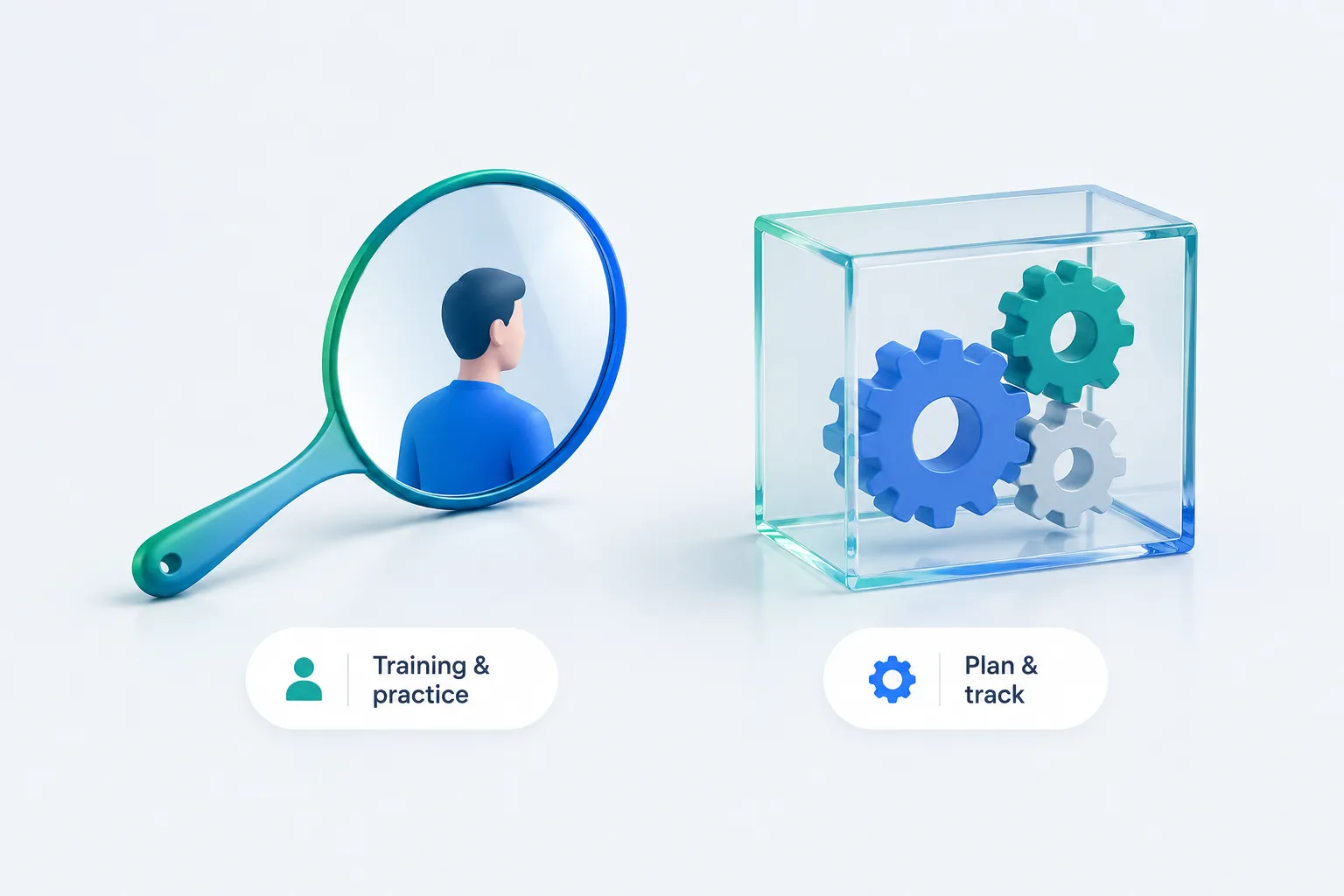
The Knowledge and Ability elements of ADKAR turn into concrete training and practice once desire exists. Prosci's Manage Change phase produces a Master Change Management Plan here, consolidating individual plans into one guiding document for the change team, while transformation leaders also need a way to see whether skills and usage are actually shifting.
A note on reading survey results at this stage: when employees report higher confidence, skill, or perceived productivity, that describes their own perception, not a measured or audited change in output. In one Gallup survey, most AI-adopting employees said AI had improved their personal productivity, a figure that reflects self-report rather than proof. Treat that figure as a useful signal for coaching decisions, not a verified outcome.
Gallup's data also found that despite these personal productivity perceptions, many organizations had not yet redesigned workflows, roles, or processes around AI, meaning individual skill gains do not automatically translate into organizational change.
| Dimension | Definition | Example signal | Data source |
|---|---|---|---|
| Usage | How often and for what tasks employees use AI tools | Frequency of tool use in daily work | Employee self-report |
| Skills | Employees' confidence and competence applying AI | Ability to complete a task independently | Employee self-report |
| Readiness | Whether teams feel prepared for upcoming changes | Comfort with planned process changes | Employee self-report |
| Barriers | Obstacles employees say slow adoption | Reported lack of time or unclear guidance | Employee self-report |
| Perceived impact | Employees' sense of productivity or quality change | Self-reported time saved or output change | Employee self-report |
Sources: The Prosci ADKAR® Model | Prosci, Prosci 3-Phase Process, Rising AI Adoption Spurs Workforce Changes
Stage 4: Reinforce and Sustain the Change
Prosci's Sustain phase and ADKAR's Reinforcement element both treat the end of rollout as the start of a longer effort, not the finish line. Leaders who close the project plan at go-live often see early gains fade as habits drift back to old workflows.
Given that lag, reinforcement often means revisiting roles and processes repeatedly as tools and use cases keep changing, rather than treating adoption as finished after one training push.
Sources: The Prosci ADKAR® Model | Prosci, Prosci 3-Phase Process, Rising AI Adoption Spurs Workforce Changes
Governance Checkpoints to Add Alongside Change Stages
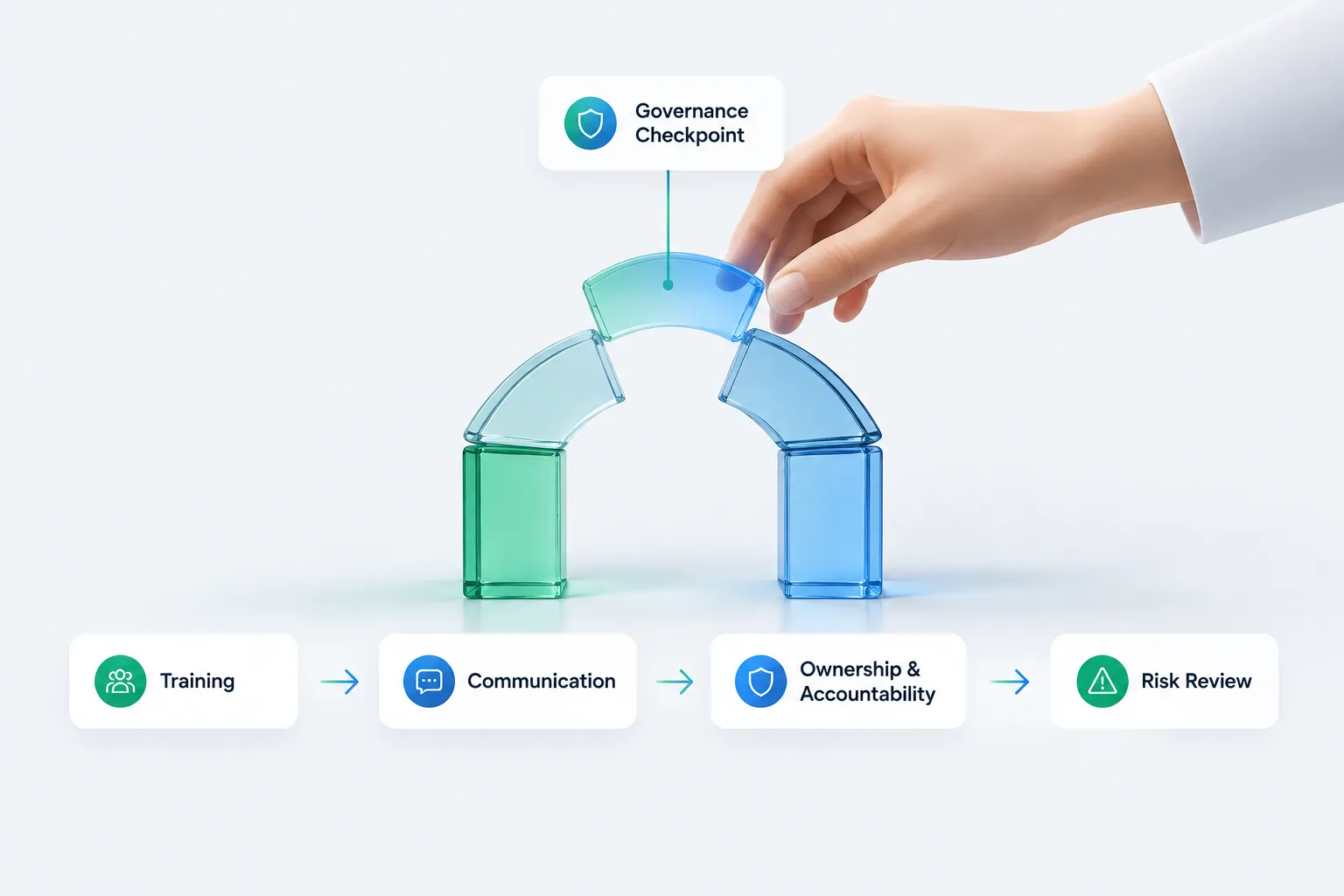
Grant Thornton's own survey report on senior leaders finds that organizations with stronger AI governance practices tend to adopt AI faster, suggesting governance and change management reinforce rather than compete with each other. That pattern is correlational, drawn from executive self-reports rather than a controlled study of cause and effect.
One Grant Thornton advisory leader described the underlying gap this way in the firm's own report:
“AI deployment has outpaced the infrastructure to defend it.”
— Tom Puthiyamadam, Managing Partner, Advisory Services, Grant Thornton Advisors LLC, as identified in the report · Source: 2026 AI Impact Survey Report | Grant Thornton
Grant Thornton's governance findings show what is change management in project management without governance: an incomplete plan. This gap is a reason to add governance as its own checkpoint, alongside training and communication, rather than assuming ownership, accountability, and risk review happen automatically during technical rollout.
Sources: 2026 AI Impact Survey Report | Grant Thornton
Frequently asked questions
Who should own the change management stages in an AI project plan?
Usually a transformation or program lead coordinates the stages, working alongside project sponsors, people teams, and L&D. They typically report progress to an executive sponsor who holds budget and priority decisions, keeping the change plan visible alongside the technical rollout.
How long should each change stage take in an AI rollout?
Not documented in general terms, since duration depends on project scope and organization size. A practical approach is to move forward only once readiness and skills checks show real progress at that stage, rather than advancing on a fixed calendar schedule.
How often should employee surveys be repeated across the stages?
There is no single validated cadence. A reasonable pattern is surveying before launch, shortly after initial rollout, and again once new workflows have had time to settle, so leaders see how readiness and barriers shift rather than relying on one snapshot.
Does completing all four stages guarantee successful AI adoption?
No. These frameworks provide a structured sequence, but as noted earlier, survey findings describe employee perceptions rather than proof that following the stages caused adoption success. Completing every stage reduces guesswork about what employees need next; it does not guarantee that adoption will succeed or that outcomes will follow automatically.
Where does governance fit if we're already using a change management framework?
Add it at each stage gate: before scaling from pilot to full rollout, and again before declaring the reinforcement stage complete. Survey data has linked stronger governance practices to faster organizational AI adoption, so treating these checkpoints as fixed calendar items, not afterthoughts, is worth the effort.
Sources: Rising AI Adoption Spurs Workforce Changes, 2026 AI Impact Survey Report | Grant Thornton