
Why Organizational AI Readiness Checks Matter Before Scaling
Before rolling AI tools out to every team, many CIOs and CTOs run some version of an organizational AI readiness check, sometimes called an AI assessment, to confirm foundations are actually in place rather than assumed. Skipping that step often means discovering gaps in governance, data or skills only after the rollout is underway.
How to read the findings below: most figures come from vendor-commissioned surveys or opinion columns in which leaders describe their own perceptions, not independent audits or controlled studies of outcomes. Treat them as self-reported snapshots of how organizations describe their own state, not proof that any single practice causes better AI results.
Strategy and Leadership Alignment
A readiness check should start with who owns the decision, not just what technology is deployed. One Forbes Technology Council framework, proposed by Intetics CEO Boris Kontsevoi, argues that organizational AI readiness rests on five interdependent dimensions, where the weakest dimension limits how far a company can safely scale.
That framing reflects a broader shift in how leaders are asked to treat the topic.
“AI readiness is no longer an IT concern; it is a leadership responsibility.”
— Boris Kontsevoi, Technology executive, President and CEO of Intetics Inc., a global software engineering and data processing company · Source: The 5-Dimension Assessment For AI Readiness: A Board-Level Framework
Sources: The 5-Dimension Assessment For AI Readiness: A Board-Level Framework
Data and Infrastructure Foundations
A separate Forbes Technology Council framework, from an analytics-vendor CEO, holds that data engineering, data governance and data explainability together determine whether AI scales beyond isolated pilots or stays stuck as one-off experiments.
A readiness check can use this as a prompt to verify pipeline quality, access controls and lineage documentation before committing budget to a company-wide rollout, since data gaps are a recurring theme across the sources reviewed.
Sources: Moving On From Pilots: The Critical Steps To Scaling Enterprise AI
Governance, Risk and Responsible-AI Oversight
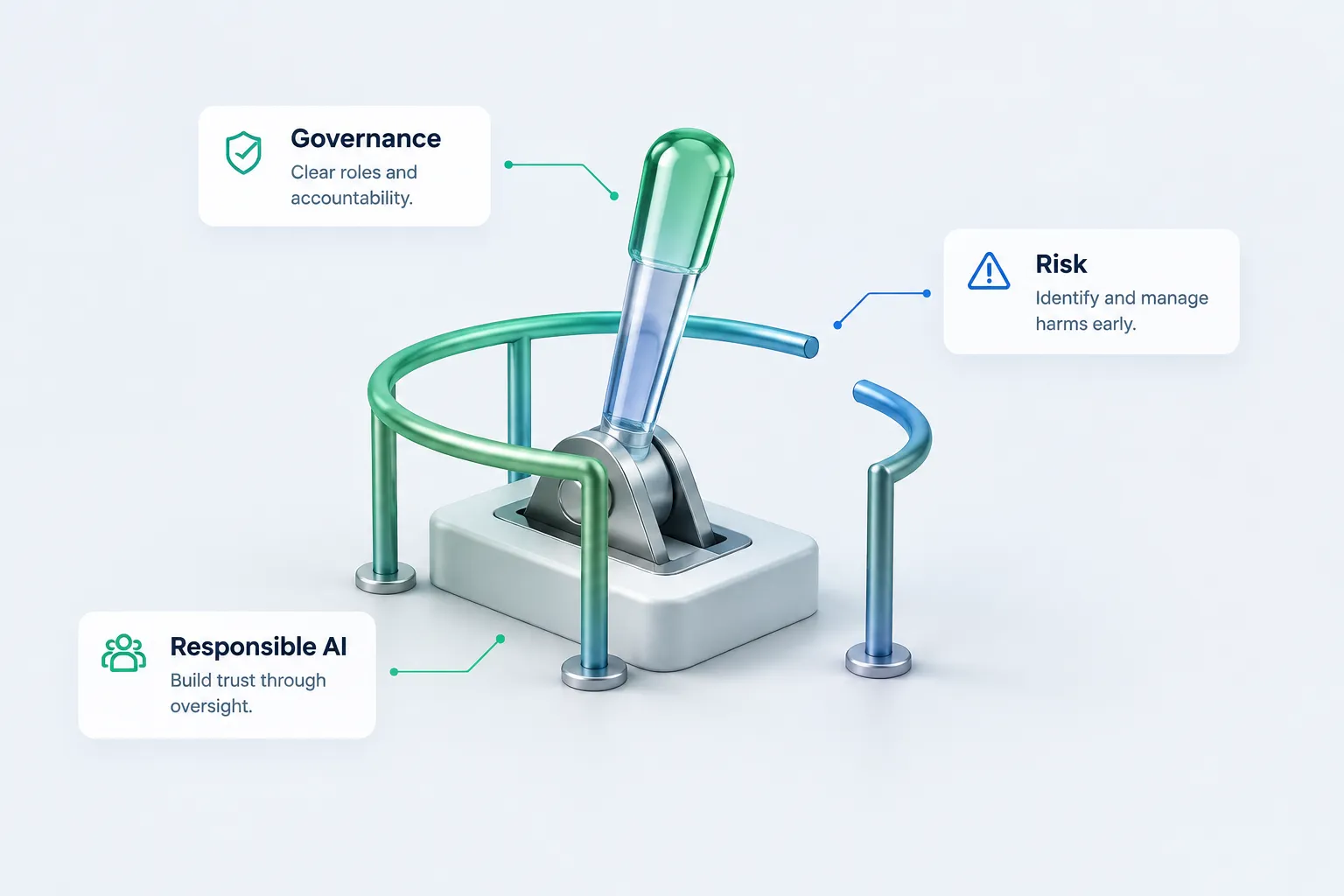
Governance is where several sources describe the widest gap between ambition and current state. NIST's AI Risk Management Framework offers voluntary guidance for incorporating trustworthiness considerations into an AI system's design, development, use and evaluation, though it is not itself a scaling checklist.
The table below compares governance signals a readiness check might verify, each drawn from a different source.
| Signal | What it checks | Reported gap | Source |
|---|---|---|---|
| Trustworthiness framework | Structured risk consideration across an AI system's lifecycle | Voluntary guidance, not a readiness stage or certification | NIST AI Risk Management Framework |
| Agent action guardrails | Live monitoring and control of autonomous AI agent actions | Only 24% of organizations report having this in place | Cisco AI Readiness Index |
| Comprehensive AI policy | A documented, company-wide AI policy | Most organizations reported not having one as of a 2023 survey | Cisco and Futurum, 2023 |
| Agent governance maturity | A mature oversight model for autonomous agents | About one in five companies reported having this | Deloitte, August-September 2025 |
Even against these gaps, 72% of CEOs surveyed by Cisco in January 2026 across companies with 250 or more employees expect humans to remain accountable for AI-related decisions by 2030 — a sign that oversight expectations are rising faster than the guardrails many organizations report having in place today.
Sources: AI Risk Management Framework | NIST, Cisco AI Readiness Index - Cisco, Cisco Study Finds Only 14% of Global Organizations Are AI-Ready - Futurum, The State of AI in the Enterprise - 2026 AI report | Deloitte US
Talent, Skills and Culture
Technology and governance checks matter little if the people expected to use AI daily lack skills or confidence. Camunda CEO Jakob Freund frames this as a question of organizational maturity rather than model sophistication.
“AI readiness is not defined by the power of the models you deploy but by the maturity of the systems you build around them.”
— Jakob Freund, CEO of Camunda, a software company innovating end-to-end process orchestration and automation with agentic AI · Source: A CIO's Guide To Scaling Enterprise AI Readiness
Measurement and Training Effectiveness
A readiness check should confirm measurement exists before scaling, not after. Among organizations Cisco's January 2026 survey identified as the most AI-ready, most reported having defined metrics for AI's impact, and about two-thirds reported measuring the effectiveness of their AI training — a pattern far less common across the wider surveyed population.
That gap is itself a useful readiness signal: an organization without defined impact metrics has no way to distinguish perceived productivity gains from measured change over time.
Sources: How CEOs see AI in 2026 - Cisco
Change Management and Employee Adoption
Editorial frameworks commonly flag employee resistance, unclear role expectations and thin support structures as barriers once AI tools move from a pilot team to the whole company. A thorough organizational AI readiness check treats change management as a distinct dimension from technical readiness, not an afterthought.
A readiness check should ask whether communication plans, manager support and feedback channels exist before removing pilot-stage restrictions, not assume adoption will follow once access is granted.
What Completing the Checklist Means
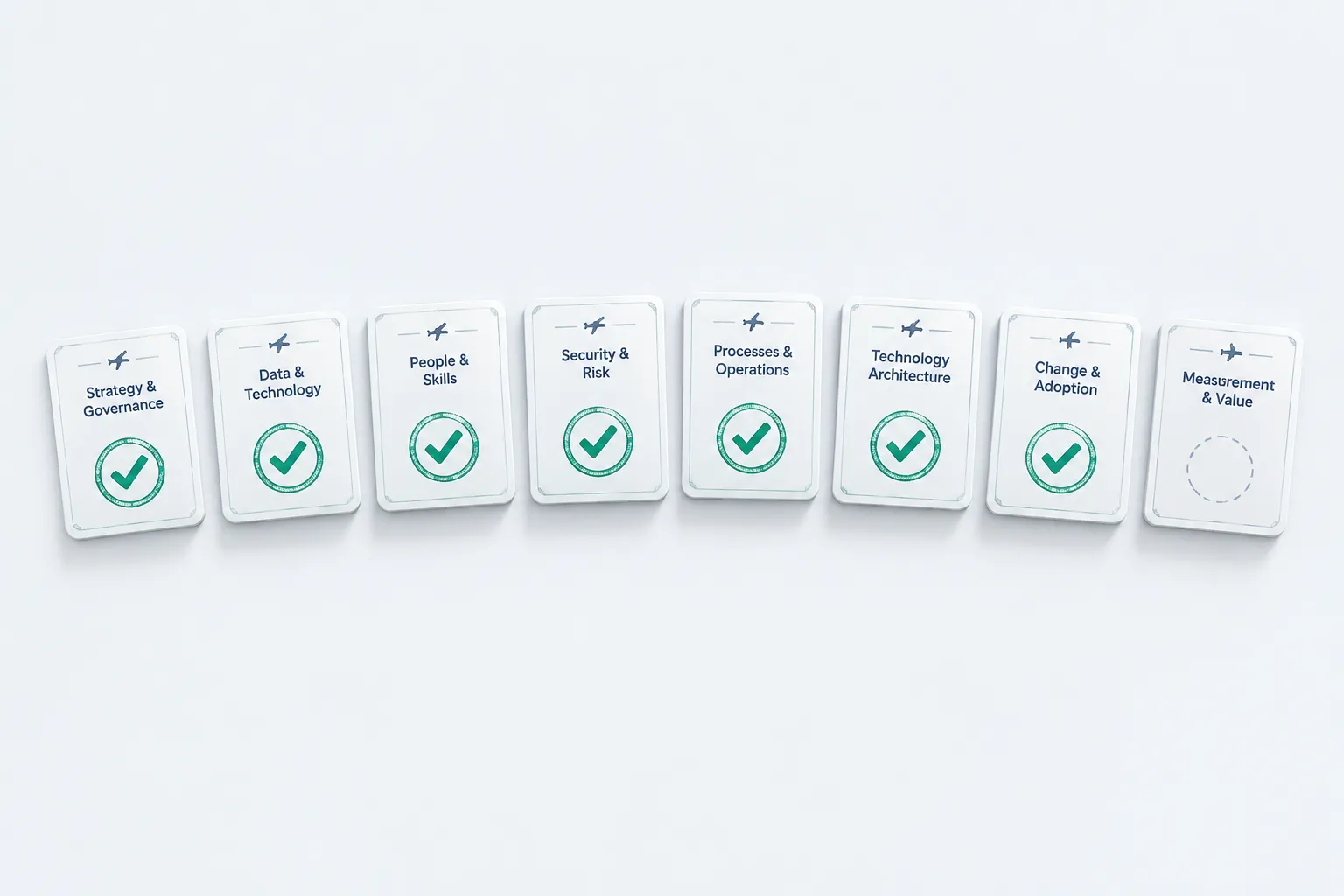
Completing an organizational AI readiness checklist does not certify success; it means every dimension below has a documented, current answer rather than an aspiration. Sources reviewed here describe no single universal threshold for being officially ready, so treat this as a staged go or no-go decision rather than a score to clear once.
The checklist below groups the dimensions discussed above into concrete checks a CIO or CTO can tick off before approving a company-wide rollout.
Frequently asked questions
Who should own the organizational AI readiness check inside a company?
A single accountable executive should own the decision, rather than leaving it spread across IT, HR and business units. Editorial guidance suggests naming one owner before funding a company-wide rollout so the go/no-go call has a clear decision-maker.
How often should a readiness check be repeated after the first rollout?
There is no documented industry standard cadence in the sources reviewed here. As a suggestion, many teams treat it as a living check, revisiting governance, skills and measurement dimensions whenever tools, policies or headcount change materially, not only once before launch.
Does passing every checklist item guarantee successful AI scaling?
No. A completed checklist reduces known gaps across the dimensions covered here, but it does not guarantee successful scaling, adoption or measured performance outcomes on its own.
What is the difference between an AI readiness check and an AI maturity assessment?
The terms overlap in practice. Readiness usually asks whether foundations are in place before scaling; maturity assessments often describe how advanced current AI use already is. Both draw on similar dimensions such as governance, skills and data, per the frameworks discussed above.
Sources: The 5-Dimension Assessment For AI Readiness: A Board-Level Framework, Moving On From Pilots: The Critical Steps To Scaling Enterprise AI