
The update: what Gallup announced on September 9, 2026
On September 9, 2026, Gallup published a Gallup AI workforce study titled "Using AI More Does Not Reassure Workers, Managers Do." The announcement reports that frequent AI use at work does not, by itself, ease an employee's fear of being replaced by the technology. What appears to matter more is how respected and supported that employee feels.
According to the announcement, the finding draws on Gallup Panel data tracking the same U.S. employees over time, comparing each person's own responses as their AI use and perceptions changed between 2023 and early 2026. Gallup describes this workplace AI displacement study as evidence that manager behavior, not adoption speed, shapes how workers feel about their job security.
Sources: Using AI More Does Not Reassure Workers, Managers Do
The core finding: AI use job displacement fear rises with frequency
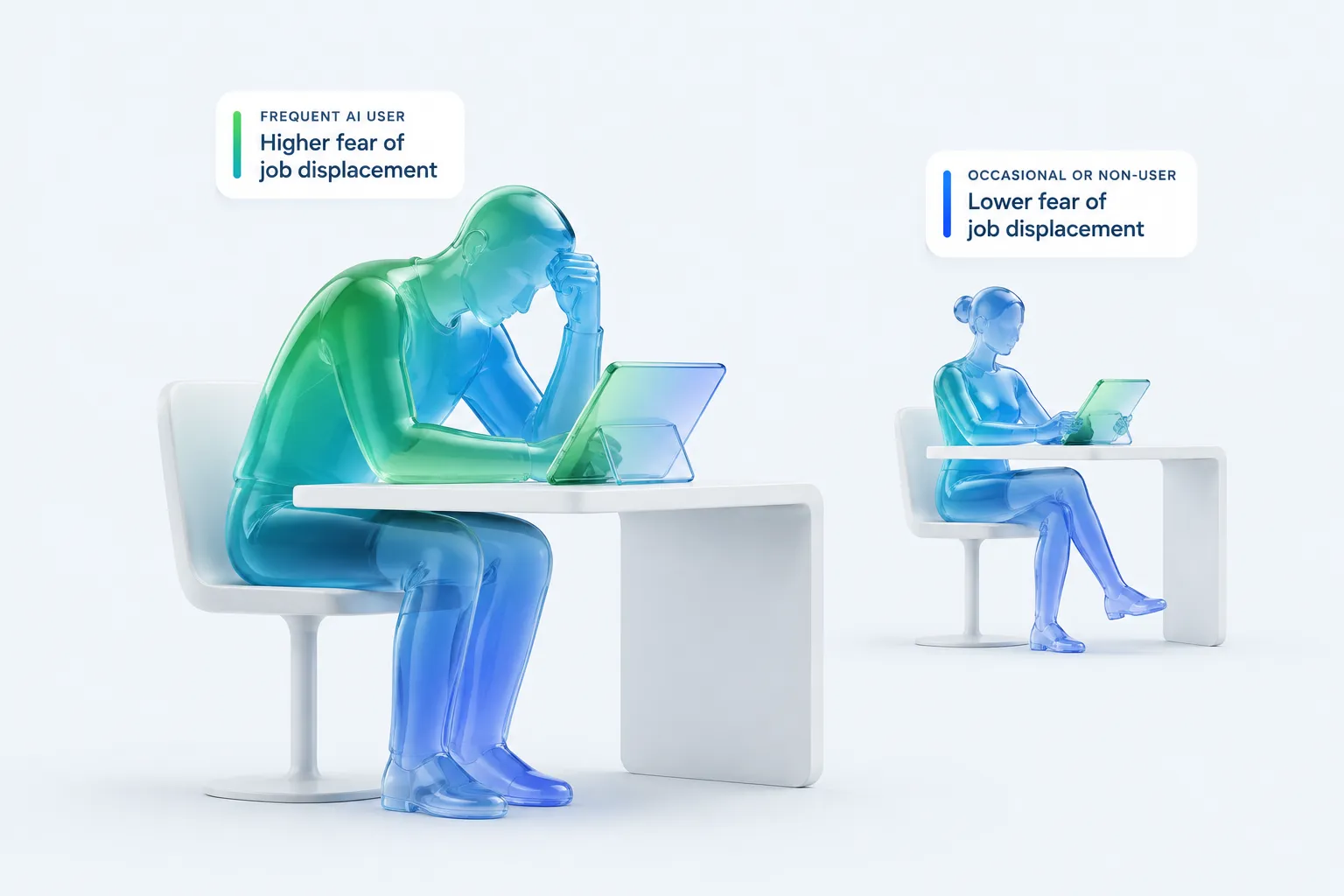
Gallup reports that among workers who use AI most frequently, fear of job displacement is measurably higher than among occasional or non-users. The announcement frames this as the central puzzle behind the Gallup AI workforce study: greater familiarity with AI tools does not automatically translate into greater confidence about one's own job.
A quick note on interpretation: Gallup's findings describe associations from self-reported survey responses collected over time, not results from a randomized test of specific management actions. Reading them as reliable signals about where this AI use job displacement fear pattern concentrates, rather than as proof that one intervention caused a change, is the more accurate approach.
Gallup states that this pattern held even after accounting for broad shifts in sentiment over time, since the panel design lets researchers compare each employee to their earlier self rather than to a different group of people.
Sources: Using AI More Does Not Reassure Workers, Managers Do
Why manager support outweighs usage frequency
The announcement's key contribution is narrowing down what changes the picture: among employees who feel most respected by their organization, the statistical link between frequent AI use and displacement fear shrinks substantially compared with workers who feel less respected. Gallup reports this gap at 6.8 points smaller, drawn from the panel regression described above.
Gallup senior researcher Christos Makridis, commenting on the analysis, points to management as a lever separate from technology exposure itself.
“Better management may not erase workers’ fears about job elimination due to AI, but it can substantially ease those fears”
— Christos Makridis, Ph.D., Content Senior Researcher at Gallup · Source: Using AI More Does Not Reassure Workers, Managers Do
Gallup's announcement does not specify which exact manager behaviors produce this effect, only that perceived respect and wellbeing are the two factors most closely associated with lower fear among frequent AI users. That distinction matters because it shapes the management practices AI job security depends on, particularly how People teams design AI rollout communications.
Sources: Using AI More Does Not Reassure Workers, Managers Do
Who this affects
The announcement states that displacement fear is not felt equally across the workforce. Frequent AI users show the strongest reported link between AI use and displacement fear, particularly when they do not feel respected or supported by their organization, according to Gallup's analysis.
Separately, an April 2026 Gallup report found that half of employed U.S. adults said they used AI in their role at least a few times a year, context that helps explain why displacement fear has become a widespread management concern rather than a niche one.
Sources: Using AI More Does Not Reassure Workers, Managers Do, Rising AI Adoption Spurs Workforce Changes
What People leaders should do now
Gallup's announcement does not prescribe a specific training program, but its findings point toward a few practical shifts for People and AI adoption leaders managing rollout communications and manager enablement.
The checklist below groups these shifts as a starting point for People teams to adapt to their own rollout and management practices.
Sources: Using AI More Does Not Reassure Workers, Managers Do
What Gallup's study does not tell us yet
Several questions remain open. Gallup's September 9 announcement does not provide a full breakdown by industry, company size, or country; it also does not describe a specific manager training program, a hosted dashboard, or other editions of the study. Where the announcement is silent, that silence is treated here as unstated rather than as evidence.
The announcement does not distinguish frontline managers from senior leadership when discussing which relationships matter most for easing displacement fear, so readers should not assume the effect applies equally to both.
Gallup separately reports that it is building a global survey of AI awareness, use and attitudes across more than 140 countries, work that could eventually test whether the manager-support pattern found in the U.S. holds elsewhere, though that project is not part of this announcement.
Sources: Using AI More Does Not Reassure Workers, Managers Do, How Gallup Developed Global Survey Questions About AI
Explore your organization's AI adoption and management signals
This Gallup AI workforce study suggests that employee confidence during AI rollouts depends less on how much AI people use and more on whether they feel supported by their managers. For Chief People Officers weighing how to manage AI adoption inside their own organization, that means measurement needs to cover more than usage rates.
Frequently asked questions
Does Gallup's announcement provide example questions or conversation prompts managers could use?
No, Gallup's announcement does not provide a script. As an editorial suggestion, not a validated Gallup tool, People teams might pilot manager check-ins that ask how each employee's work and evaluation criteria are changing because of AI, then refine from there.
Should organizations wait for data from outside the U.S. before acting on this finding?
No. Gallup's announcement covers only U.S. employed adults, so it doesn't confirm the pattern elsewhere. Organizations don't need to wait: piloting manager-support practices domestically now, and watching engagement scores as an early signal, is reasonable regardless of whether future non-U.S. data confirms the same pattern.
If Gallup doesn't distinguish frontline managers from senior leaders, who should People teams engage first?
That choice isn't specified by Gallup. As editorial guidance, prioritizing frontline managers may be reasonable since they have the most regular contact with frequent AI users, though this is an interpretation, not a tested recommendation from the study.
How often should People teams reassess AI-related anxiety among employees?
Gallup's announcement does not recommend a cadence. As editorial guidance, revisiting engagement and sentiment signals whenever AI tools, roles or evaluation criteria change is a reasonable starting point until an organization sets its own rhythm.
Sources: How Gallup Developed Global Survey Questions About AI