
Why a Gen AI Readiness Assessment Needs a Prompting and Verification Check
Before a company-wide Copilot-style rollout, a generic gen ai readiness assessment that only checks infrastructure, security posture, and general enthusiasm misses a narrower but consequential question: do employees know how to prompt these tools effectively, and do they know when to double-check what the tool produces.
Vendor guidance on Copilot-style rollouts specifically names understanding of how to prompt AI and when to trust its output as a distinct skill gap worth checking on its own, separate from broad AI literacy or general sentiment questions.
Sources: Is Your Organization Ready for Microsoft Copilot? | Worklytics
The Specific Skill Gap: Prompting and Trust
Two separate skills sit inside this gap. The first is prompt construction: can an employee give an AI tool enough context to get a useful answer, or do they send short, vague queries and accept whatever comes back.
The second is judgment about trust: does the employee know when an answer needs checking against a source, a colleague, or their own expertise, versus when it is low-stakes enough to use as-is. A rollout readiness check should ask about both, because strong prompting skill does not guarantee good verification habits, and vice versa.
Sources: Is Your Organization Ready for Microsoft Copilot? | Worklytics
Using Surveys to Capture Sentiment and Behavior Before Rollout

A practical gen ai readiness assessment can use employee surveys to capture initial self-reported sentiment and behavior as a reference point before the tool rolls out broadly, giving L&D something concrete to compare against later.
How to read these results: survey answers describe what employees say about their prompting habits, confidence, and verification checks, not a verified log of what they actually did. Treat the findings as self-reported starting points for comparison, not as proof that behavior has changed.
| Metric | What it captures | Example signal | Data source |
|---|---|---|---|
| Prompting confidence | Self-reported comfort writing context-rich prompts | Employee rates how often a first prompt gets a usable answer | Pre-rollout survey |
| Verification frequency | How often employees say they check AI output before using it | Employee reports checking accuracy or sourcing on sensitive tasks | Pre-rollout survey |
| Trust calibration | When employees say they trust output versus double-check it | Employee names situations that trigger a manual check | Pre-rollout survey |
Sources: Is Your Organization Ready for Microsoft Copilot? | Worklytics
What Broader Readiness Checks Leave Out About Day-to-Day AI Use
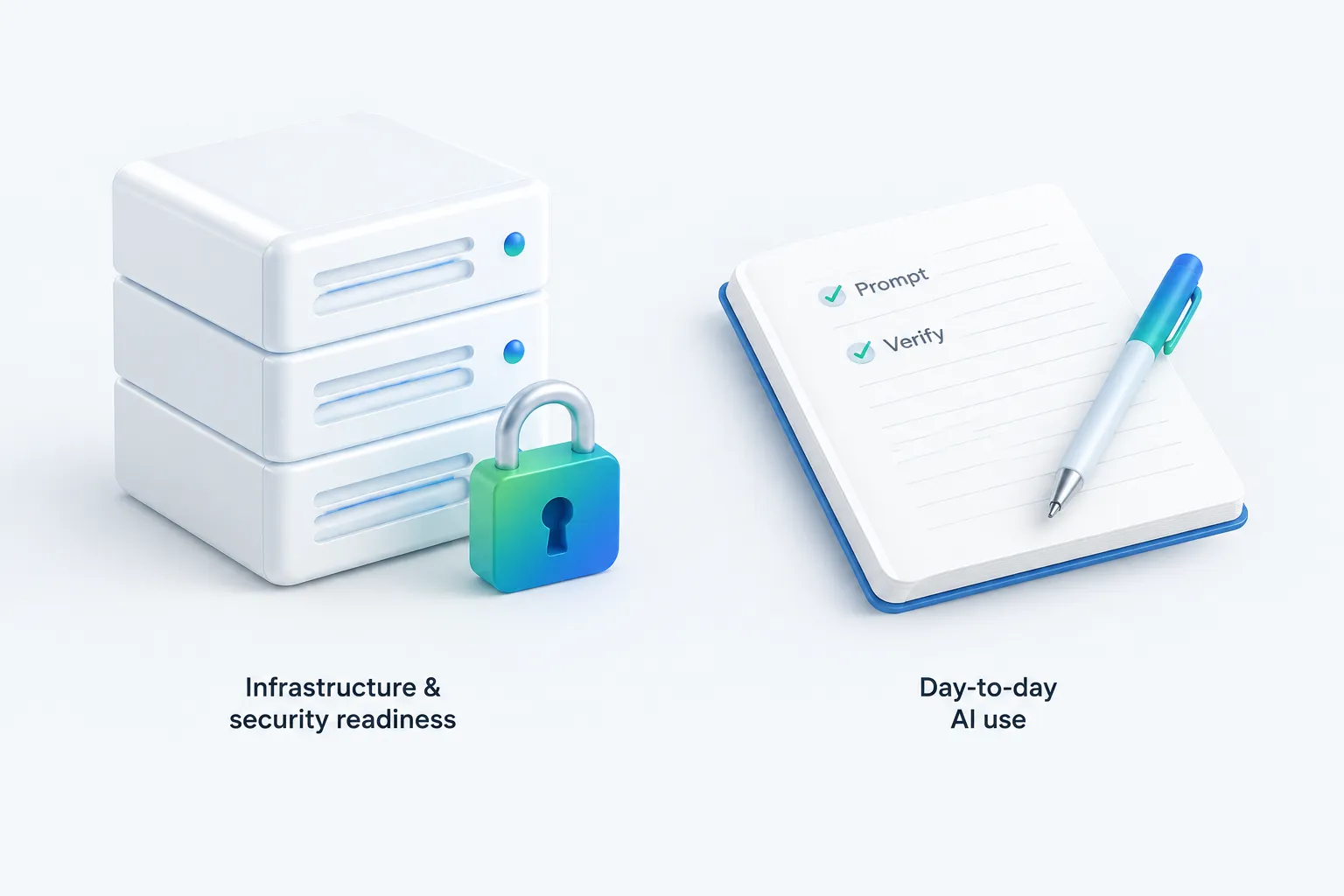
Vendor guidance frames a dedicated pre-rollout assessment as a way to reduce false starts once a tool deploys broadly; this is an editorial claim from a source promoting its own approach and is not backed by independent evidence, but it points at a real gap.
Security reviews, infrastructure checks, and culture surveys tell you whether the organization can support AI tools and whether leadership is bought in. They generally do not tell you whether an individual employee writes a usable prompt or pauses to verify a client-facing answer.
Sources: Is Your Organization Ready for Microsoft Copilot? | Worklytics
A Practical Pre-Rollout Checklist for L&D Leaders
The following items are suggested question areas for an L&D-led readiness check, not a validated instrument. Adapt wording to your organization's tools and risk profile before using them.
Sources: Is Your Organization Ready for Microsoft Copilot? | Worklytics
Turning Survey Results into Training Priorities
Once baseline answers from a gen ai readiness assessment are in hand, L&D can decide whether initial training should emphasize prompt construction, output verification, or both, instead of running a generic AI 101 session for every team.
From baseline survey to training priority
- Collect baseline: Survey employees on prompting habits and verification triggers before rollout.
- Review patterns: L&D reviews where confidence is low or verification checks are inconsistent.
- Prioritize training focus: Decide whether initial sessions emphasize prompt construction, output verification, or both.
- Recheck after rollout: Repeat the same questions after rollout to see whether reported habits shifted.
This prompting and verification check works best as a supplement to broader readiness areas like data security, governance, and infrastructure, which cover different risks and should not be replaced by it.
Repeating the same questions after rollout lets L&D see whether reported prompting confidence and verification habits shifted, distinct from the usage-volume metrics IT teams typically track.
Sources: Is Your Organization Ready for Microsoft Copilot? | Worklytics
Frequently asked questions
Who should own the prompting and verification check, L&D or IT?
L&D is generally better positioned to own this check because it feeds training design, while IT typically owns usage-volume and security metrics. The two should coordinate, since verification habits and security risk overlap but require different survey questions.
How often should the survey be repeated after rollout?
There is no single validated cadence. A common editorial approach is to repeat the same baseline questions shortly after initial training and again a few months later, to see whether reported prompting confidence and verification habits have shifted.
Should this check replace security or governance readiness reviews?
No, keep the two separate but coordinated. Share prompting and verification findings with security or governance teams so they can flag risk signals like low reported checking on sensitive tasks, while L&D uses the same data to shape training content.
Can survey results prove the rollout improved productivity or accuracy?
No. Use the self-reported shifts to decide where training emphasis should go next, such as adding more verification practice if reported checks stay low, rather than to score productivity or accuracy gains.
Sources: Is Your Organization Ready for Microsoft Copilot? | Worklytics