What Is Change Management in HR — and Why AI Rollouts Need It
What is change management in HR when the change itself is artificial intelligence? In practice, it means treating an AI rollout the way HR treats any major workforce shift: preparing people's awareness, skills and motivation, not only installing software. When AI tools arrive without that layer, IT ships a deployment plan, employees get a login, and adoption stalls.
That gap shows up in how organizations describe building AI strategy. HR professionals surveyed by SHRM reported that more than half of organizations do not involve HR in setting AI strategy or vision. Separately, Protiviti's survey found CHROs report far less confidence than IT leaders that their organizations are ready to redesign roles for AI.
How to read these results: the percentages above describe how HR professionals and executives perceived their own organizations in 2026 surveys. They are self-reported impressions, not independent measurements of what happened inside those companies, and they do not prove that HR involvement causes better AI adoption outcomes.
Sources: The State of AI in HR in 2026: 5 Critical Insights for CHROs, AI Pulse Survey 2026: Workforce & AI Readiness | Protiviti US
Two Models for Sequencing the Change Management Cycle: ADKAR and Kotter
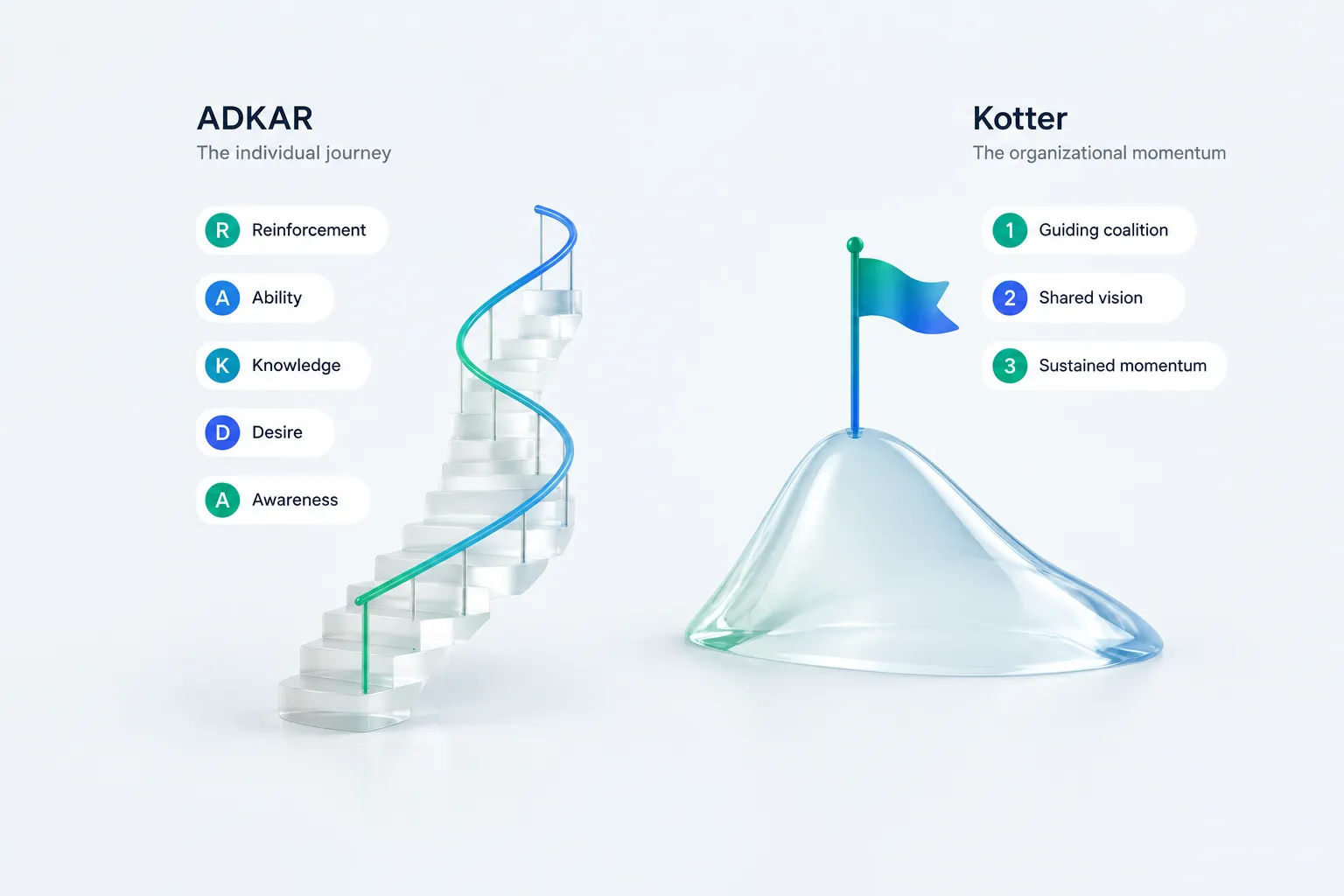
Two established frameworks can help HR sequence the change management cycle for an AI rollout. Prosci, the consultancy behind ADKAR, describes the model as focusing on the individual: building awareness of why AI is changing the work, desire to engage, knowledge of how to use new tools, ability to apply skills, and reinforcement so the change sticks.
“The ADKAR Model has been a great complement to AI adoption, supporting a greater understanding of the individual change model.”
— Chris Lunney, Change Execution/Lean Process Improvement Leader (per the page) · Source: The Prosci ADKAR® Model | Prosci
Kotter's 8-step model works at the organizational level instead, sequencing a guiding coalition, a shared vision and sustained momentum. Kotter's own materials describe removing obstacles that block people from adopting new ways of working, and collecting and communicating short-term wins early and often to keep momentum going.
Both descriptions come from the vendors' own published methodology pages — Prosci for ADKAR and Kotter Inc. for the 8-step model — presenting their proprietary frameworks. Neither page offers independent third-party evaluation of how effective the framework is in practice.
Used together, ADKAR paces what each employee experiences while Kotter's steps align leadership and communication across the wider organization. HR teams may find it useful to borrow structure from both rather than adopting either model exactly as published.
| Framework | Level of focus | Key mechanism |
|---|---|---|
| ADKAR | Individual employee | Awareness, desire, knowledge, ability, reinforcement, per Prosci's published model |
| Kotter's 8 steps | Organization-wide | Removing obstacles, generating short-term wins |
Sources: The 8-Step Process for Leading Change | Dr. John Kotter
Where AI Rollouts Commonly Stall
Answering what is change management in HR for an AI rollout starts with naming where it breaks down. Drawing on 1,908 HR professionals, SHRM's 2026 survey found HR is frequently absent from strategy conversations, and even where AI-driven upskilling is underway, only a minority of respondents said HR is the function leading it.
Protiviti's survey of executives adds a related signal: CHROs report notably lower confidence than IT leaders that their organizations are ready to redesign roles around AI.
- HR left out of AI strategy and vision setting, according to surveyed HR professionals
- AI-driven upskilling often led by functions other than HR
- CHROs reporting lower confidence than IT leaders in role-redesign readiness
Sources: The State of AI in HR 2026, The State of AI in HR in 2026: 5 Critical Insights for CHROs, AI Pulse Survey 2026: Workforce & AI Readiness | Protiviti US
A Practical Phased Structure for an HR AI Change Management Plan

Combining the two models above with where organizations report stalling suggests a five-stage structure HR can adapt, rather than a single launch-and-train event.
A five-stage HR AI change management structure
- Secure a seat: HR joins strategy and governance conversations before a rollout plan is finalized.
- Pilot and assess: A small group tests the tool while HR gathers readiness, skills and barrier data.
- Build coalition and communicate wins: Leaders across functions align, and early results are shared often, echoing Kotter's short-term wins.
- Scale with reinforcement: Training and support expand to more employees, paced by ADKAR's ability and reinforcement stages.
- Measure and iterate: Adoption and reported barriers are checked again before the next expansion decision.
Building in a measurement checkpoint from the first pilot, rather than after a full rollout, is a deliberate design choice: it keeps the plan adjustable and gives HR evidence to justify scaling decisions.
Sources: The 8-Step Process for Leading Change | Dr. John Kotter, The State of AI in HR in 2026: 5 Critical Insights for CHROs, AI Pulse Survey 2026: Workforce & AI Readiness | Protiviti US
Where Employee Surveys Fit in Sequencing the Rollout
Employee surveys are one practical way to gather the readiness, culture, leadership-support and barrier signals a phased plan depends on. In Protiviti's survey, organizations that reported effective AI adoption pointed to learning programs, employee involvement and clear communication as the approaches behind that success, suggesting these are reasonable areas to ask about.
Employees reported barriers and confidence levels can then guide sequencing decisions: which team pilots next, which skill gap needs training first, and where leadership support still needs reinforcing. Revisiting these signals at each phase transition keeps the sequencing responsive as the rollout expands beyond the pilot group.
Sources: AI Pulse Survey 2026: Workforce & AI Readiness | Protiviti US
A Starting Structure for the Next 90 Days
That's the practical answer to what is change management in HR when applied to AI: a repeatable structure, not a one-time training day. The next 90 days can be organized around a short checklist rather than a finished roadmap.
None of this replaces judgment about your organization's pace, culture or existing AI maturity, but it gives HR a starting sequence rather than a blank page.
Frequently asked questions
Who should own an HR AI change management plan, HR or IT?
IT typically owns technical deployment, but the change plan works best as a shared effort with HR leading the people side — readiness, training and communication — while staying aligned with IT's timeline and governance requirements throughout the rollout.
How long should a pilot phase run before scaling AI to the whole company?
There's no fixed length; readiness is the better guide than the calendar. Extend the pilot until surveyed readiness, skills gaps and reported barriers have been reviewed and addressed, then set a scaling checkpoint instead of a fixed end date.
How often should HR re-survey employees during an AI rollout?
Many HR teams check in at each major checkpoint — after the pilot, before scaling, and periodically during reinforcement — rather than on a fixed monthly cadence. The right frequency depends on how fast the rollout is expanding and how much is changing.
What happens if leadership doesn't prioritize a formal AI change plan?
Skipping a formal plan rarely stops deployment, but it usually means adoption goes untracked and training decisions get made ad hoc. Without checkpoints, HR has little evidence to justify slowing a rollout, adding training budget, or addressing barriers before they compound.
Sources: The State of AI in HR in 2026: 5 Critical Insights for CHROs, AI Pulse Survey 2026: Workforce & AI Readiness | Protiviti US