
Running every AI workstream at once stalls them all
You scored your organization, and now your board wants the AI maturity roadmap that follows: what gets fixed first, second, and third over the next year. The pull is to launch skills training, a governance council, workflow redesign, and a wider rollout in the same quarter.
Do that and your AI maturity roadmap turns into six half-finished projects instead of one that actually moves.
McKinsey's October–November 2024 survey of more than 3,600 employees and 238 C-level executives, mostly at US companies, found that just 1 percent of leaders called their organization "mature" on AI deployment, even though 92 percent of those same companies planned to increase AI investment over the next three years.
Value numbers look just as uneven once you line up recent surveys side by side:
| Source | Finding | Population and year |
|---|---|---|
| BCG, December 2025 article | 60% of companies worldwide generate no material value from AI | Global companies, research cited 2025 |
| BCG 2025 maturity study | Only 26% of companies are creating real value from AI | 1,000 senior executives, 59 countries, 2025 |
| BCG Build for the Future, 2025 | Just 5% are achieving AI value at scale | More than 1,250 firms worldwide, 2025 |
| BCG AI at Work survey, July 2025 | Regular frontline AI use has stalled at 51% | Over 10,600 leaders, managers and frontline employees, 11 countries |
One fix finished beats five workstreams stalled at a third done.
Sources: AI in the workplace: A report for 2025 | McKinsey, AI Adoption Puzzle: Why Usage Is Up But Impact Is Not | BCG, The CIO’s Role in AI Transformation and Productivity | BCG, https://media-publications.bcg.com/The-Widening-AI-Value-Gap-Sept-2025.pdf, AI at Work 2025: Momentum Builds, but Gaps Remain | BCG
What matters more than the stage label
If you've looked at the AI maturity roadmap Gartner has published in its own marketing materials, the shape will look familiar: stages that start with ad hoc experimentation and limited coordination and end with scaled deployment carrying measurable return.
What AI roadmap maturity stages include varies from vendor to vendor. We're skeptical of any vendor's stage labels as a fixed standard; what matters is whether governance, skills and workflow actually moved, not which stage name you can now claim.
What research does support is that one jump matters more than any label. MIT CISR's original 2022 survey of 721 enterprises found organizations in the first two maturity stages had financial performance below their industry average, reported in CISR's August 2025 briefing.
A later MIT CISR survey of 152 organizations, reported by MIT Sloan in October 2025, found the biggest financial impact shows up when companies move from stage 2 to stage 3.
Sources: Gartner AI Maturity Model and AI Roadmap Toolkit | Gartner, Grow Enterprise AI Maturity for Bottom-Line Impact | MIT CISR, How to boost your organization’s AI maturity level | MIT Sloan
Fix governance first, in the first three months
Start here, not with tools. McKinsey's July 2024 Global Survey of 1,491 respondents whose organizations use AI found that 28 percent report their CEO is responsible for overseeing AI governance, more than any other single role.
“Effective AI implementation starts with a fully committed C-suite and, ideally, an engaged board.”
— Alexander Sukharevsky, Senior partner and global coleader of QuantumBlack, AI by McKinsey · Source: https://www.mckinsey.com/~/media/mckinsey/business%20functions/quantumblack/our%20insights/the%20state%20of%20ai/2025/the-state-of-ai-how-organizations-are-rewiring-to-capture-value_final.pdf
That's a correlation, not proof. McKinsey's own analysis found this attribute correlates with EBIT impact at an R-squared of only 0.20, so CEO ownership tracks with stronger results without fully explaining them.
This is also where the shape of an AI adoption measurement matters. AI Adoption Score maps every person, team and department across skills, usage, culture, impact, vision and governance, which is exactly the spread a governance sprint needs to see before it hands work to the business units.
CEO ownership of AI governance beats delegating it down
Handing AI governance to a committee with no senior sponsor is a common shortcut, and it's the one that leaves risk decisions stuck for months.
The sponsor effect shows up in change outcomes too. Prosci's benchmarking research found projects with extremely effective sponsors were 79 percent likely to meet their objectives, against 27 percent for projects with extremely ineffective sponsors.
That gap is large enough to treat sponsor quality as a line item, not a courtesy title. Put a name against it before you fund anything downstream.
Sources: Best Practices in Change Management
Centralize risk and data governance before you decentralize execution
Once a sponsor is named, the next move is structural: put one function in charge of risk and data rules before every team runs its own AI pilots. BCG's 2025 study of 1,000 senior executives found that 86 percent of "AI future-built" companies have IT leading or co-leading generative AI with the business, compared with 54 percent at AI-stagnating companies.
That's the pattern worth copying in the first quarter:
Sources: The CIO’s Role in AI Transformation and Productivity | BCG
Fix skills and workflows second, in months three to six
With a sponsor and a governance function in place, the second phase of your AI maturity roadmap is skills and workflow, not more pilots. BCG's prior research found only 36 percent of employees feel they've received adequate AI training, and Deloitte's 2026 global survey of senior leaders found insufficient worker skills are seen as the biggest barrier to integrating AI into existing workflows.
A predefined survey covering usage, skills and perceived barriers turns that general complaint into a specific fix. The AI Adoption Barriers Survey is built to uncover the actual reasons a given team isn't using AI more, rather than guessing from company-wide averages.
Sources: AI Adoption Puzzle: Why Usage Is Up But Impact Is Not | BCG, The State of AI in the Enterprise - 2026 AI report | Deloitte US
Training hours close the frontline adoption gap
The training gap has a visible floor. BCG's 2025 AI at Work survey of more than 10,600 leaders, managers and frontline employees across 11 countries found regular frontline AI use has stalled at 51 percent, and that regular usage is sharply higher among employees who get at least five hours of training.
Access alone doesn't close that gap. CompTIA's June 2026 AI Skills Tracker, surveying more than 1,000 business and technology leaders, found only 29 percent report a high level of familiarity with AI technologies even though 80 percent say they use AI tools multiple times a month.
The usual advice is to let people explore AI tools on their own time; we'd skip that and budget real training hours instead, since access alone hasn't closed the gap.
Sources: AI at Work 2025: Momentum Builds, but Gaps Remain | BCG, Survey of business and tech leaders reveals persistent gap between corporate AI adoption and workforce readiness
Redesign one workflow end to end before you add tools everywhere

Pick one high-volume workflow and rebuild it end to end before you expand to a second. A single rebuilt process shows what AI can actually change; a dozen shallow pilots mostly show that AI was present.
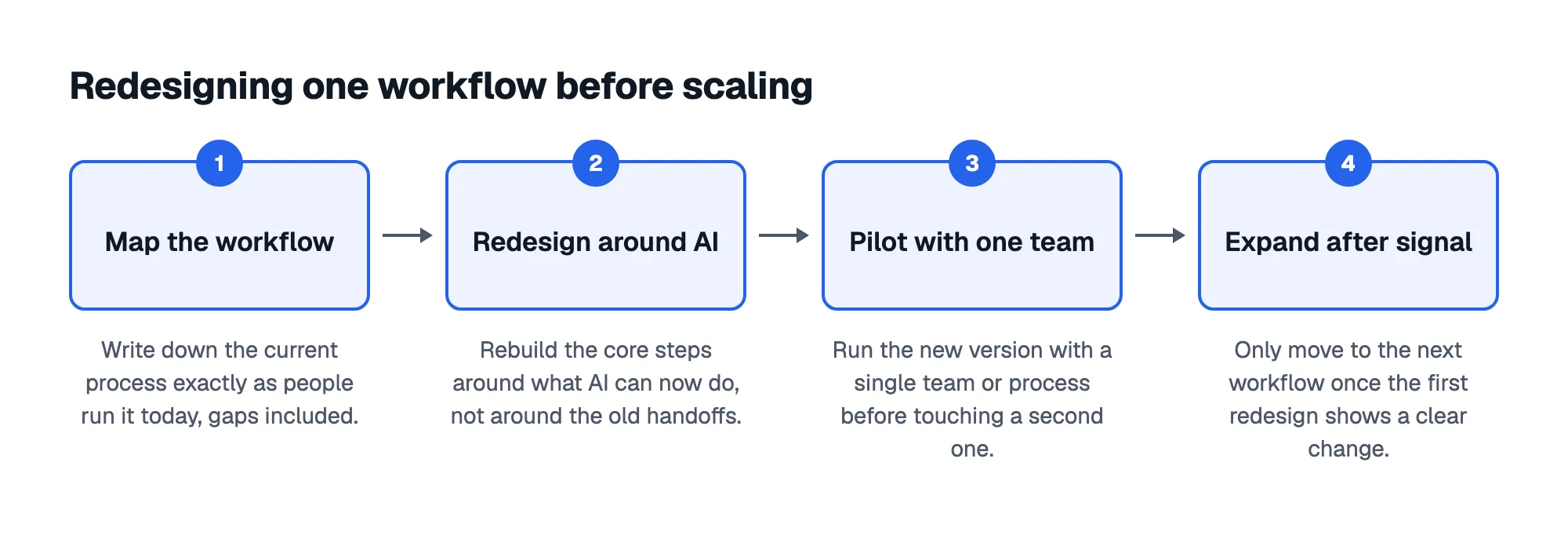
MIT CISR's interviews with Italgas describe its WorkOnSite AI tool accelerating construction project completion by 40 percent and cutting inspections by 80 percent, a single-company case, not a benchmark to assume for your own workflow.
MIT Sloan's October 2025 reporting on Guardian Life Insurance describes an RFP-automation pilot cutting turnaround time from about a week to 24 hours, another individual example rather than a general result to expect.
Sources: Grow Enterprise AI Maturity for Bottom-Line Impact | MIT CISR, How to boost your organization’s AI maturity level | MIT Sloan
Fix scaling and change discipline third, in months six to twelve
By month six, the third phase of your AI maturity roadmap is about scaling what worked and keeping it alive, not opening new fronts. Deloitte's Q4 2024 survey of 2,773 director-to-C-suite respondents found the IT function shows the most AI maturity, with cybersecurity, operations, marketing and customer service also showing strong adoption.
Scaling without a visible owner for sustainment is where most rollouts quietly lose momentum after go-live; budget time for reinforcement, not just launch.
Sources: Generating a new future
Move from pilots to scaled ways of working
Scaling only pays off when the earlier phases actually happened. Prosci's 12th-edition benchmarking study of more than 10,800 respondents across 101 countries found a direct correlation between managing the people side of change effectively and higher project success rates.
Line up the signals that separate a pilot from a scaled way of working:
| Dimension | Pilot stage signal | Scaled stage signal |
|---|---|---|
| IT's role | IT supports isolated experiments | IT co-leads generative AI with the business at 86% of AI future-built companies |
| Frontline usage | Usage concentrated in a few early adopters | Not documented by maturity stage; higher among employees who get at least five hours of training |
| Change management | Handled ad hoc, project by project | Not documented by maturity stage; change-management portfolios are becoming more common generally (38% to 43% across Prosci study editions) |
Sources: https://www.prosci.com/hubfs/Website_English/2.downloads/webinars/EN-EUR%20Webinar/Best-Practices-in-Change-Management-12th-Edition-Executive-Summary.pdf, The CIO’s Role in AI Transformation and Productivity | BCG, AI at Work 2025: Momentum Builds, but Gaps Remain | BCG, 6 Notable Shifts in the Best Practices in Change Management
Change-management discipline is what keeps the gains
Where that discipline sits has shifted. Prosci's 12th-edition study found the change-management office is now most commonly located in the PMO rather than HR, for the first time in Prosci's research history, and the share of organizations actively managing a portfolio of changes rose from 38 percent to 43 percent between study editions.
We read that PMO shift as a hopeful sign: change management is being treated as delivery discipline, not a soft add-on after the technical work is done.
Sources: 6 Notable Shifts in the Best Practices in Change Management
Turn your AI maturity roadmap into next quarter's one priority
Nothing in this sequence is a controlled test of ordering; it's a synthesis of stage-transition and correlational research applied to a practical timeline. Treat it as a reasoned starting sequence for your AI maturity roadmap, not a guarantee of results.
The mechanism for deciding what's next is a repeat measurement, not a guess. Open Access, Private Access and Team Assessment plans all use the same self-serve survey format, which makes a quarterly re-check of usage, skills, culture and governance a realistic habit rather than a special project.
Repeat measurement is also what can surface a specific insight, like whether culture or skills is the real constraint, as one customer's reflection on a re-run survey suggests.
“The index showed Culture was the real bottleneck, not skills.”
— Roman Rodomansky, Co-Founder & CTO, Ralabs · Source: AI Adoption Score
A sequence worth keeping in view looks like this:
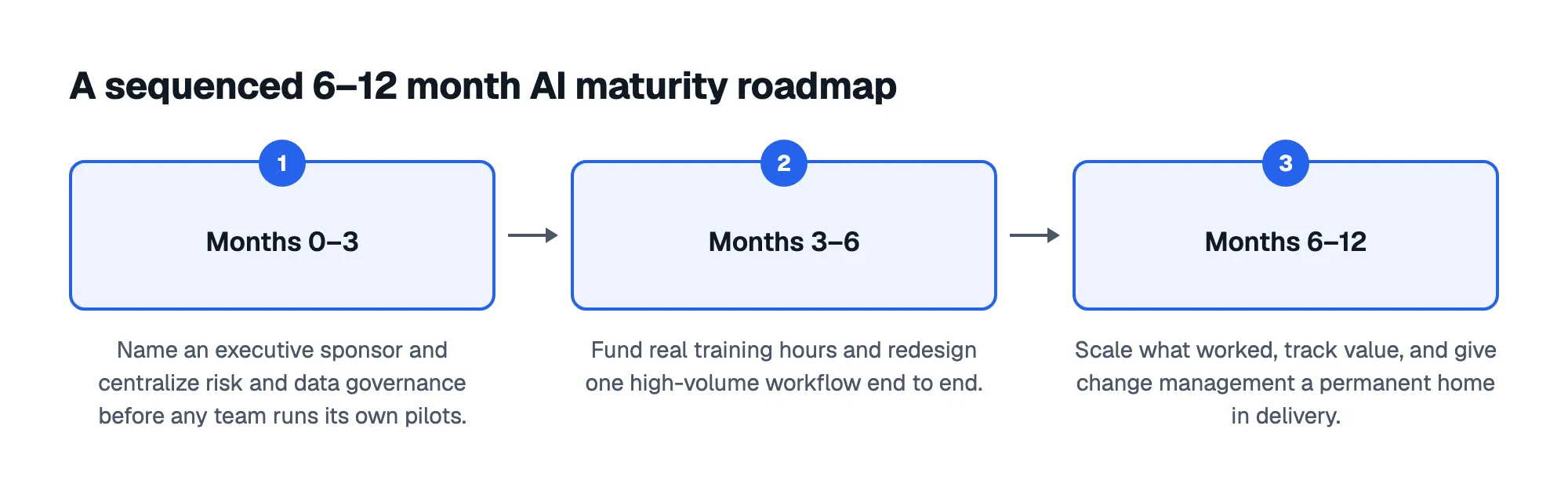
Your score told you where you stand. The sequence above tells you what to fix first, second and third, so the next conversation with your board is about progress, not about which workstream to start next.
Frequently asked questions
Who should own the AI maturity roadmap inside the company?
A Digital Transformation Leader or Chief AI Officer typically coordinates the plan, but accountability for governance decisions should sit with a senior executive sponsor, ideally at CEO level, since McKinsey's 2024 survey found that attribute reported most often among organizations using AI.
Is it ever okay to run governance and skills work at the same time?
Some overlap is normal; a training pilot can start while governance rules are being drafted. The guidance here is about which workstream leads and gets the budget first, not a strict ban on any overlap between phases.
How often should we reassess where we are on the roadmap?
A quarterly cadence works well in practice: re-run the same baseline survey, compare movement on usage, skills, culture and governance, and let that delta decide the next quarter's single priority instead of opening a new workstream.
What if frontline teams resist spending time on training instead of just using the tools?
Expect some resistance, since training takes people off billable or production work in the short term. Frame it against the alternative this guide describes: regular usage stalling well below full adoption when training hours are skipped.
Sources: https://www.mckinsey.com/~/media/mckinsey/business%20functions/quantumblack/our%20insights/the%20state%20of%20ai/2025/the-state-of-ai-how-organizations-are-rewiring-to-capture-value_final.pdf, AI at Work 2025: Momentum Builds, but Gaps Remain | BCG