
Why AI rollouts need a deliberate change management choice
Your board wants proof the AI rollout is working, not another slide about pilots. You need an AI change management framework before you pick a vendor or hire a consultant, because the choice of who runs the rollout shapes what you can show in six months.
The common move is to treat an AI rollout like any other software rollout: announce it, train people, measure logins, move on. That gets you a launch date. It doesn't tell you whether anyone actually changed how they work, and it leaves the real decision, who owns adoption after launch, unanswered.
- Whether people actually changed how they work
- Whether confidence or trust in the tool improved
- Whether the real gap is skills, culture, or something else entirely
That gap matters more at AI scale than it did for a CRM rollout, because leadership is approving renewed budget every quarter based on whatever adoption story you can tell them.
Imagine a 300-person sales team that rolled out a generative AI assistant eight months ago. Usage dashboards show steady logins. Nobody on the leadership team can say whether reps write better proposals, close deals faster, or just paste in more boilerplate.
BCG's December 2025 article cites a survey finding that 60% of companies globally were not generating any material value from AI despite substantial investment. Gartner's David Furlonger, a Distinguished Vice President Analyst and Gartner Fellow, points to a related risk in enterprise AI strategy:
“an overconfidence that technology can compensate for leadership, infrastructure, and operational and technology systems that were never designed for algorithmic speed”
— David Furlonger, Distinguished Vice President Analyst and Gartner Fellow · Source: Your AI Strategy Success Depends on More Than Just Investment
We think that gap has less to do with model quality than with who's accountable for the slow, unglamorous work of changing habits. Pick a delivery model, in-house team, consultant, software or some blend, before the first survey goes out, not after adoption has already stalled.
Sources: AI Adoption Puzzle: Why Usage Is Up But Impact Is Not | BCG
How AI adoption differs from the rollouts you've managed before
Past rollouts had a fixed target: everyone learns the new CRM, usage plateaus, and you're done. AI adoption doesn't plateau the same way, because the tool keeps getting more capable and the gap between a confident user and a cautious one keeps widening instead of closing.
Gartner's survey of 782 infrastructure and operations leaders, run in November and December 2025, found that only 28% of AI use cases in that function fully succeeded and met ROI expectations, while about a fifth failed outright. Gartner's Melanie Freeze, Director of Research, frames what separated the two groups:
“High‑performing I&O leaders start with realistic AI business cases and upfront preparation.”
— Melanie Freeze, Director Research, Gartner · Source: Gartner Says AI Projects in I&O Stall Ahead of Meaningful ROI Returns
BCG's own research on software developers found more than 85% remained stuck at stages two and three of AI adoption, task assistance and delegation, with fewer than one in ten reaching semiautonomous collaboration. Skill alone didn't move most of them past that wall.
- Stage two, task assistance: AI used for targeted needs such as drafting or calculations
- Stage three, delegation: well-defined tasks, like compiling reports, assigned to AI
- Stage four, semiautonomous collaboration: the stage BCG found fewer than 10% of surveyed developers had reached
That 85% figure describes BCG's surveyed software developers, not your whole workforce. If your technical or knowledge-worker teams show a similar pattern, still mostly at task-assistance level, the gap you're solving for is usage and confidence, not advanced governance, and the model you pick should match that stage.
Gartner's own 2026 analysis found that 59% of AI pilots fail to reach production, mostly because of organizational constraints rather than technical ones. That matches the pattern across every source here: the blocker usually sits in how change is managed, not in the model itself.
Prosci's study of 1,107 professionals, part of its 'Keys to Unlocking AI Adoption' research, found that 63% of organizations cite human factors, not technical limits, as their primary AI implementation challenge. We'd treat that figure as directional: it's a vendor-commissioned study built to support Prosci's own methodology, so weigh it alongside your own barrier data rather than as an independent benchmark.
Sources: Gartner Says AI Projects in I&O Stall Ahead of Meaningful ROI Returns, AI Adoption Puzzle: Why Usage Is Up But Impact Is Not | BCG, AI Adoption: Driving Change With a People-First Approach
Four ways to build your AI change management framework

Most rollouts default to one option because it's familiar, not because anyone compared it against the alternatives. There are four basic ways to deliver an AI change management framework, and they aren't mutually exclusive.
| Model | Who owns it | Typical fit | Main risk |
|---|---|---|---|
| In-house team | Someone on your staff, added to an existing role | A single business unit with early adoption data already in hand | Change work competes with that person's day job |
| Consultant | An outside firm's change practice | Cross-functional rollouts or a first AI-scale change with no internal playbook | Cost and a handoff gap once the engagement ends |
| Software layer | A platform tracking usage and surfacing prompts or nudges | Keeping a usage signal alive after launch, at any rollout size | Access and prompts without context on why behavior isn't changing |
| Hybrid | A mix of the above, split by task | Rollouts that start narrow and are expected to scale | Unclear ownership if no one is assigned the measurement itself |
None of these is automatically right. The fit depends on how complex the rollout is, how much internal capability already exists, and how fast leadership needs a usage signal.
A hybrid often looks like this: an internal lead owns communication and timing, a consultant designs the first training sprint for a cross-functional launch, and a software layer tracks who's actually using the tool three months later. None of those roles needs the same vendor.
Before you choose, ask the questions a CIO or Head of L&D would actually ask: 'Who already owns something like this?' 'Do we have a four-week runway or a two-quarter one?' 'What happens to the data if the consultant's engagement ends?' The honest answers point toward one of the four paths faster than a maturity model would.
When an in-house team fits
An in-house AI change management team usually fits a single business unit rollout, where leadership already trusts someone to own change and you have enough early usage data to know roughly where the gaps sit.
This path is lightest on vendor spend and heaviest on internal time: someone on your team is now responsible for communication, training coordination and tracking adoption, on top of whatever they were already doing.
Watch for the signal that in-house isn't enough: adoption plateaus after the first few weeks, or the person owning change can't get time on senior leaders' calendars. That's usually when a consultant or a software layer needs to join, not replace, the effort.
The questions that confirm fit: 'Has anyone on this team run a cross-functional change before?' and 'Do we already know, from a survey or otherwise, where the skill gaps sit?' If the answer to either is no, in-house alone is a riskier bet.
When to bring in a consultant
Forrester's Q2 2026 evaluation of AI consulting providers found that all ten firms it assessed, including Accenture, Bain, BCG, Deloitte, IBM, KPMG, McKinsey and PwC, now bundle change management into their AI transformation offerings. That's a signal the market treats this as core delivery work, not an add-on.
Forrester's analysts describe the industry as being in the early years of a 15-year transition to AI-powered business, with most current consulting work still focused on fixing internal operating models before anything customer-facing. A transition that long argues for outside capability when your own team hasn't run an AI-scale change before, not for every rollout.
Forrester's related AI Consulting Services Landscape report profiles a broader list of 37 providers beyond the ten in its formal evaluation, reflecting how crowded this market has become for AI-specific change work.
In our view, dedicated consulting spend earns its keep on rollouts that cross several departments or touch roles that have never used AI tools before; for a single-team pilot, it's usually more than the problem needs.
Sources: Which AI Consulting Service Provider Is Best For You?, The Future Of AI Consulting Services Is Disruptively Bright
Where software fills the gap
Deloitte's State of AI in the Enterprise report, based on a survey of 3,235 leaders across 24 countries in August and September 2025, found that worker access to AI rose by 50% in 2025. Access without a way to see who's actually using what is exactly where a software layer earns its place.
WalkMe's vendor page reports that Gartner's 2026 Market Guide for Digital Adoption Platforms expects buying a commercial platform to be more cost-effective than building one internally over five years.
The same page cites Gartner forecasting that by 2028, 40% of organizations will use generative AI built into their adoption platforms to automatically surface workflows for employees. Treat that as a vendor's framing of Gartner's work, not a figure Gartner published to you directly.
That always-on layer keeps producing a usage signal long after launch excitement fades, which is exactly when most rollouts lose visibility.
Software shows you what people click, not why they hesitate before clicking. A usage dashboard that reports high engagement and a workforce that privately says it doesn't trust the output are both real signals, and neither one, alone, is the whole picture.
The question worth asking a vendor demo: 'What does this tool tell us about why adoption stalled, not just that it did?' Most digital adoption platforms are better at the first question than the second.
Sources: The State of AI in the Enterprise - 2026 AI report | Deloitte US, 2026 Gartner® Market Guide for Digital Adoption Platforms | WalkMe
Build or buy the adoption layer

The in-house-versus-consultant question gets most of the attention, but the build-or-buy question for the measurement and nudging software underneath it matters just as much, because that layer is what tells you whether any of it worked.
Prosci's 12th Edition benchmarking study, built from 2,668 respondents across 38 industries, reports that U.S. projects with excellent change management were about 8 times more likely to meet or exceed objectives than those with poor change management.
Multipliers like that come from Prosci's own commissioned research promoting its own methodology, so read them as a general case for structured change work, not as a number your AI rollout will replicate.
Our take: the specific multiplier matters less than having any agreed way to check progress at all; chasing the biggest benchmark number is the wrong contest to enter.
Picture a 1,200-person logistics company piloting an AI dispatch tool in one region. Running it in-house for the pilot, then adding a software layer before a nationwide rollout, costs less and teaches you more than committing to one model enterprise-wide on day one.
Ask before signing anything: 'Who owns the data a year from now, us or the vendor?' and 'What does switching cost if this layer doesn't fit once we scale?' Those two questions matter more than any single benchmark multiplier.
Matching the delivery model to your rollout
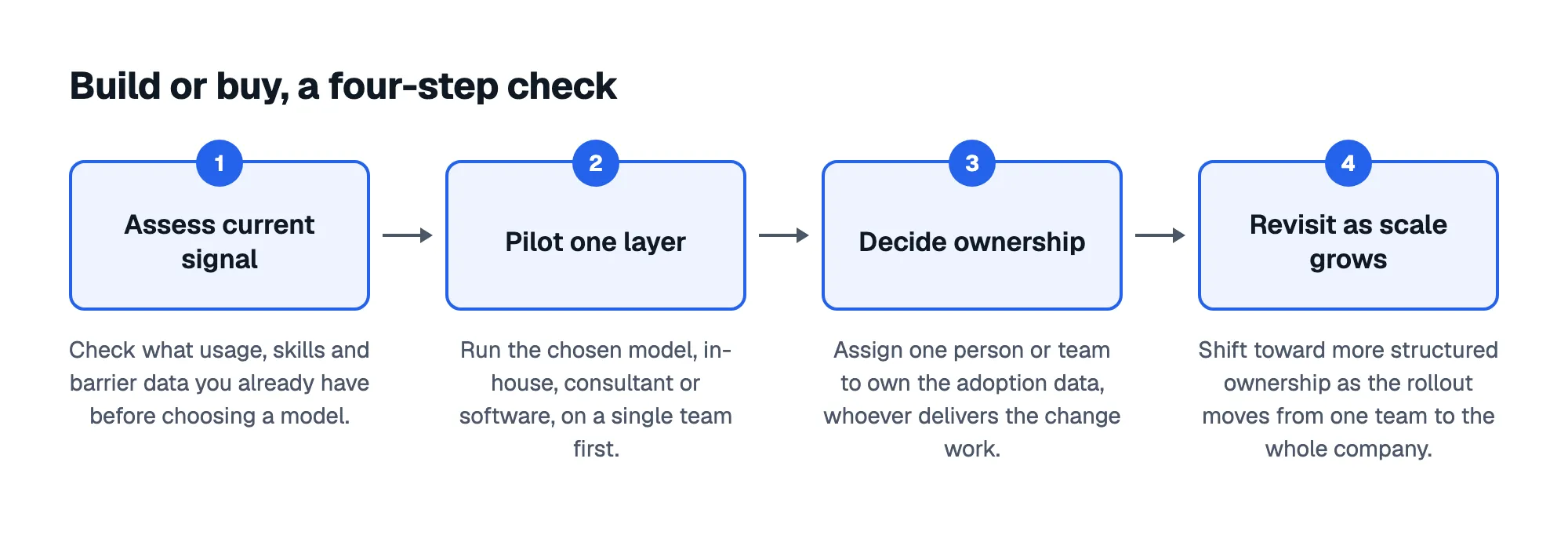
A 40-person marketing team piloting one AI writing tool doesn't need the same AI change management framework as a 3,000-person company rolling AI across claims processing, sales and support at once. Match the model to the rollout's complexity and your team's existing muscle, then revisit it as adoption scales.
| Rollout profile | Likely fit | Why |
|---|---|---|
| Single-team pilot | Light in-house ownership | Low complexity and a fast usage signal matter more than outside process |
| Cross-functional rollout | Consultant or hybrid | Coordination cost is high and internal teams may not have run an AI-scale change before |
| Enterprise-wide scaling | Software layer plus revisited governance | The usage signal needs to outlast any single project team or engagement |
McKinsey's 2021 analysis, now dated, suggested that capability-building work needs to directly engage at least a quarter of the workforce to shift a cultural norm. Even as an older benchmark, it's a useful floor to check your rollout's reach against, not a target worth chasing for its own sake.
AI Adoption Score's own index found that for one customer's engineering team, culture, not skills, was the real bottleneck behind slow AI adoption, a reminder that the gap your delivery model needs to close isn't always the one leadership assumes.
At enterprise scale, the department that piloted first often isn't the department that struggles months later; a software layer keeps the signal running across all of them, no matter which team originally championed the rollout.
A Head of L&D weighing this should ask: 'Which rollout profile matches what we're actually doing today, not what we hope to be doing in a year?' Answer that honestly before locking in a model built for a different stage.
Sources: Better transformations through capability building | McKinsey
Measuring whether the change actually happened, whoever runs it
Whichever model you pick, in-house, consultant, software or hybrid, the same question follows it: how do you know the change actually happened, not just that training was delivered?
BCG's AI at Work 2025 survey found that only 36% of employees said they were satisfied with their AI training. That's employees' own rating of the experience, not a measured change in how they work afterward, so a training-completion number alone won't answer your board's question.
Deloitte's report also found that only one in five companies has a mature governance model for autonomous AI agents, which suggests the measurement gap isn't limited to training, it extends to how AI use is governed once it's running.
A dedicated adoption survey can carry that measurement load regardless of who runs the rollout. AI Adoption Score offers nine survey types covering skills, usage, barriers, culture and governance.
It also maps every person, team and department to one of five maturity levels, so you can see where the gap actually sits before you commit more budget to any one delivery model.
A CIO comparing delivery models should ask one more question before signing off: 'Will this measurement survive a change in who runs the rollout?' If the answer is no, the measurement layer needs to move outside whichever team or vendor currently owns it.
The sequence that holds up: baseline first, pick the delivery model the gap actually calls for, then keep measuring on a cadence, not just at launch.
Pick the model. Then prove it worked.
Sources: As AI Changes Work, CEOs Must Change How Work Happens | BCG, The State of AI in the Enterprise - 2026 AI report | Deloitte US
Frequently asked questions
Can you combine an in-house team, a consultant and software on one AI rollout?
Yes, and most rollouts end up doing exactly that. A common split has an internal lead owning communication and timing, a consultant designing the first training sprint, and a software layer tracking usage after launch. Where roles overlap, decide upfront which party owns the adoption data itself, not just who delivers training, so a consultant handoff or vendor switch doesn't leave the measurement record orphaned.
How long should you run a delivery model before deciding it isn't working?
Give any model enough time to produce a second data point, not just a launch number. A baseline survey followed by a check eight to twelve weeks later is usually enough to see whether usage and confidence actually moved.
Does hiring a consultant mean you don't need an internal change owner?
No. Forrester's review of AI consulting providers found all ten firms it evaluated bundle change management into their AI transformation work. That bundling is a delivery capability the provider brings to the engagement, not a substitute for having someone inside the company who owns adoption once the engagement ends.
How do you know AI training actually changed behavior, not just satisfaction?
You don't, from a satisfaction score alone. Checking behavior change takes a separate before-and-after measure, such as a usage or skills survey run a few weeks after training, compared against the same group's baseline, not just how they rated the session afterward.
Sources: Which AI Consulting Service Provider Is Best For You?, As AI Changes Work, CEOs Must Change How Work Happens | BCG