How long should an employee survey be?
Your board wants a repeat AI adoption survey every quarter. HR worries the last one already caused employee survey fatigue. Before you pick a cadence, answer a narrower question first: how long should an employee survey be, and does that change once you start repeating it?
The common practice is to keep every wave as long as the first one. That protects comparability but ignores how fatigue builds inside a single session.
In a 2022 analysis of household surveys in rural Liberia and Malawi, Jeong, Aggarwal, Robinson, Kumar, Spearot and Park found each extra hour of survey time raised the odds a respondent skipped a question by 10 to 64 percent. Those were multi-hour, in-person interviews, not short workplace pulses, but the direction is a warning: length costs you data, not just goodwill.
We'd rather run a ten-minute core wave every quarter than a thirty-minute survey half your team abandons partway through. Short and frequent beats long and rare.
Sources: https://people.ucsc.edu/~aspearot/survey_fatigue.pdf
How often should you run repeat AI adoption surveys?

Many teams ask, "how often should employee engagement surveys be conducted?" and then copy that monthly cadence for AI adoption tracking, simply because the survey platform makes monthly easy to schedule, not because it reduces employee survey fatigue. We're skeptical that cadence serves the data: most AI rollouts don't shift fast enough to need a fresh read every few weeks.
The Federal Highway Administration's 1997 guidance for travel-behavior panel surveys recommends collecting data from respondents once a year unless the study's objectives genuinely require more frequent waves. That's a transportation-panel rule, not an AI-adoption one, but the logic holds: add frequency only when a specific decision needs it.
Our recommendation: default to quarterly or biannual full waves, and reserve monthly check-ins for a small, deliberately rotating set of questions tied to an active rollout, not the whole instrument.
Sources: F:\STATMETH\DOT\PANEL\TITLE.WPD
Does answering the same survey again change how people respond?
Yes, and timing matters. Warren and Halpern-Manners's 2011 review, cited in Halpern-Manners and Warren's 2012 study of U.S. household heads interviewed between 2007 and 2010, found panel conditioning effects show up most often when waves run a month or less apart.
A related signal comes from the U.S. Current Population Survey: according to Halpern-Manners and Warren's 2012 study citing Bureau of Labor Statistics Technical Paper 66, first-time respondents in 2003 and 2004 showed an unemployment-rate index 6.3 percent higher than the average month-in-sample respondent. Duke University's D. Sunshine Hillygus makes a related point about longitudinal panels generally:
“Panel studies typically suffer from attrition, which reduces sample size and can result in biased inferences.”
— D. Sunshine Hillygus, Associate Professor, Department of Political Science, Duke University · Source: Handling Attrition in Longitudinal Studies: The Case for Refreshment Samples
The risk compounds over a long panel. Deng, Hillygus, Reiter, Si and Zheng's 2013 review found the 2008-2009 American National Election Studies panel, which interviewed respondents monthly through the 2008 U.S. election, lost 36 percent of its sample within less than a year.
Sources: Panel Conditioning in Longitudinal Studies: Evidence from Labor Force Items in the Current Population Survey - PMC, Handling Attrition in Longitudinal Studies: The Case for Refreshment Samples
Should you rotate survey questions instead of asking everything each time?

The same 1997 FHWA panel guidance that recommends annual cadence also advises changing core instruments only when absolutely necessary, so waves stay comparable over time. Swap the whole survey and you lose your baseline.
Our take: hold a stable core, usage, skills, barriers, perceived impact, and rotate everything else around it. A module on trust in AI tools or knowledge sharing doesn't need to run every quarter if usage and barriers are your main tracking question.
- Core every wave: usage, skills confidence, barriers, perceived impact
- Rotate in: trust, knowledge sharing, governance, archetype balance
- Retire a module once it has answered its question
- Never change a core item's wording without starting a new baseline
AI Adoption Score's nine survey types work this way: you can run a core usage and barriers check every wave and bring in the trust or knowledge-sharing survey only when a rollout decision calls for it.
Sources: F:\STATMETH\DOT\PANEL\TITLE.WPD
Where does gamification help participation, and where does it skew answers?
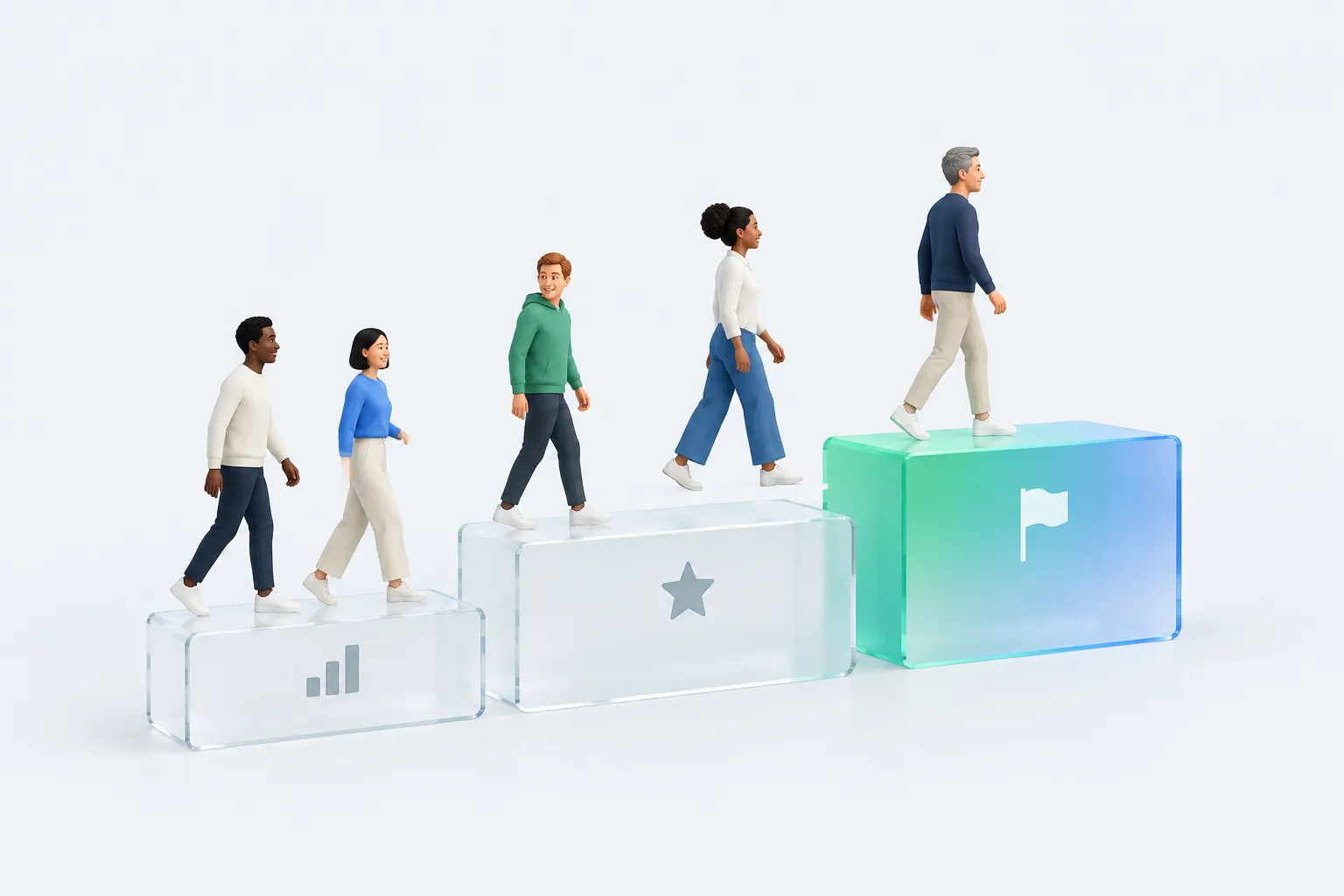
Progress bars and team completion goals can genuinely raise response rates. No supplied source tested that effect for employee or AI-adoption surveys directly, so treat it as editorial judgment about employee survey fatigue, not a measured result.
We're critical of leaderboards and badges tied to particular answers: that design pressures people to report more AI use or more confidence than they actually have. Tie any reward to completion only, never to content.
That matters because perceived impact and usage are self-reported by design: a survey tells you what employees report, not a measured productivity outcome. Gamify the wrong way and you inflate the one number leaders are most tempted to act on.
Frequently asked questions
Who should own the recurring AI adoption survey?
Usually whoever owns the AI rollout decision, such as the Head of AI, Chief People Officer or an L&D lead, rather than a general engagement-survey team. The questions that matter here, usage, skills, barriers, are tied to specific tools and teams, and someone needs authority to act on what they show.
Does every team need the same survey length?
Not necessarily. A sales team piloting one tool can likely answer a shorter module than a department rolling AI across five workflows, as long as the core comparison questions stay identical across teams so results stay comparable over time.
What's an early sign that a wave is too long or too frequent?
Watch completion time and partial-completion rates across waves, a signal already built into the recurring checklist. Once either metric climbs, whoever owns the survey should shorten the core or move a module to the rotating set before the next send, rather than waiting for a full redesign.
Do we need to restart our baseline if we change a question?
Yes, in effect, since a changed question breaks the comparison the survey was tracking. If a question truly needs updating, run the old and new wording side by side for one wave to bridge the two before retiring the old item, rather than switching cold and losing the trend line.
Sources: F:\STATMETH\DOT\PANEL\TITLE.WPD