
What does an AI skills certification verify?

Imagine your board asks, "We certified 400 people. Are they working differently?" The certificates can't answer that. An AI skills certification verifies that someone met a test standard, and that standard is narrower than most training budgets assume.
Take an AI skills certification from Microsoft. Its study guide for the AI-901 Azure AI Fundamentals exam (skills measured as of April 15, 2026) covers conceptual knowledge and implementing AI solutions in Foundry, and it's aimed at people starting a career in AI solution development.
Microsoft's guide for the retired AI-900 exam says a score of 700 or greater is required to pass, and that certifications expire annually unless renewed. A pass is a score threshold. The same logic applies to any AI skills certification, free or paid.
In our view, counting certificates as adoption is the most common shortcut, and it measures your course catalogue more than your workforce. Decide which behaviors you expect before the course starts.
Sources: Study guide for Exam AI-901: Microsoft Azure AI Fundamentals | Microsoft Learn, Study guide for Exam AI-900: Microsoft Azure AI Fundamentals | Microsoft Learn
Do AI skills training courses make people independent?

In Study.com and Candova's March 2026 Pollfish survey of 1,000 employees, a vendor report, only 18% of those who had AI training said it prepared them to work independently. Another 25% said it helped with simple tasks only, and 5% said it didn't prepare them at all.
These are self-reports, so they show what employees said, not what training changed or why. The same survey shows confidence thinning as the questions get more concrete.
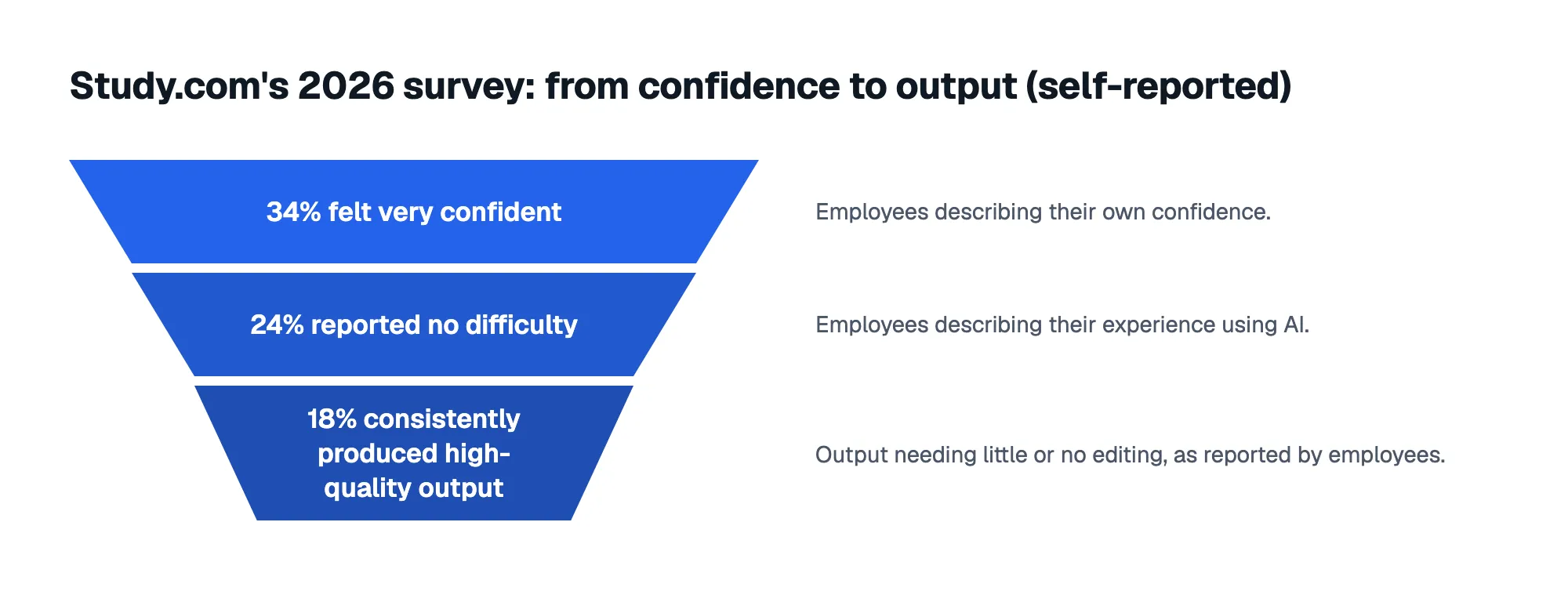
The report's authors conclude that self-reported confidence isn't a reliable signal of actual skill. A peer-reviewed study of 358 Taiwanese K-12 teachers (data collected February 2025) found a low correlation between self-reported and objective AI literacy, with some people overestimating and others underestimating. Teachers aren't corporate staff, but the pattern is worth testing in your own workforce.
We'd be wary of AI skills training courses that end with "How confident do you feel?" and stop there.
Sources: State of AI Jobs and Skills Report 2026: The Training Gap Slowing Down the AI Revolution - Study.com, How to Assess AI Literacy: Misalignment Between Self-Reported and Objective-Based Measures
Do usage numbers show whether people got skilled?

Usage data feels firmer than surveys, but it has limits. In Microsoft's randomized field experiment (66 firms, 7,137 knowledge workers, September 2023 to October 2024), over 90% of workers assigned Copilot used it at least once. Weekly use settled just under 40% after 12 weeks. It tested tool access, not training.
Telemetry showed users spent about two fewer hours a week on email, with no detected shift in the quantity or composition of tasks. Real use didn't automatically mean reshaped work.
Microsoft defines its AI adoption score as Copilot use as a daily habit, based on active days in the prior 28 days. A score of 100 means licensed users average at least three days a week. It covers Copilot only and measures activity, not skill. Microsoft separately suggests a four-statement sentiment survey for perceived impact.
We'd treat active days as the floor of your evidence and read them next to what people say they do with the tool.
Sources: https://www.nber.org/system/files/working_papers/w33795/w33795.pdf, AI Adoption Category in Adoption Score - Microsoft 365 admin | Microsoft Learn
How can you check behavior 6 to 12 weeks later?

Don't rely on one post-course rating. Blume and colleagues' 2010 meta-analysis of 89 studies found that transfer outcomes taken from the same source in the same measurement context consistently inflated transfer relationships. It concerns training in general, not AI.
Will Thalheimer's 2020 review of transfer research, a non-exhaustive synthesis by a practitioner, raises the same worry about perception-based evidence. In his words:
“do not actually measure transfer. They measure learners’ perceptions of transfer.”
— Will Thalheimer, PhD, Will Thalheimer, PhD, Work-Learning Research, Inc. · Source: https://www.worklearning.com/wp-content/uploads/2020/01/Transfer-of-Training-Quick-Research-Review-2020-v1a.pdf
The 6 to 12 week window is our editorial suggestion, not an interval taken from research. The sequence below is also editorial advice rather than a validated method. Supports such as early practice and manager follow-up have mixed evidence, so test them in a pilot.
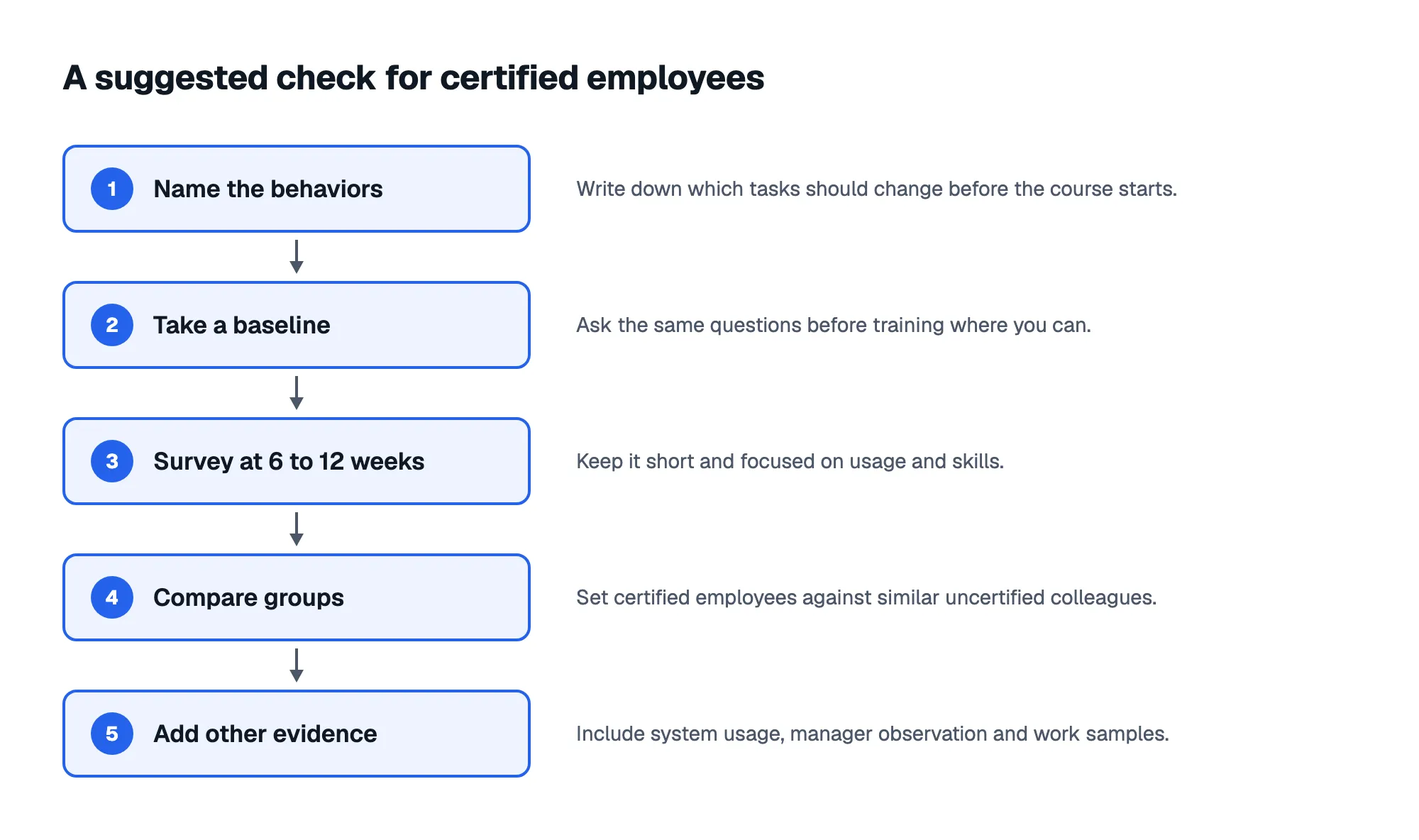
Imagine a 60-person finance team where 20 people finished a course. Comparing those 20 with their uncertified colleagues, on the same questions, tells you far more than the 20 certificates do.
Sources: Transfer of Training: A Meta-Analytic Review - Brian D. Blume, J. Kevin Ford, Timothy T. Baldwin, Jason L. Huang, 2010, https://www.worklearning.com/wp-content/uploads/2020/01/Transfer-of-Training-Quick-Research-Review-2020-v1a.pdf
What should a post-training survey ask?
Ask about tasks, not feelings. These are suggestions to adapt, not a validated instrument:
- Which tasks did you use AI for last week?
- How many days did you use it?
- What do you check or edit before using the output?
- Which part of the course have you applied at work?
- What stops you from using AI more?
Label anything about impact as perception, not measured productivity. Be equally careful with vendor statistics. DataCamp, a training vendor, found in its 2026 survey of 500+ US and UK enterprise leaders that 26% struggle to report on training ROI, so treat its other figures as leader self-reports too.
AI Adoption Score measures skills and usage habits through predefined surveys, so you don't have to draft the instrument yourself.
Sources: State of AI Jobs and Skills Report 2026: The Training Gap Slowing Down the AI Revolution - Study.com, AI Skills Gap in 2026: Why Training Isn’t Enough | DataCamp
Frequently asked questions
How often should you repeat the check?
Repeat it for each training cohort, at the same interval after completion, so results stay comparable. Add a periodic re-check for earlier cohorts if skills or tools change quickly. This is editorial guidance on cadence, not a research-derived schedule.
Is a free AI skills certification worth less than a paid one?
Not necessarily. Price tells you little; the exam's scope and passing rule tell you more. Ask who the credential targets, whether it includes hands-on tasks, and whether it matches the work your teams actually do. This is editorial guidance.
What should managers do after their team finishes a course?
Ask each person to apply one course skill to a real task within a week or two, then review the output together. Keep the conversation about the task, what was checked and what to change next time. This is editorial advice.
Should AI certification count toward promotion?
Be cautious until you have behavior evidence. HiBob's 2026 survey of 1,200 AI decision-makers, a vendor report, found 67% of surveyed AI decision-makers said their organizations link AI skills to promotion criteria, without clear shared standards. A pass alone doesn't show how someone works.
Sources: AI Maturity Benchmarks: Where the Workforce Stands | HiBob