
A sector AI adoption plan is a start, not a roadmap
When a board member asks "what's our AI adoption plan," pointing to a slide deck doesn't hold up. If your sector published one in 2026, you already have something sturdier: the UK's sector AI adoption plans, convened by DSIT and HM Treasury, cover financial services, advanced manufacturing, creative industries and more. The question is what you do with it next.
The AI adoption plan for financial services groups its recommended actions into categories such as immediate priorities for near-term regulatory scaling, built from 2026 stakeholder engagement across industry, regulators and trade bodies that surfaced five key themes. The AI adoption plan for advanced manufacturing proposes a phased Scan-Pilot-Scale pathway, and the AI adoption plan for creative industries sets out eight practical steps.
Here's where most teams fall short: they cite the plan instead of mining it. Treat it as raw material, not a reference. Extract every named theme, pin one to an internal owner and a checkpoint date, and build your roadmap around that mapping, not a quote from the document.
In our view, a plan without an internal owner and a target date is just a document gathering dust: useful for context, useless for accountability.
Financial services firms aren't starting from zero either: according to DSIT's AI Adoption Survey from early 2025, as cited in the GOV.UK Financial Services AI Adoption Plan, 21% of financial and real estate sector firms had already adopted AI.
Sources: Financial Services AI Adoption Plan - GOV.UK, AI Adoption Plan: Advanced Manufacturing - GOV.UK, AI Adoption Plan: Creative Industries - GOV.UK
What you need before you map anything

Start by confirming three things: which published sector plan applies to you, who will own the rollout internally, and whether you already have baseline survey data. Skipping the third item is the most common shortcut, and it is the one that makes your first checkpoint impossible to read.
If you're in manufacturing, build this in early. The Advanced Manufacturing AI Adoption Plan names legacy operational systems and fragmented industrial data as the barriers facing UK manufacturers, particularly smaller firms, which shapes both your timeline and which baseline questions are worth asking.
Sally Davies, the UK's AI Champion for the Creative Industries, frames her own published plan in personal terms:
“I have prepared this plan as the AI Champion for the Creative Industries.”
— Sally Davies, AI Champion for the Creative Industries sector · Source: AI Adoption Plan: Creative Industries - GOV.UK
Sources: AI Adoption Plan: Advanced Manufacturing - GOV.UK
Five steps that turn plan targets into roadmap lines

Here's the sequence we'd run, whether your sector plan is financial services, advanced manufacturing or creative industries.
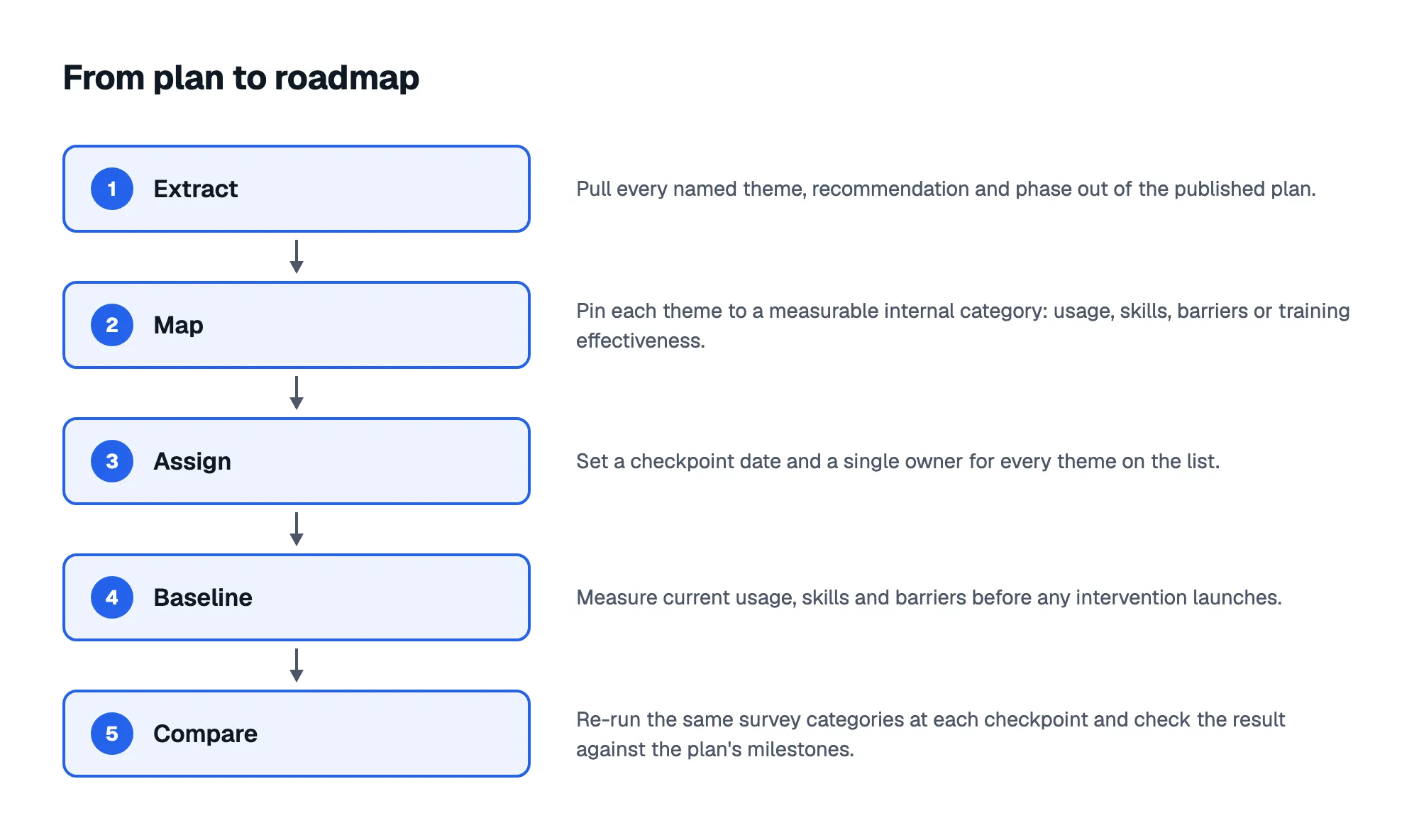
Step two is where most roadmaps stay vague. Each theme needs a category you can actually survey, not a restatement of the plan's own language.
| Plan theme (example) | Internal category | Example signal | Data source |
|---|---|---|---|
| Immediate priorities for regulatory scaling (financial services) | Governance readiness | Employees report clarity on approved AI tools | Internal survey |
| Scan-Pilot-Scale pathway (advanced manufacturing) | Usage stage | Share of teams in pilot versus scaled use | Internal survey |
| Augmentation-first step (creative industries) | Culture and attitudes | Employees report viewing AI as a tool, not a replacement | Internal survey |
| Practical AI Adoption Framework (digital and technologies) | Training effectiveness | Employees report training changed day-to-day tasks | Internal survey |
We'd set checkpoint dates against the plan's own phase boundaries, like Scan, Pilot and Scale, rather than a generic quarterly calendar.
For the skills category, mapping expertise person by person matters more than a team average. AI Adoption Score's Individual Skills Distribution maps each person's expertise so training gets allocated by actual gap, not assumption.
Sources: Financial Services AI Adoption Plan - GOV.UK, AI Adoption Plan: Advanced Manufacturing - GOV.UK, AI Adoption Plan: Creative Industries - GOV.UK, AI Champions' Adoption Plans: Summaries - GOV.UK
What a first checkpoint cycle actually shows you
After your first checkpoint, expect a mix: some themes will show movement, others won't have budged. Employees report perceived changes in confidence and productivity, and that's a useful signal, not proof a plan's target was met: a self-reported perception isn't the same as a measured, causal effect.
We're skeptical of treating a single checkpoint's perceived-impact number as a scoreboard. One data point tells you where attention is lacking, not whether an intervention worked.
A tool built around predefined employee surveys, such as AI Adoption Score, with guidance on which survey to start with, lets you baseline usage, skills, barriers and training effectiveness before the rollout begins, then repeat the same categories at every checkpoint.
Where the plan and your rollout will disagree

Expect friction. The Creative Industries AI Adoption Plan frames its recommendations as help for the sector to adopt AI with confidence, and the Digital and Technologies AI Adoption Plan names building a practical AI Adoption Framework as one of three priority actions; neither hands you a ready internal checkpoint calendar.
Build a review habit into your roadmap regardless: revisit your mapping whenever the published plan updates, instead of treating your first version as final.
Match the plan's direction, not its pace. Moving exactly as fast as the published document suggests often means moving slower than your own baseline data tells you that you should.
Sources: AI Champions' Adoption Plans: Summaries - GOV.UK
Run the mapping before you run the rollout
Layer a lightweight governance check alongside the roadmap. NIST's AI Risk Management Framework, published in January 2023, organizes AI risk governance into four functions: Govern, Map, Measure and Manage. NIST describes the framework as voluntary and not tied to any particular sector, so you're adapting it, not following a prescribed sector checklist.
We like checklists that run alongside a sector plan's own milestones, not instead of them. Governance without a plan is paperwork; a plan without governance checks is a wish list.
Your sector's plan already names the themes that matter. Your job is to give each one an owner, a date and a baseline, then check it again. Start the mapping before you start the rollout.
Sources: Artificial Intelligence Risk Management Framework (AI RMF 1.0)
Frequently asked questions
Who should own the internal roadmap once you've mapped a sector plan?
No single person should own the whole document. Assign one internal owner per theme, usually whoever runs that function day to day, with the Digital Transformation Leader holding the overall mapping and checkpoint schedule together.
How often should you re-run the baseline survey after launch?
Tie it to the plan's own phase boundaries rather than a fixed calendar. If your sector plan uses stages like Scan, Pilot and Scale, re-run the same survey categories at each stage boundary so results stay comparable.
What if our sector doesn't have a published AI adoption plan yet?
Borrow the structure from the closest published plan, such as financial services, advanced manufacturing or creative industries, and adapt its theme categories to your own priorities rather than waiting for a sector-specific version.
Does perceived productivity count as proof a plan's target was met?
Not on its own. Treat a self-reported productivity or confidence signal as one input: check whether it moves the same direction as your usage and skills measures at the next checkpoint before deciding to expand, adjust or drop an intervention.
Should governance sit inside the roadmap or run separately?
Run it alongside, not inside. Keep your roadmap focused on the plan's themes and checkpoints, and use a lightweight governance check, such as Govern, Map, Measure, Manage, as a parallel review rather than another roadmap line.
Sources: AI Adoption Plan: Advanced Manufacturing - GOV.UK, Financial Services AI Adoption Plan - GOV.UK, AI Adoption Plan: Creative Industries - GOV.UK, Artificial Intelligence Risk Management Framework (AI RMF 1.0)